California curtails effort to find young wolves whose parents were euthanized
Published in Science & Technology News

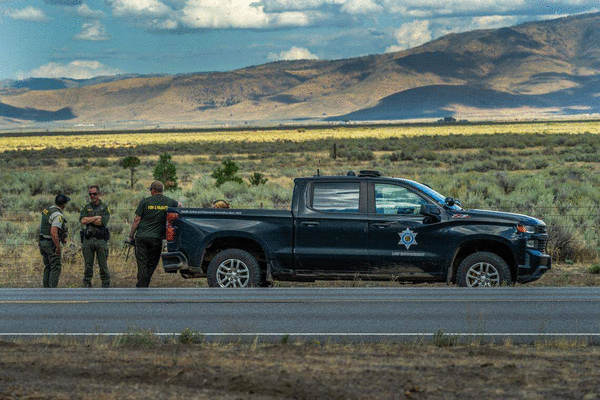

Wildlife managers have significantly pared back their efforts to find three juvenile gray wolves who are the last remaining members of a pack that had established itself in the Sierra Valley ranch lands north of Truckee, the California Department of Fish and Wildlife said Tuesday.
Three adult wolves and one juvenile from the same group, the Beyem Seyo pack, were euthanized by state game wardens in October after nonlethal efforts to stop them from preying on local cattle failed, the first time in a century that California sanctioned killing the protected animals.
Officials had vowed to find the remaining juveniles and transport them to a sanctuary but efforts to locate them have not been successful, said CDFW spokesperson Katie Talbot.
“This is not the update we had hoped to provide,” Talbot said. “After weeks of trying ... we’re not seeing them.”
Earlier this fall, biologists said they were optimistic that the young wolves would survive the winter, but on Tuesday the department did not address the question of whether they were believed to still be alive.
Wolves are returning to California after being hunted to local extinction in the 1920s. The arrival of a wolf known as OR-7 from Oregon in 2011 was cause for celebration among conservationists, and the animals became near-celebrities, with trail cameras capturing their wanderings and media reports that detailed the formation of new packs and the birth of pups.
But along with the environmental success came trepidation among farmers and ranchers who had established lives and businesses in areas that the wolves were now repopulating. The Beyem Seyo pack settled in Sierra Valley, terrifying residents and becoming unusually habituated to preying on livestock. The pack’s three adults are believed by scientists to have been responsible for killing about 90 calves in the area in about six months.
It is a situation that has played out across the West, as protections under federal and some state endangered species laws allowed the apex predators have returned to places where they had once been eradicated. States have struggled to find solutions, some opting to allow significant hunting of wolves, while others continue to outlaw it. The Trump administration said this fall it did not believe protections for the animals were still warranted.
Because California wolves are protected by both state and federal laws, it is illegal for ranchers to kill or aggressively harass them. State and federal wildlife managers stepped in last summer, citing an increase in the wolf population to allow for some addition hazing meant to keep the animals away from homes and ranches.
But despite shooting rubber bullets at them and intense harassment from drones, the pack continued to prey on the thousands of cattle sent to graze each year in Sierra Valley from across the state. Finally, in September, officials decided to euthanize the three adults in the pack, and transport the juveniles to a sanctuary.
The first wolf to be killed was euthanized by mistake, officials admitted, after a game warden shot it from a helicopter without realizing that the animal was still a juvenile. After that, three more were first shot with tranquilizer darts, identified as adults, and then euthanized.
Biologists remained in the area searching for the three remaining juveniles, now about a year old, but have not found them, Talbot said.
“We haven’t had a confirmed sighting of one of these juveniles since Oct. 30,” she said.
State biologists still planned to monitor trail cameras to see if they can find them, Talbot said. But more active searches have already wound down.
Paul Roen, a rancher who serves on the Sierra County Board of Supervisors, said the state had placed traps on the property he manages, but removed them several weeks ago.
Wolves are still in the area, he said, but the cattle that spend the summer in the high rangeland grazing have been sent home to the Central Valley, limiting the opportunities for predation.
“About a week ago I got a recording of them along the highway, howling early in the morning,” he said.
It was not immediately clear whether the animals he heard were the Beyem Seyo juveniles or wolves from another pack.
____
©2025 The Sacramento Bee. Visit at sacbee.com. Distributed by Tribune Content Agency, LLC.






Comments