Eviction levels hit an all-time high in WA, especially in Seattle area
Published in Home and Consumer News
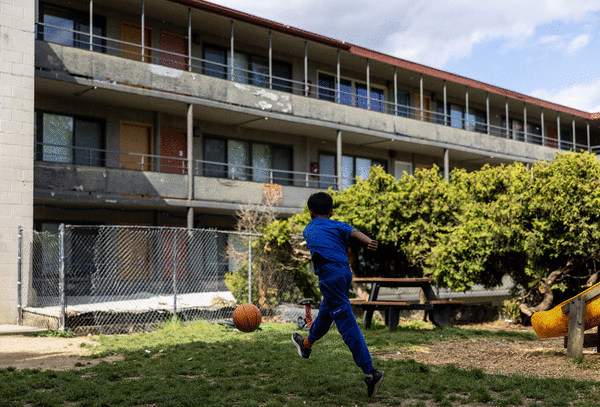
Washington state and King County recorded more evictions in 2025 than ever before — a sign that the affordability crisis is deepening.
The number of eviction cases filed in Washington courts rose to 23,965 in 2025, a 3% increase from 2024. The increase was significantly greater in the Seattle area.
Eviction cases grew by 12% to 8,732 in King County and 16% to 2,579 in neighboring Snohomish County.
The number of people forced from their homes is likely much higher than eviction filings show. Most agreements to end a tenancy occur outside of court. But those who do receive eviction summons are most likely low-income and behind on rent.
Around 9 in 10 cases in 2025 were due to nonpayment of rent statewide, according to the Office of Civil Legal Aid data.
Record eviction levels in 2025 follow a trend of skyrocketing eviction filings after the pandemic-era pauses on evictions ended in 2022 — a rise observers now describe as a lasting change rather than a passing phenomenon.
After being inundated with cases for the last three years, King County courts are just now catching up. But postpandemic funding for tenants’ lawyers is set to expire soon, raising concerns about whether more tenants across the state will have to represent themselves in court.
“In my mind, I feel like we have to reach an apex somewhere, but every year has taught me that that apex is a lot higher than I would think,” said Vallen Solomon, managing attorney of the King County Housing Justice Project, which represents tenants facing eviction in King County.
Tenants stretched thin
The continued escalation of eviction cases has shocked officials who hoped a surge after the pandemic would level off.
State officials initially attributed a 58% rise in eviction filings between 2022 and 2023 to pent-up demand during pandemic eviction moratoriums, which temporarily paused evictions for nonpayment of rent. But the trend continued into 2024, with eviction filings rising 40% statewide.
By 2024, the number of evictions had almost doubled from prepandemic levels — and the rise wasn’t simply due to population growth. Comparing eviction rates with census data, Washington landlords have increasingly filed more eviction cases per renter household since the pandemic.
Rising rents don’t account for the change, either. Rents have barely ticked up across Washington over the past few years.
Rather, rents are simply too high for tenants to afford.
In the Seattle area, where tenants were already paying some of the highest rents in the nation, average rents jumped up around 12% between the start of 2020 and the end of 2022, according to the Washington Center for Real Estate Research’s apartment reports.
The average rent of a two-bedroom apartment in King County is now around $2,450, according to the center’s reports. That’s affordable for a household bringing in more than $88,000 a year.
The share of people in King County who say they’re cost-burdened by rent has grown at a faster rate since the start of the pandemic, with almost half of renters spending more than 30% of their income on rent, according to the King County Office of Economic and Financial Analysis.
“One step back and they’re getting evicted,” said Scott Crain, an attorney with the Northwest Justice Project who frequently represents tenants in eviction cases.
The affordability outlook doesn’t look much better in 2026. Economists don’t expect the labor market to improve much. Rents are projected to stay flat, but not decline. Incoming Medicaid cuts will make insurance more expensive for thousands in Washington.
Still, attorneys are hopeful that eviction cases, especially in the state’s major counties, will subside eventually and provide relief to an overwhelmed, underresourced system.
“Until then, we’re just trying to push through this,” Crain said.
A swamped system
The eviction system has been strained by the influx of eviction cases since the pandemic, despite efforts early on to curb the tide.
Between 2020 and 2021, the state granted tenants the right to an attorney and Seattle restricted evictions during winter and school year. But those didn’t deter landlords from filing more cases, even if they knew they would take longer to secure an eviction order.
“I think that myself and others really thought this was going to lead to less eviction filings,” said Philippe Knab, who manages the eviction defense program at the Office of Civil Legal Aid, which funds attorney programs for tenants. “But the economic climate has made it so that’s not the case.”
Keon Knutson, an attorney who represents landlords in King County eviction cases, said he’s struggled to keep up with demand.
Higher demand and longer cases have led many landlord attorneys to increase their rates, he said. A landlord can now expect to spend $3,500 to $5,000 on a typical eviction in King County, he said.
That can be a stretch for small landlords, he said. But faced with the prospect of losing even more income in unpaid rent, the cost doesn’t ultimately deter many.
“Most of them are struggling … I don’t think landlords recoup very much at the end of the process,” Knutson said. “It’s sad all around.”
Many of his smaller clients have developed relationships with tenants and end up settling to end a case earlier and avoid an actual eviction order.
Corporate landlords can more easily bear the rising costs and are less willing to negotiate with tenants to avoid eviction, he said.
Last year, King County Superior Court issued more eviction orders than ever before.
The court sent 6,635 orders to the King County sheriff’s office to evict people from their homes in 2025. That’s 51% more than in 2024 and 217% more than in 2023.
The increase has been taxing on sheriff’s office staff, spokesperson Brandyn Hull said, and significantly increased the time it takes to enforce an eviction order. The sheriff’s office added staff specifically dedicated to evictions to help manage the load in 2025.
King County Superior Court also added staff in 2025, including two judges dedicated to evictions, which helped it catch up on a major backlog of cases, said King County Superior Court Judge Averil Rothrock.
But that made caseloads heavier for tenant attorneys.
For much of 2025, King County didn’t have enough lawyers for every tenant that needed one, forcing some tenants to represent themselves in eviction cases. Tenants without attorneys are more likely to be evicted, which makes it difficult to qualify for other housing.
“It’s extremely challenging to go into court and just see your clients and a bunch of other people that you know need your help, but there’s no help for them,” said Crain, the Northwest Justice Project attorney. “To see them have their hearings go forward is pretty awful.”
Attorneys with the King County Housing Justice Project have shifted resources and now expect to be able to represent every tenant in eviction cases by March.
But that won’t last long if the Legislature goes through with a cut to the Office of Civil Legal Aid, said Knab, who oversees the agency.
Under the current budget plan, funding for the program would drop by $3 million in 2027 — even though the number of eviction cases isn’t expected to fall.
If the office isn’t funded at current levels, Knab said he expects the state to lose 17 full-time attorneys. That would cause nearly 2,000 tenants each year to go through eviction proceedings without representation.
“It would be devastating,” he said. “I think it would lead to a really significant slide back.”
©2026 The Seattle Times. Visit seattletimes.com. Distributed by Tribune Content Agency, LLC.







Comments