
Eric's Autos: 2026 Chevy Colorado
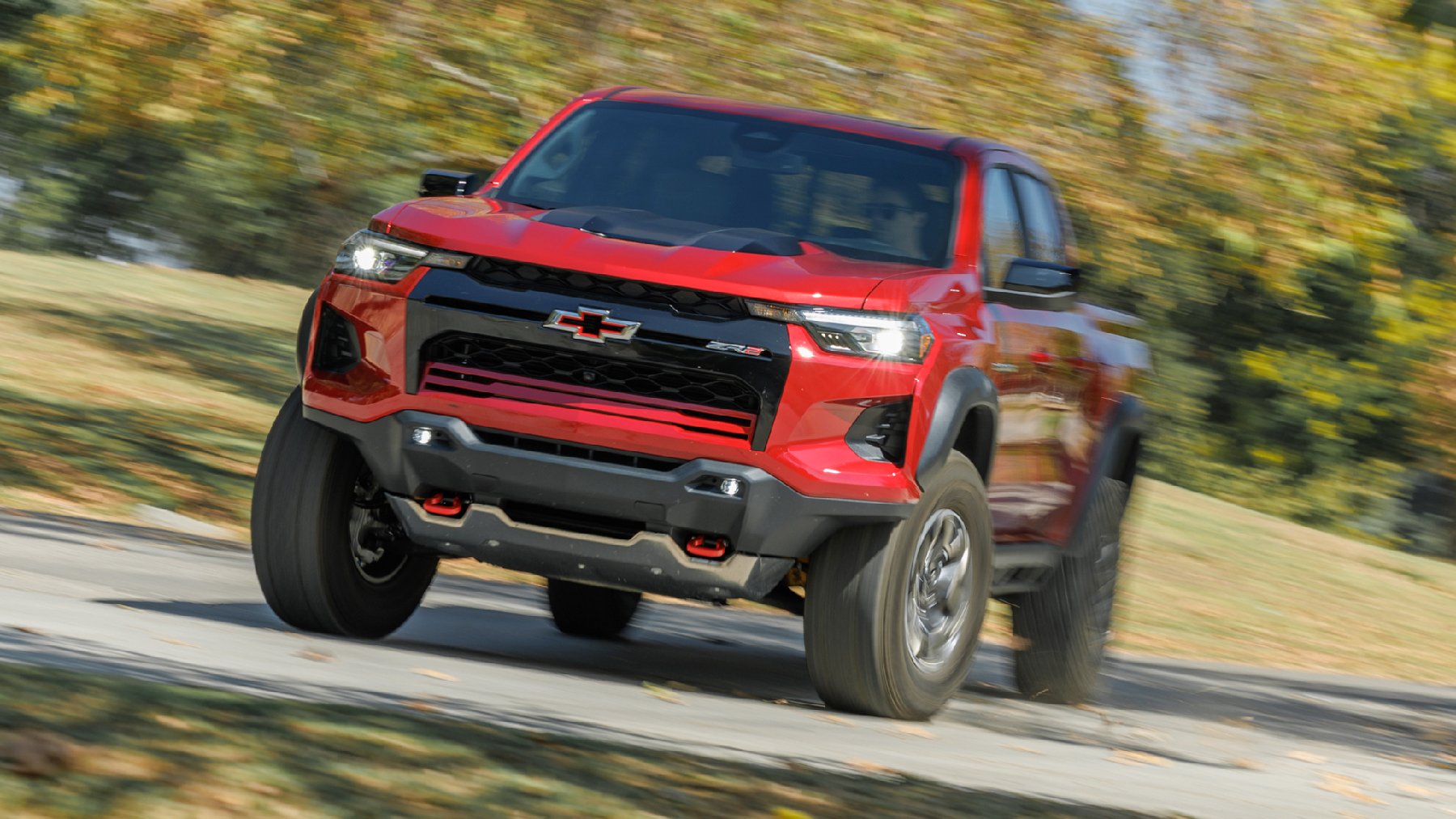
The Chevy Colorado is simpler to buy than it was a few years ago -- because now it only comes in one configuration -- crew cab, with a 5-foot bed -- and with just one engine, a turbocharged four.
This truck used to be available in extended cab or crew cab configurations, and you used to be able to pick from three different engines, ranging from a four without a turbo to a turbodiesel to a V6 that didn't need a turbo to make plenty of power.
Does one size fit all?
What It Is
The Colorado is a midsize truck sold by Chevy. It is similar to other midsize trucks in the class like the Ford Ranger and Toyota Tacoma as well as the Nissan Frontier. It is also essentially the same truck as the GMC Canyon, which is styled to look slightly different and considered the slightly "nicer" of the two.
As mentioned, the Colorado comes just one way -- crew cab, with a 5-foot bed and a turbocharged four-cylinder engine, paired with an eight-speed automatic. The only drivetrain choice is whether to stick with rear-wheel drive (two-wheel drive) or go with the optionally available four-wheel-drive system.
There are five trims.
The first is the $32,400 Work Truck. It comes standard with features and equipment that would have been considered high-end/loaded truck features only a decade or so ago. These include AC and power windows/locks, a digital main instrument cluster, WiFi hot spot, six-speaker stereo system and 11.3-inch center LCD touch screen.
The $34,37 LT adds heated seats and steering wheel, a telescoping steering column and an upgraded multi-function EZ Lift/StowFlex tailgate.
The $38,949 Trail Boss gets off-road upgrades such as a 2-inch suspension lift, tow hooks, fender flares and a set of 18-inch wheels with all-terrain tires.
If you want the off-road upgrades but not the 2-inch lift, the $42,256 Z71 is for you.
The top-of-the-line ZR2 gets even more aggressive mud-terrain tires on 17-inch wheels, a 3-inch lift, special Multimatic DSSV shocks, locking front and rear differentials, unique front and rear ends to allow for increased angles of approach and departure, and a spray-in bedliner.
This one lists for $48,453.
What's New for 2026
There are no major changes for the new model year.
What's Good
-- Standard turbocharged four-cylinder engine makes almost V8 horsepower (310) and more torque (430 foot-pounds) than many V8s.
-- Extremely roomy up front.
-- Standard 7,700-pound tow rating.
What's Not So Good
-- Nearly the same size as half-ton trucks used to be -- except for the bed.
-- No engine options.
-- No cab options.
Under the Hood
Regardless of trim, every '26 Colorado comes standard with a 2.7-liter four-cylinder engine pumped up by turbo boost to whelp out 310 horsepower and 430 foot-pounds of torque. To put these figures in some context, the 5.3-liter V8 that's available in the half-ton Chevy Silverado touts 355 horsepower and just 383 foot-pounds of torque.
Interestingly, there's not much of a mileage difference between these two. The 5.3-liter V8 in the larger (and heavier) Silverado touts 16 mpg city, 21 mpg highway. The 2.7-liter turbo four -- in the smaller and lighter Colorado -- touts 19 mpg city, 23 mpg highway.
The 2.7-liter turbo's immense torque output lets this Chevy pull up to 7,700 pounds, which is only about 2,000 pounds less than the full-size, V8-powered Silverado can pull.
The other trucks in this class such as the Ford Ranger and Toyota Tacoma are also powered by turbocharged four-cylinder engines; the only one that still comes standard with (or even offers) a V6 is the Nissan Frontier. It comes with a 3.8-liter V6 that touts 310 horsepower and 281 foot-pounds of torque. Its standard (and maximum) tow rating is 7,040 pounds.
Torque matters when it comes to pulling.
The Colorado used to be available with a turbodiesel four that didn't make as much horsepower -- or torque -- as the current 2.7-liter turbo four gas engine does, and towing capacity was the same 7,700 pounds. But the diesel-powered Colorado -- last available back in 2022 -- had a highway driving range just shy of 650 miles on a full tank, or about 150 miles more highway driving range than the current Colorado's got.
The Colorado also used to be available with a not-turbocharged 2.5-liter four that wasn't nearly as powerful as the current Colorado's 2.7-liter turbocharged four -- but the 2022 Colorado was also much less expensive when equipped with the 2.5-liter four. Back then, the base price of the truck was $27,100 -- about $4,000 less than the current Colorado's base price. It's more expensive now because it comes standard with a high-powered engine -- and because there's no longer a "base" engine.
The optional (in lower trims) 4WD system adds $3,300 to the Colorado's price. An eight-speed automatic is standard regardless.
On the Road
The Colorado is longer than a full-size, regular cab truck from the late 1990s/early 2000s. But it's not as wide -- and that makes it feel less big than a current full-size truck can on narrow country roads.
It is also much more powerful than the compact trucks that are no longer available for sale in this country. The Colorado can get to 60 mph in about 6.5 seconds -- about four seconds quicker to 60 mph than a compact pickup from the early 2000s with a non-turbocharged four-cylinder engine. The four feels V8 strong too -- a function of the tremendous low-end torque. It pulls hard -- and easily.
The body-on-frame construction imparts that brawny feeling most truck buyers like as well as a very smooth ride, because the body rests on rubber biscuits in between it and the frame, which absorbs most of the road shock that would otherwise be more readily felt. The electric-assisted power steering is not, however, as natural-feeling as the hydraulic-assisted power steering most vehicles (and especially trucks) used to have, and the Lane Keep Assist can be annoying on those narrow country roads, where the painted lines are often not painted exactly accurately. Tread on one and -- even though you're not veering out of your lane -- the system will try to "correct" your line.
There is tremendous space up front -- 45.2 inches of legroom -- and the driver and front-seat passenger do not rub shoulders as was often the case in the compact trucks that aren't available anymore.
This truck can be seen as a more everyday-manageable alternative to current full-size trucks, which have grown to gargantuan dimensions on par with the length and width and height of 2500 and 3500 trucks 20 years ago. If you were comfortable driving a half-ton truck circa the late 1990s/early 2000s, this truck will feel comparably comfortable.
On the other hand, it's still much bigger than the compact trucks that used to be available and, in some respects, less functional -- about which more now.
At the Curb
Chevy only sells the 2026 Colorado with a four-door cab and a disproportionately stubby (5-foot) bed. This truck used to be available with a 6-foot bed -- because it used to be available with an extended cab. The current Colorado's 5-foot bed is shorter than the 6-foot beds that were commonly standard with the compact trucks that are no longer available in this country. The 6-foot bed endowed those much smaller trucks with more cargo-carrying capacity -- with the caveat that the load had to be lighter, because those littler trucks weren't rated to carry (or pull) nearly as much. But getting a dozen 2-by-4-by-8s from Lowes was less awkward with the littler trucks because -- with the tailgate down -- those 2-by-4-by-8s fit in the bed.
Mostly.
With this truck, a couple of feet of 2-by-4-by-8 will be hanging in the breeze.
Of course, trucks are bought today as much for carrying people as 2-by-4-by-8s, and that's probably why Chevy decided it made more sense to make the crew cab standard. The 5-foot bed is certainly adequate for a wet dog. That said, people who need a larger bed (and who don't need a crew cab) won't find what they need here -- and that is probably going to cost Chevy some sales.
The rear seats are surprisingly tight too -- relative to the space up front. Backseat riders get just 34.7 inches of legroom, nearly a foot less than the driver and front-seat passenger enjoy. But the full-size rear doors do make it just as easy to access the back seats as it is to access the front seats.
The bed may be small, but Chevy does offer a hidden storage compartment (in the tailgate) that's a fine place to put stuff out of sight (provided it fits).
The interior is very touch-screeny, but aren't they all? On the upside, many of the important secondary controls are toggle-style switches and knobs that are large and easy to grab or press without having to look. There's also still a traditional row-it-back-and-forth gear selector for the automatic transmission -- as opposed to a button or rotary knob controller thing that has the feel of a video game console rather than the feel of a truck.
The Rest
The ZR2's off-road bona fides can be kicked up another notch by opting for the Bison Edition, which bundles 35-inch M/S tires, American Expedition Vehicle skid plates and stamped steel (exposed) front and rear bumpers and fender flares.
But it'll add $6,000 to the price tag of a ZR2 -- bumping the MSRP to more than $55,000.
The Bottom Line
Chevy's decision to consolidate the Colorado into one-size-fits-all (and one-engine-fits-all) has certainly simplified the buying odyssey. Just pick your trim.
But if you're wanting something that fits you, it may not be for you.
========
Eric's latest book, "Doomed: Good Cars Gone Wrong!" will be available soon. To find out more about Eric and read his past columns, please visit the Creators Syndicate webpage at www.creators.com.
Copyright 2026 Creators Syndicate, Inc.






Comments