Can school climate solve chronic absenteeism? Ask these principals
Published in Lifestyles
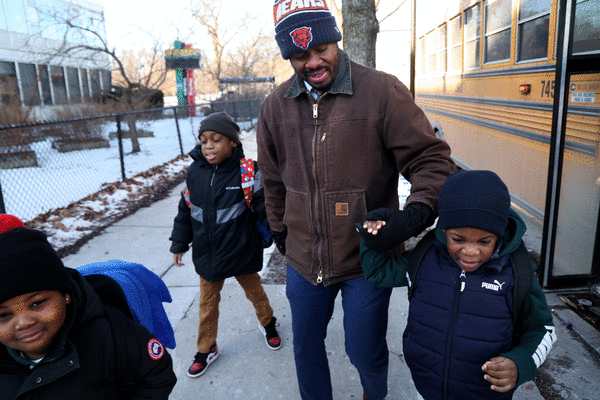
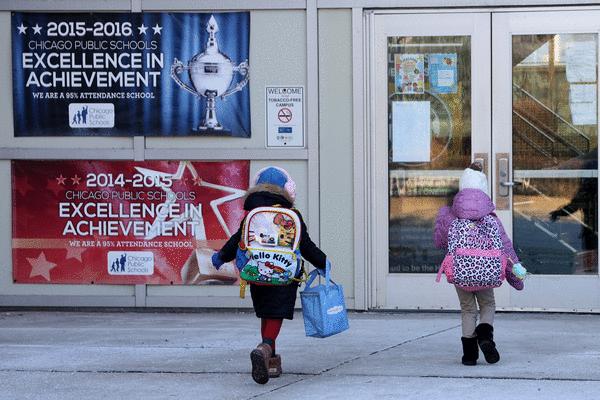




CHICAGO -- Even in the freezing air, Romian Crockett stood outside Chalmers STEAM Elementary with a boombox blaring ’90s music. Swaying to the beat, the principal hugged or high-fived each student who walked through the door. He knows all 218 by name.
“Terrence, good morning,” Crockett told a young boy bundled in layers.
“Wow, I got all of them today,” he said, as four students tumbled out of a carpool.
Crockett notices who isn’t there, too. “Yo, where’s your sister?” he asked a boy with a navy backpack. (She was down the block with her dad.)
By the time the last stragglers walk in at 9 a.m., Crockett already knows that just a handful will be marked absent.
Attendance at Chalmers rebounded after the pandemic, even as other schools struggled across Chicago and Illinois. During the 2021-22 school year, nearly half of Chalmers students were chronically absent, missing at least two days of class per month. Last year, that figure had fallen to fewer than 1 in 6 students, or about 17%.
It’s a rare bright spot for CPS: The districtwide chronic absenteeism rate was 40% last year. That’s a significant jump from 2019, when the rate was 24%. Experts warn that the stubborn metric has long-term implications for learning.
A new report from the University of Chicago Consortium on School Research offers a road map for recovery. School climate, researchers found, is perhaps the most powerful predictor of how many students show up to class.
It’s not a surprise to staff at Chalmers. Crockett attributes their success to an “attendance culture,” steadily built up over time through parental engagement and consistent expectations.
“The school is very welcoming, very warm, where kids can be kids,” said Crockett, who has been principal for a decade. “So naturally, our kids actually want to come to school.”
Two girls in matching pink jackets raced down the sidewalk to Crockett, grinning before giving him a hug.
‘I don’t make excuses’
The U. of C. consortium report found that even among schools serving similar students, absentee rates varied widely. But attendance was higher in schools with greater levels of perceived student safety, parental involvement and stronger student-teacher relationships.
Less than 2 miles west of Chalmers, for example, is another North Lawndale elementary school enrolling about 200 mostly low-income students. Yet its chronic absenteeism rate was about four times higher.
The report used data from the Illinois State Board of Education’s 5Essentials Survey, which polls students, families and teachers across the state on school climate.
“I think the big takeaway is that schools can and do influence attendance, and focusing on changing the experiences of students in schools can go a long way,” said Marisa de la Torre, a senior research associate at the Consortium.
For Crockett, boosting attendance is both holistic and practical. When students are absent, he calls their families that same morning. At drop-off, he focuses on building relationships with parents, and if a student was absent the day before, he’ll ask where they were.
“I don’t make excuses for kids not coming to school,” Crockett said simply.
Chalmers is also sporting a new look. It’s one of three North Lawndale schools benefiting from a $40 million investment in STEAM programming, meaning science, technology, engineering, arts and math. After a major second-floor renovation last summer, staff are unveiling the latest addition next month: a student-tended chicken coop.
But Crockett puts equal value on the small gestures.
On National Cereal Day, for instance, teachers handed little cereal boxes to students. That environment helped bring back kids amid the pandemic-era attendance slump, he said.
“I stress to my staff, ‘Don’t skip out on doing the little things,’” Crockett said. “The little things have the biggest impact on whether or not kids come to school.”
It may matter now more than ever: Not only are more students chronically absent, a larger share are missing significant portions of school, according to the consortium report. Roughly 1 in 10 sixth graders missed at least 36 days of the 2023-24 school year — a level of absenteeism that was rare before the pandemic.
Meanwhile, consistent attendance is less common: Two-thirds of sixth graders missed fewer than nine days of school pre-pandemic. But during the 2023-24 school year, that was the case for just under half.
A CPS spokesperson said in a statement that the district is continuing to implement targeted strategies to increase attendance, including school-level work like early intervention, family outreach and other school climate initiatives.
The report’s findings “validate the district’s focus on building systems of relational trust with the goal that every student has a meaningful connection with a trusted adult in their learning community,” the statement said.
‘A regular part of what we do’
At Cesar Chávez Multicultural Academic Center in Back of the Yards, Principal Barton Dassinger created a formal attendance team as part of the school’s improvement plan.
It has paid off: While the school’s chronic absenteeism rate rose to 39% after the pandemic, that figure plummeted to just 9% last year — outperforming the vast majority of CPS schools and bucking districtwide trends.
Mornings at Chávez have become a choreographed routine of spreadsheets, phone calls and home visits. Around nine staff members, including Dassinger, begin calling and messaging families at 8:15 a.m. If they don’t pick up, administrators may go door-to-door.
Before the pandemic, a dedicated attendance team might have seemed excessive. But today, staff at Chávez view it as the backdrop to student success. “It’s a regular part of what we do, knocking on doors, letting parents know, ‘Hey, come on, let’s go. What’s the problem? How can we help you?’” Dassinger said.
Chávez is also part of the CPS Sustainable Community Program, offering after-school programs, parent outreach and other wraparound services to families. That cultivates community on campus, Dassinger added.
“We realized that it doesn’t matter what your curriculum is, what your instruction is, what kind of great lessons you’re planning. If the students are not in school, they’re not going to learn,” he said.
The consortium report charted the direct relationship between students’ attendance, GPA and test scores. The verdict? Attendance matters just as much as it did before.
For example, there was an average 0.4 GPA difference between sixth graders who missed 10 days of school and sixth graders who missed no school. That was the case in both pre- and post-pandemic years.
It’s not necessarily a new finding. But the research underscores how school matters across achievement levels — and each day makes a difference. “Post-pandemic, right, people are wondering, ‘Do young people still need to go to school every day?’” said de la Torre. “This study shows that, yes … attendance still matters.”
‘I enjoy being here’
The consortium report focused on middle and high schoolers, who have higher rates of chronic absenteeism. Some research shows that may be due to factors like increased independence and mental health challenges.
But that doesn’t mean the results at Chalmers and Chávez can’t be replicated at larger high schools. At Chicago High School for Agricultural Sciences in Mount Greenwood, about 36% of students were chronically absent last year. It’s a slight rise from the year prior, but it still puts CHSAS among the top district schools.
Principal William Hook said the courses and activities at CHSAS are designed around engagement and retention. Students travel all across the city to experience the school’s 80-acre operational farm, greenhouse and welding stations.
“Every pathway is built for academic instruction, but also for hands-on learning,” Hook said. “The teachers enjoy doing that, and I know the students do.”
Teacher retention is also high, he added, in part because they instruct such specialized courses. Hook himself has been principal for 19 years. “I’m here because I enjoy being here, and I think the teachers would probably say the same thing,” he said. “And most of the students would say the same thing.”
This year, chronic absenteeism is trending slightly upward, district officials told the Chicago Board of Education last month. The pattern comes amid the Trump administration’s intensified immigration enforcement, dubbed Operation Midway Blitz. Many parents reported keeping their children home from class as federal agents stormed the city.
And while the district’s five-year strategic plan sets a goal to reduce chronic absenteeism by 15%, CPS has made slow progress. Chronic absenteeism hit a high of 46% during the 2021-22 school year, and has since only dropped roughly 6 percentage points. Schools, though, aren’t helpless.
Back at Chalmers, Mckinley Morris watched his kindergartner bound toward Crockett, hugging him before racing through the colorful entryway. Morris shook Crockett’s hand before turning back down the sidewalk.
“He’s a great principal, he’s out here every morning, supporting the kids. It’s awesome,” said Morris, 35, as a Beyoncé song blared from the speaker.
Even in 20-degree weather, Morris wouldn’t dare keep his son home. “They’re gonna call everyone,” he said. “And it’s irritating, but it’s protocol. I’m glad.”
©2026 Chicago Tribune. Visit at chicagotribune.com. Distributed by Tribune Content Agency, LLC.




















Comments