Incarcerated women often don't have enough period products
Published in Health & Fitness
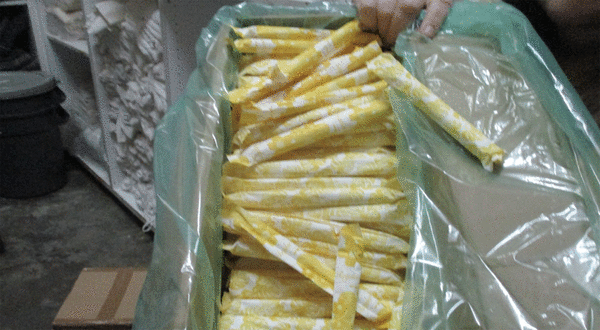
When Yraida Faneite was on trial for drug-related charges, the judge had to halt proceedings at one point because her period was so heavy that blood was running down her legs.
The same struggle followed her into a federal prison in Florida after she was convicted. For about a decade, officials allowed her only a small ration of menstrual products, and she couldn’t afford extra pads from the commissary. She bartered with other women. On her worst days, she tore up her own T-shirts and used them as makeshift pads.
When she told officers she needed to see a doctor and couldn’t safely continue a mandatory kitchen shift, she said, she was placed in solitary confinement. She eventually found out that her heavy bleeding was caused by cysts.
“I didn’t have enough napkins to use during my period. … No matter what you say, they don’t care,” recalled Faneite, who was released from prison in 2006 and went on to found the prison reentry nonprofit YG Institute.
Her experience echoes what researchers, advocates and formerly incarcerated people describe across prisons and jails nationwide: Even where menstrual products are available, limited supplies, low-quality products, strict disciplinary rules and delays in medical care can result in incarcerated people facing potentially avoidable health issues or disciplinary write-ups.
Access to menstrual products also has been a persistent issue in immigration detention centers, with recent reports and lawsuits alleging that women in some facilities have been unable to obtain or outright denied feminine hygiene products despite federal standards and law requiring sufficient and timely access.
A new report from the Prison Policy Initiative, a research and advocacy organization, says that menstruation is still regularly treated as a disciplinary matter — through contraband rules, work violations and sanitation write-ups — even in prisons and jails that provide free products.
These disciplinary actions can affect everything from parole eligibility to access to programming and services.
Women make up a growing share of the state prison population, which rose about 5% nationwide from 2022 to 2023, according to the latest data from the federal Bureau of Justice Statistics.
In recent years, more states have begun taking steps to improve access to menstrual products in jails and prisons, and to address the overall conditions that shape incarcerated women’s experiences.
The Ohio legislature last month passed legislation to strengthen access to period products for incarcerated people in jails and prisons. The bill is awaiting the governor’s signature. And Wisconsin lawmakers introduced a bill on the issue this month.
At least 24 states and Washington, D.C., require that people in state prisons or local jails have free access to menstrual products, according to the National Conference of State Legislatures. Federal correctional facilities have provided free products since 2017.
More than a dozen states have passed versions of the Dignity of Incarcerated Women Act, which includes provisions to improve basic conditions, such as access to and the quality of period products and pregnancy care.
Still, in most of the country, access depends on a patchwork of laws and corrections department policies. Nearly every state has a rule on the books about providing menstrual products, but the specifics, implementation and enforcement vary widely. Advocates say that leaves many incarcerated people without the consistent access they need.
“In the system that we have where there’s very little oversight, accountability, transparency, you have no easy way of enforcement,” said Miriam Vishniac, the founder and director of the Prison Flow Project, a database tracking access to menstrual products in U.S. jails and prisons.
In Alabama, the state Department of Corrections says it provides menstrual products — pads and tampons — free of charge. People can choose a monthly allotment of 30 pads, 30 tampons or a mix of both. Housing unit staff keep small supplemental supplies on hand and can issue additional products as needed, according to Rand Champion, the agency’s chief of communications.
In Colorado, corrections officials said staff are prohibited from using access to menstrual products as a behavior-management tool, and facilities are required to keep products stocked and available regardless of an individual’s financial status.
Maryland’s policy requires correctional facilities to provide menstrual products at no cost during admission or transfer, on a monthly basis and upon request. The state says it offers tampons, winged pads, and both light- and heavy-flow pads. The products must be provided in quantities appropriate to each person’s health needs. Corrections officials told Stateline there have been no recent challenges with implementation.
In the months after a Maryland law requiring correctional facilities to provide free menstrual products and maintain a sufficient supply took effect in 2018, advocates said women at the Correctional Institution for Women were still paying for tampons and relying on flimsy pads handed out each month. State officials acknowledged the policy was not being implemented consistently systemwide.
Rules and restrictions
The new report from the Prison Policy Initiative outlines several ways that prison and jail rules can indirectly penalize people who menstruate.
Some facilities classify having more pads or tampons than the allowed number as contraband, which can lead to confiscation or formal disciplinary actions. Rules on property and hygiene mean that leaking through uniforms or bedding may be treated as a violation.
Asking for additional menstrual products can sometimes be interpreted as abusing medical rules or “feigning illness.” And trading or sharing products with other incarcerated people may also be prohibited under unauthorized exchange rules, the report said.
“It’s just another reminder that they have no autonomy over themselves, over their bodies, over their lives,” said Alycia Welch, the associate director of the Prison and Jail Innovation Lab at the University of Texas at Austin.
Access is further complicated by shower schedules and clothing allocations, which can make it difficult to change products regularly. Items available for purchase at the commissary — including pads, tampons and pain relief — are often costly.
Transgender men, nonbinary people and older women who menstruate or experience irregular cycles may face additional scrutiny or confusion from staff when requesting menstrual products, creating further barriers, according to prison policy experts.
Disciplinary actions can include fines, loss of commissary privileges, restrictions on phone or visitation access or placement in segregation units.
Many advocates and formerly incarcerated people say that even in facilities that provide free menstrual products, the supplies are often of poor quality, with thin pads and low-absorbency tampons.
“We can’t just stop at creating these rules that mandate that people have access to these products,” Vishniac, of the Prison Flow Project, said. “There needs to be some kind of way of ensuring that it’s actually happening.”
Strengthening access in Ohio
The bill Ohio lawmakers unanimously passed would require that all incarcerated women in state or local correctional facilities have free access to feminine hygiene products. It also would mandate that facilities allow incarcerated women to shower once per day while menstruating.
The bill also would require safe, designated disposal containers for used menstrual products and prohibit denial of products based on race, sex, income, charge, disability or other protected traits and identities.
In 2022, the Ohio Department of Rehabilitation and Correction adopted a new policy requiring state prisons (but not jails) to provide free menstrual products; advocates, however, say there’s no mechanism to hold staff or facilities accountable.
While the bill does not lay out an explicit oversight mechanism, its language would give incarcerated women a clear legal standard they can reference if access is denied, said Kayelin Tiggs, an advocate who helped author the bill’s language. Tiggs created the Ohio Coalition for Menstrual Equity.
“The fact that we were able to pass it here with that anti-discrimination language is a good sign,” Tiggs said. “I feel like we could take this nationally.”
____
Stateline reporter Amanda Watford can be reached at ahernandez@stateline.org.
©2025 States Newsroom. Visit at stateline.org. Distributed by Tribune Content Agency, LLC.









Comments