One thousand Pennsylvanians now dropping health insurance daily
Published in Health & Fitness
PITTSBURGH — Nansi Armstrong is living in America's painful health insurance purgatory: earning too much to qualify for Medicaid but not enough to cover premiums set to double next year.
The 48-year-old mother works multiple jobs, including a full-time gig as an office manager for a Harrisburg law firm that comes without benefits.
At $650 per month, coverage this year was already expensive. But it paled in comparison to the forecast for 2026, which Armstrong described as "insane."
So, despite lingering nerve pain from a bout of shingles and the uncertainty of her family's history of cancer, Armstrong made the difficult decision to forgo coverage next year.
"It's scary," she said. "If I get sick or anything like that, I just have to deal with it on my own."
Part of her feels fortunate she got a hysterectomy out of the way this year.
"If I hadn't the insurance, I wouldn't have been able to get that procedure," she said.
Armstrong is one of 55,000 Pennsylvanians who have dropped health care coverage since Nov.1 as premiums doubled due the expiration of federal subsidies. A thousand state residents are now dropping health insurance each day as hope of a last ditch fix from Congress fizzles, said Devon Trolley, executive director of the Pennsylvania Health Insurance Exchange.
She is still hoping lawmakers will pass an eleventh hour measure to extend the Affordable Care Act subsidies, although a vote is not expected before the new year. Three Republican House members from Pennsylvania broke from their party to force the vote on Wednesday.
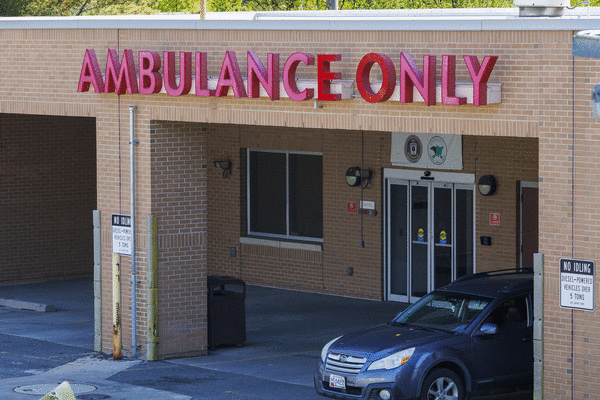
While the majority of people are renegotiating their budgets to cover the spike, a significant portion are unable and will enter 2026 without coverage, forgoing necessary surgeries and medication while straining the state's systems of care. Hospitals that advocated to extend the subsidies are bracing for overburdened emergency rooms while rural centers warn they won't be able to account for the sudden surge in uninsured patients in need of treatment.
"It's a catastrophe waiting to happen," said Beverly Kennedy, clinical executive director of the Meadville Area Free Clinic, a nonprofit that relies on a limited pool of volunteer providers to care for about 60 rural patients each month.
Kennedy said her own health plan doubled from $546 to $1,039, forcing her to dip into her savings. She is already fielding calls from people who plan to drop coverage asking what services the clinic can provide.
"The system's broke," she said. "I don't have the resources now to handle the patients I have."
People who opt out of coverage will be more likely to visit emergency rooms when they need access to care, said Grace McHale, a Pittsburgh-based coordinator for the nonprofit Pennsylvania Health Access. They will lose access to free preventative screenings and could need more expensive treatment down the line.
"Medical debt is a common experience," McHale said, although special enrollment periods could provide flexibility, especially if people's financial circumstances have changed their eligibility.
Those who have stayed enrolled are often opting for plans with high deductibles, McHale said, which carry a higher risk of having to pay thousands of dollars for unexpected treatment. Others are talking through the out-of-pocket costs for monthly prescriptions and upcoming procedures. In many cases, those costs are also rising.
"A few people have expressed hope that tax credits might still be renewed and the situation will change, but not a lot of optimism coming from Pennsylvanians at this point," McHale said.
As residents from Allentown to Erie confront the higher costs, many who signed up for plans may start to drop out throughout the year. The state marketplace has already seen failures from people to pay their initial bills, Trolley said. That will compound the strain on health systems across the state, including rural hospitals that were already struggling.
"We have heard a really high level of concern from providers and hospitals about really any additional financial strain," Trolley said.
The American Hospital Association wrote to Congress this fall advocating for an extension in health care subsidies, arguing that hospitals and health systems would face "considerable stress" if they disappear.
The University of Pittsburgh Medical Center said clinicians will continue to provide care for "every patient in need."
"We remain committed to working with those we serve to access and create the best assistance when needed," Dr. Donald M. Yealy, the center's chief medical officer, said in a statement.
Experts warn that serving a greater portion of uninsured patients could eventually drive up costs for everyone. That's because when hospitals aren't reimbursed for care, they end up raising prices across the board to cover the difference. Insurers may also raise rates, compounding the premium increases families saw this year.
Part of the reason the system was so reliant on subsidies was because the price of treatments such as prescription drugs has skyrocketed, said Jonathan Greer, president and CEO of the Insurance Federation of Pennsylvania, a trade group representing UPMC and other insurers.
"It very much worries me what's going on here," he said. "It's a problem for hospitals, it's a problem for insurers, it's a problem for the state of Pennsylvania, and it's a problem as an issue of public health."
The introduction of Affordable Care Act subsidies in 2014 along with Medicaid expansion originally cut the state's uninsured rate by half — from 14% in 2013 to just 8% two years later — but progress plateaued then reversed slightly last year, census data shows. The end of enhanced premium tax credits, which were introduced during the pandemic, will accelerate that backward slide, Trolley said.
Congressional Republicans have proposed a few unsuccessful alternatives to extending the subsidies. Vice President JD Vance said this week at an event in Pennsylvania that the White House is open to preserving the subsidies if Congress reaches an agreement.
From Harrisburg, Armstrong has been watching the shifting situation in Washington while negotiating with her part-time job for an offer that could include health benefits.
"You always try to be hopeful but it's not looking that bright," she said.
At this point, she's more hoping to simply stay healthy next year.
_____
© 2025 the Pittsburgh Post-Gazette. Visit www.post-gazette.com. Distributed by Tribune Content Agency, LLC.







Comments