Flu season could get a lot worse in the coming weeks, experts say
Published in Health & Fitness
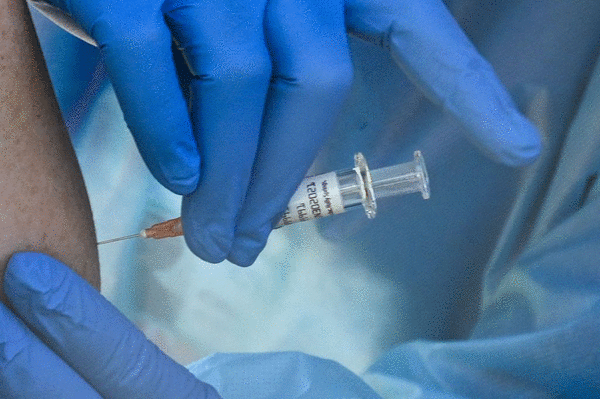
NORFOLK, Va. — This flu season has been relatively mild so far but medical experts expect it to intensify in the coming weeks due to a new strain that emerged after the current vaccine’s production — though that inoculation remains the best form of protection.
Data out of the United Kingdom indicates the new strain has resulted in the highest rate of flu hospitalizations the country has seen this time of year, according to the U.K.’s National Health Service. Subclade K first emerged in Australia near the tail end of its flu season and has since been identified in Japan and the United States, according to Lisa Sollot, the respiratory disease program coordinator for the Virginia Department of Health.
Figures from the U.K., which uses the same vaccine as the U.S., shows the current vaccine is only about 32-39% effective in preventing flu infection, though it is proving to be 72-75% effective in children, according to the University of Virginia.
Frederick G. Hayden, a professor at the UVA School of Medicine who is also part of UVA’s Division of Infectious Diseases and International Health, co-authored an article in the Journal of the American Medical Association analyzing the latest data. He said in light of subclade K being a subtype of the strain which contributed to last flu season being “severe” — a label largely given based on the rate of deaths in children — this season is likely to be severe as well.
A Dec. 11 report from the Centers for Disease Control and Prevention supported the expectation that the virus is accelerating in the U.S.
“The 2024-25 influenza influenza season, largely due to influenza A H1N1 and H3N2 viruses, was associated with high severity across all age groups, including an exceptionally high number of pediatric deaths. Unfortunately, we are seeing the circulation of a new variant of H3N2 virus for which our vaccines may be somewhat less effective,” Hayden said in a UVA release. “However, available vaccines will reduce the risk of serious illness and potentially the spread of this virus.”
Sollot explained there’s never been high-severity flu seasons in back to back years.
“Low vaccination rates combined with subclade K’s emergence may potentially lead to a severe season, but we really can’t say exactly how severe,” Sollot said in an interview.
Currently in Virginia, the vaccination rate across all age groups is about 28%, with the lowest at 20.6% for ages 5-17 and the highest at 39.8% for those 50 and older.
CDC data for last flu season showed that about 90% of the children who died from the flu were not vaccinated, and 50% of those who died did not have any underlying conditions.
“Those are really shocking statistics for the season,” Sollot said. “Everybody get vaccinated, wash your hands, and stay home when you’re sick.”
The CDC recommends influenza vaccination for everyone 6 months and older, with only rare exceptions.
©2025 The Virginian-Pilot. Visit at pilotonline.com. Distributed by Tribune Content Agency, LLC.









Comments