'Blade Runner 2099' review: A visually stunning, slightly empty sequel
Published in Entertainment News



“Blade Runner 2099” starts off as an intriguing sci-fi mystery with a fascinating philosophical question at its core: Can we ever change what we are?
Across its eight episodes, Prime Video’s limited series sequel to the “Blade Runner” movies (premiering Wednesday) sets the stage to answer that question in marvelous ways. It establishes a hauntingly beautiful retro-futuristic world that’s been shattered by hubris and a deeply ironic inability to not repeat past mistakes. It piques your interest from the get-go: You wait with bated breath for the next revelation, the next puzzle piece to fall into place.
But somewhere along the way, the series becomes less about soul-searching and more about easy answers. The closer we get to solving the show’s central mystery, the farther we get from answering that fundamental question, and the series is a lesser creation for it — especially considering what else it has going for it.
In “ Blade Runner 2049,” the world was run by humans who were still using Replicants — bioengineered humanoids meant to be “more human than human” — as slave labor. This, even after the events of the first “Blade Runner,” in which Replicants wanted more than what was given to them and were willing to kill for it. (It’s hard to blame them: I also wouldn’t want to be forced to work in outrageously dangerous conditions on other planets.) Fifty years later in “2099,” created by Silka Luisa and inspired by Philip K. Dick’s 1968 novel “Do Androids Dream of Electric Sheep?,” Replicants are in control, having won a devastating war against humans, who are now the ones sent off-world to labor and die, ostensibly for the ecological damage they caused to the planet before the war.
So the oppressed are now the oppressors, and the cycle of inhumanity continues. The most ironic part? Replicants used to fear Blade Runners, since their entire goal was to “retire” rogue Replicants. Now they are the Blade Runners, chasing down insubordinate humans. (The hood and intubation tube the Replicants use to subdue them is uniquely horrifying.)
Like in the movies, “2099” takes place in and around Los Angeles, and the city continues to play an important storytelling role. This L.A. is a city of contrasts: bathed in neon lights and doused in pitch-black shadows, high-tech for the Replicants and squalid for the humans, familiar and alien all at once. Its sense of scale, both small and large, is staggering: The streets and apartments are densely packed to the point of claustrophobia, and the sheer size of the city’s buildings and empty outskirts will take your breath away. The cinematography is truly awe-inspiring, especially when paired with the franchise’s trademark synth- and trumpet-heavy score. The two combined make for a striking visual-audio punch, and it’s one of the best parts of the show.
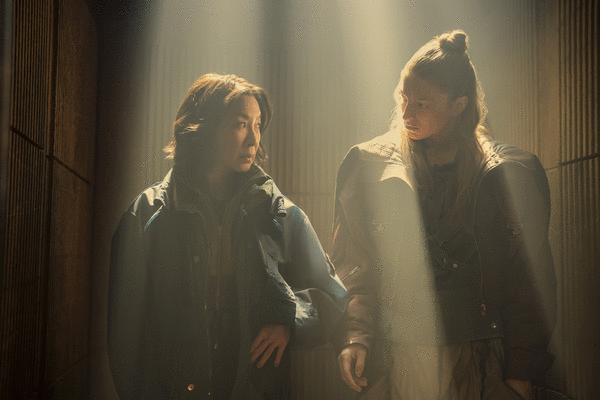
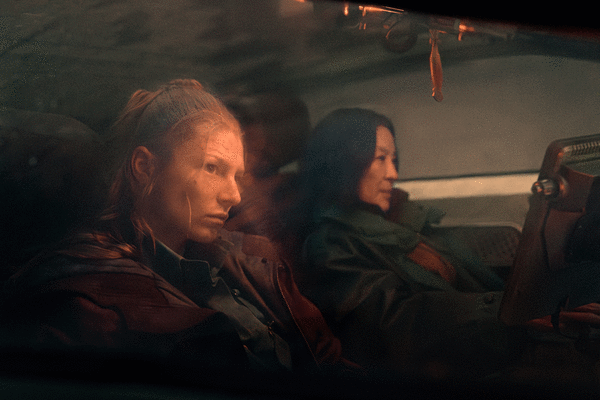
Speaking of a powerful combination: the stars of “2099,” Michelle Yeoh and Hunter Schafer. The former portrays Olwen, a ruthlessly efficient Replicant Blade Runner tasked with locating a missing Blade Runner. The catch? She has just a few days left to live.
Schafer’s Cora, on the other hand, is a human with an important task of her own: to find an artifact that could alter the balance of power between humans and Replicants forever. (World-changing secrets are standard fare for the “Blade Runner” franchise at this point.) The catch? Doing so requires her to pretend to be a Replicant Blade Runner.
As you can imagine, their paths eventually cross, and their missions, once separate, become one and the same.
Yeoh delivers a restrained but powerful performance as Olwen, expertly melding intimidation and vulnerability. She also gets the best dialogue — her “I’ve made so many worlds; I won’t live in yours” sliced right through me — though nothing tops Rutger Hauer’s “tears in rain” monologue in the first film. Schafer doesn’t quite hold the screen the same way Yeoh does, but the two of them share a captivating chemistry when together onscreen. There’s an amazingly nerve-wracking tension between the characters as their secrets simmer just under the surface.
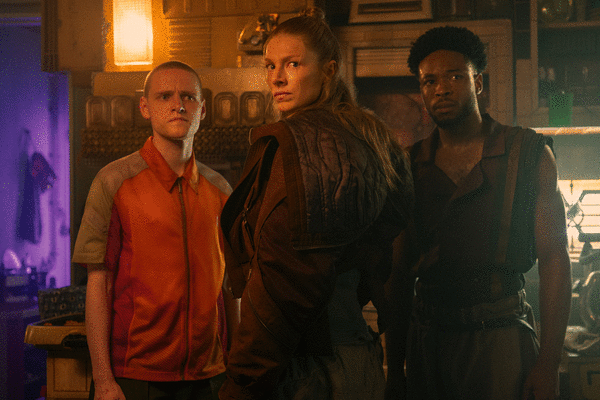
You can see the pieces of something really exciting here, but the show does itself a disservice when it loses focus — something that happens with disappointing regularity. Too many paper-thin characters and subplots that don’t go anywhere distract from what truly matters. I’m curious if the series would have been better as a movie, shorn of all the fluff and distilled to the most important elements.
So maybe “Blade Runner 2099” does answer that core question — because no matter how much I might want otherwise, the series is what it is, and there’s no changing that.
———
'BLADE RUNNER 2099'
Rating: TV-MA
How to watch: On Prime Video Nov. 25
———
©2026 The Seattle Times. Visit seattletimes.com. Distributed by Tribune Content Agency, LLC.











Comments