Bronx rap pioneer Afrika Bambaataa dies at 67 with a troubled legacy
Published in Entertainment News
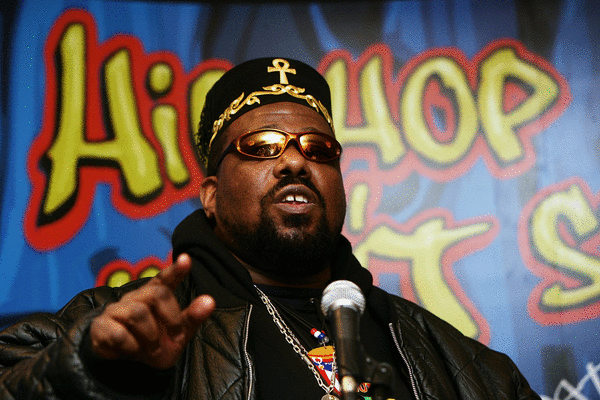
NEW YORK — Pioneering rapper and DJ Afrika Bambaataa has died. The Bronx native was 67.
The Hip Hop Alliance, headed by fellow hip-hop icon Kurtis Blow, announced his death Thursday.
“Today, we acknowledge the transition of a foundational architect of Hip Hop culture, Afrika Bambaataa,” the message said. “As the founder of the Universal Zulu Nation, Afrika Bambaataa helped shape the early identity of Hip Hop as a global movement rooted in peace, unity, love, and having fun.”
Blow acknowledged the performer, born Lance Taylor, leaves behind a legacy that is “complex and has been the subject of serious conversations in our community,” likely a reference to the multiple allegations of child abuse that have been brought against the musician.
Bambaataa died of complications from cancer around 3 a.m. in Pennsylvania, according to TMZ.
Hip-hop’s roots can be traced back to block parties hosted by Bambaataa in the South Bronx during the 1970s. The music and culture he helped incubate led to the formation of the Universal Zulu Nation. That organization aspired to draw young people away from street violence.
Bambaataa’s popularity as a musician spread in the early 1980s when he was tapped to perform in Lower Manhattan venues like Mudd Club, according to the Museum of the City of New York. He would soon come to pack venues like The Ritz.
The Village Voice claims the first time “hip-hop” appeared in a major publication was when the downtown paper published a 1982 story titled “ Afrika Bambaataa’s Hip-Hop.”
That same year he was part of a European tour that included artist and hip-hop personality Fab 5 Freddy, according to the Huffington Post. Those shows helped introduced the genre to an expanding audience.
In 1984, Bambaataa worked with James Brown to record “Unity” and collaborated with former Sex Pistols frontman John Lydon to release “ World Destruction.” That song was frequently played on MTV.
The following year, he teamed up with stars including Steven Van Zandt, Run-D.M.C., Lou Reed and U2 to record the anti-apartheid song “Sun City,” encouraging musicians to boycott South Africa.
He would later be dogged by claims of sex abuse, starting with a 2016 allegation from Bronx Democratic Party activist Ronald Savage, who told the Daily News he was 15 years old when Bambaataa began abusing him in 1980. Bambaataa’s lawyer dismissed that accusation as a publicity stunt by someone trying to sell a book.
Complaints against the cultural trailblazer included a 2021 civil case in which he was accused of sexually abusing and trafficking a 12-year-old boy. That suit was settled in the plaintiff’s favor last year when Bambaataa didn’t show up for court.
A dozen more accusers reportedly came forward with similar allegations dating back decades.
©2026 New York Daily News. Visit nydailynews.com. Distributed by Tribune Content Agency, LLC.









Comments