A revival of the indie film business? Some promising signs out of Sundance
Published in Entertainment News
LOS ANGELES — It was a chilly, nostalgic and relatively hopeful last run in Park City, Utah, last week for the Sundance Film Festival, which is moving to Boulder, Colorado.
It was also my first time at the storied festival, and after chats with industry players around town and afterward, the picture that emerged was one of guarded optimism, despite the difficult landscape for theatrical films.
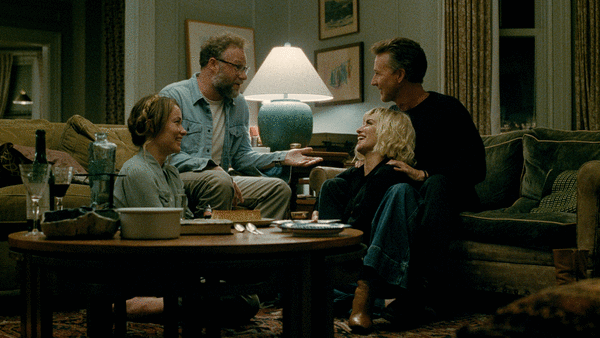
So far, at least four deals were notched during the festival, including an old-fashioned bidding war for Olivia Wilde’s comedy, “The Invite,” which ended up going to indie studio A24 for about $10 million.
Other films that sold include horror flick “Leviticus,” which Neon purchased for a reported seven figures, comedy-drama “Ha-Chan, Shake Your Booty!” and drama “Bedford Park,” both of which were acquired by Sony Pictures Classics for undisclosed prices.
Industry insiders told me the rate of deals coming out of Sundance this time appeared slightly faster than in previous years.
As I’ve written before, most recent acquisitions have taken place in the later days of the festival, if not in the weeks and months afterward. That’s a consequence of the pandemic-fueled shift to online and Zoom-based dealmaking, as well as the slower and more careful consideration of films from distributors, which now weigh the commercial potential of these films against the very real risk of a soft response at the box office.
Indie films face the same theatrical challenges as their more mainstream counterparts because moviegoing still hasn’t bounced back to pre-pandemic numbers.
That means if a film doesn’t work, there’s no longer a minimum for how little it can earn at the box office. For examples of that unpredictability, just look at films like “The Smashing Machine,” which grossed a worldwide total of $21 million, or “Christy,” which made only $1.9 million.
“People are still making lots and lots of movies,” said Paul Hardart, director of the entertainment, media and technology program at the NYU Stern School of Business. “Getting people to watch them has never been harder.”
Market uncertainty, however, hasn’t stopped new distributors from entering the fray. Warner Bros. launched a specialty label just before Sundance that’s helmed by former Neon executives. Santa Monica-based Black Bear expanded its operations to include U.S. distribution. Other new players include Row K Entertainment, 1-2 Special and Subtext.
“People are seeing a trend upside or opportunity, and that’s why they are pushing in,” said producer Justin Lothrop, head of film and television at media group Votiv, which was behind Sundance favorite “Wicker,” starring Olivia Colman.
Those entrants have boosted filmmakers’ confidence in the business.
“We’ve come out of a time in the independent space where it felt like a very contracted buying market,” said Amy Beecroft, head of Verve Venture Group at Verve Talent & Literary Agency. “To have these new companies be sitting alongside really great, established distributors ... is really helpful in creating a real marketplace.”
Verve represents musician Moby’s production company Little Walnut, which premiered Scotland-set comedy “The Incomer” at Sundance. The film stars Domhnall Gleeson as a bureaucrat who’s tasked with relocating the last two residents of a remote island, and its first screening attracted interest from buyers. Beecroft said the company was “pleased with the activity,” though she declined to disclose more details.
Could these good feelings mean a jump start to the indie business?
“We’re definitely seeing some good signs of life,” said Deborah McIntosh, co-head of WME Independent, who represented the filmmakers of “Leviticus” in their deal with Neon. “Overall, business is feeling great, continuing into a space where we can do more than we’ve seen in the past 18 months.”
And beyond the traditional distributors is a growing belief in the indie film world that self-distribution is becoming a viable option, if you can prove there is a following or community for your film, said Joe Pichirallo, an arts professor at NYU’s Tisch School of the Arts and one of original executives who set up Searchlight Pictures.
Though the typical route was to raise money from family, friends and investors, get to Sundance and hope for a deal, digital distributors such as Filmhub have made it so “that’s not your only option today,” he said.
©2026 Los Angeles Times. Visit at latimes.com. Distributed by Tribune Content Agency, LLC.









Comments