Pulitzer Prize-winning composer Anthony Davis transcends borders with new opera
Published in Entertainment News
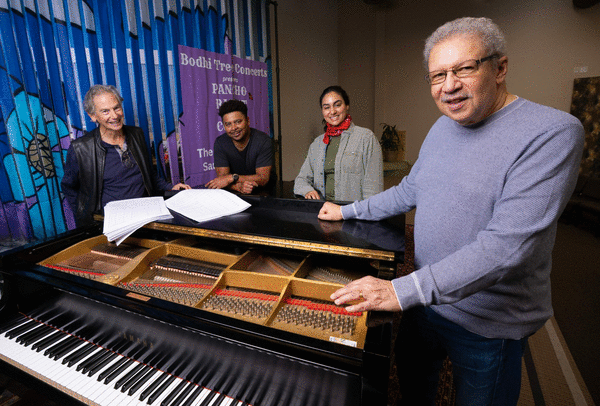
SAN DIEGO — Pulitzer Prize-winning opera composer and UC San Diego professor Anthony Davis didn’t have to look beyond his backyard — figuratively and (almost) literally — for inspiration for his latest musical opus, “Pancho Rabbit and the Coyote.”
Produced by the nonprofit presenting organization Bodhi Tree Concerts, the bilingual opera’s world premiere will take place Saturday and Sunday at Chula Vista’s Southwestern College Performing Arts Center in Chula Vista, followed by a Jan. 31 performance at Tijuana’s Casa de Cultura.
The chamber opera is based on author and illustrator Duncan Tonatiuh’s 2013 children’ book, “Pancho Rabbit and the Coyote: A Migrant’s Tale.” It received the Tomás Rivera Mexican-American Children’s Book Award in 2014 and was initially inspired by “Little Red Riding Hood,” with the big bad wolf character replaced by a coyote who smuggles people into the U.S. from Mexico.
The opera is being directed by Octavio Cardenas, a Guadalajara native who has extensive opera directing credits and is currently on the music faculty at the University of Rochester’s Eastman School of Music in New York.
The cast includes Ensenada native Mariana Flores Bucio as Pancho and Atlanta native Victor Ryan Robertson as the coyote. It also includes Bucio’s husband, Tijuana native Miguel Zazueta. They both earned doctorates this year in contemporary music at UCSD.
The libretto for this border-centered opera, which will be sung in English and Spanish with supertitles, was written by UCSD Jewish Studies Program faculty director Allan Havis. The Spanish text is by Laura Fuentes, UCLA’s Senior Director of Foundation Relations and Corporate Philanthropy.
No matter the language, “Pancho Rabbit” could not be timelier — or more potent — with its focus on immigration issues, unbreakable family bonds, social inequities and the perils of undocumented migration along the U.S./Mexico border. With a loving heart and a steady eye on current events, it also addresses some of the stark realities faced by migrant farm laborers who toil in California to support their families back home by doing back-breaking work few Americans seem willing to undertake for such low wages.
‘This magical moment’
In a sobering case of life mirroring art, the challenges of mounting such an ambitious new opera in today’s politically fraught climate are further underscored by a real-life road bump. Despite having their immigration papers and U.S. work permits in order, several Mexican cast and production crew members are opting to be part of only the San Diego or Tijuana performances of “Pancho Rabbit” — not both. They fear they might be wrongfully detained at the border, even when legally traveling from one city and country to the other.
“Living here in a border community and witnessing the politicizing of immigration is something I’m very aware of. I’ve never had any of my operas done in Mexico before, so I’m very excited about that,” said Davis, who won the 2020 Pulitzer Prize for his politically charged “The Central Park Five.” It was followed in 2022 by New York Metropolitan Opera’s acclaimed new production of his first opera, 1986’s groundbreaking “X: The Life and Times of Malcolm X.”
Davis’ new opera chronicles the titular Pancho Rabbit’s challenging journey from his rural Mexican home to find his father, Papa Rabbit, a seasonal farm worker who is late in returning from the U.S. Other characters in the cast include the coyote who takes Pancho across the border and is both an ally and a villain, two snakes, a rooster and an orange snapping turtle whose demeanor and championing of border walls are strikingly similar to that of President Donald J. Trump.
There is also a kaleidoscope of monarch butterflies — voiced by a children’s choir — whose depiction is deeply symbolic. A 17-piece orchestra, which includes contrabass great Mark Dresser, will accompany the 11 featured singers and choir.
There are no butterflies featured in the book version of “Pancho Rabbit,” whose adaptation as an opera has inspired the introduction of some new characters and story elements. In a scene created to invoke magic and mysticism, the 11-year-old Pancho dreams he has been separated from their family and imprisoned alone in a large cage.
Monarch butterflies free Pancho in the dream. Their liberating actions are symbolic by design, according to Davis and librettist Havis. The two are longtime collaborators with three previous operas together.
“Monarch butterflies do a migration every year from the U.S. to Mexico, so migration is a part of nature,” Davis said. “I wanted ‘Pancho’ to reflect that no matter how high someone is building a (border) wall, it is not going to stop people — and (walls) are only resisting what’s in nature.”
“There’s a sense of rage from seeing a child in a cage,” Havis said.
“But there’s also this magical moment when the monarch butterflies unlock the cage. It represents the liberation that will come when we free ourselves from this present political situation. There are physical walls that keep people from migrating to the U.S., but also mental walls that assault people’s intellectual freedom and are an assault on free speech.”
The opera’s use of allegory, metaphor and colorfully rendered animals who sing in place of humans is designed to enable “Pancho Rabbit” — like the 12-year-old book that inspired it — to resonate with younger and older audiences alike.
“I think the book lends itself especially well to being adapted as an opera and I’m thrilled that Anthony, who does such powerful work, is doing it,” said “Pancho Rabbit and the Coyote” author Tonatiuh, 41, speaking from his home in San Miguel de Allende in the Mexican state of Guanajuato.
“Obviously, it’s a big topic in the news now with all the targeting of immigrant communities, which is on a whole other level now than when the book came out. I think a lot of folks still aren’t aware of the dangers people go through to get to the U.S. or their reasons for doing so.”
Davis, 73, shares those sentiments.
“I like that the story deals with the border and immigration issues,” said the genre-blurring composer, who in 2021 was inducted into the American Academy of Arts and Letters.
“I think the ‘Pancho Rabbit’ book was prescient and it has allowed me to write an opera for children that is also political. It has been at least five years in the making. There were delays because of the COVID pandemic and the time it took to secure rights from the book’s publisher.
“I’m very happy it’s finally happening and that it’s happening here, in San Diego and Tijuana. A lot of people are afraid to do political work. I’m so glad Bodhi Tree had the courage to get behind doing this.”
A labor of musical love
Bodhi Tree Concerts was founded in 2011 as a labor of music-inspired love by the husband-and-wife team of Walter and Diana DuMelle, who are both seasoned opera singers as well as producers and presenters. While their nonprofit organization has presented a wide-ranging array of artists and performances over the past 15 years, “Pancho Rabbit” is by far Bodhi Tree’s most ambitious, expansive and biggest-budget production to date.
“Yes, a thousand percent!” said Diana DuMelle. “We’ve produced operas and world premieres before, but this is taking us to a whole new level. Anthony has created this brilliant new score for a story that is so timely and current. We just want ‘Pancho Rabbit’ to open hearts and minds, and to start a conversation about people — migrant workers — who are used as political pawns.”
“This is compassionate storytelling,” agreed Walter DuMelle, “and it’s moving as well as entertaining.”
“Pancho Rabbit” is the first Bodhi Tree production that will be held in two neighboring cities in two countries, let alone in such close proximity to the site of the busiest international land-border crossing in the world.
“That’s exactly right,” said Diana DuMelle. “We are on the southern U.S. border with Mexico. And it’s very important to us that our cast and design team reflect that. Because unless we’re Native Americans, all our families came here from somewhere else.”
Binational roots
The Tijuana performance of “Pancho Rabbit” is being co-presented by Maria Teré Rique, the general director of Opera de Tijuana. Bodhi Tree and Opera de Tijuana have happily collaborated for years on smaller projects.
The binational roots of the opera are further embodied by “Pancho Rabbit” author Tonatiuh, who was born in Mexico City to an American father and Mexican mother.
He grew up mostly in San Miguel de Allende but also lived for a period in Rosarito, about 35 miles south of Tijuana, before attending a private high school in Massachusetts. Tonatiuh then moved to New York where he graduated in 2008 from the Parsons School of Design and Eugene Lang College with a degree in Integrated Design.
His first children’s book, 2010’s “Dear Primo: A Letter to My Cousin,” contrasts the lives and shared traits between two cousins, one in an American city, the other on a Mexican farm. “Pancho Rabbit,” his third book, was inspired in part by his time as a young adult in New York and as an adolescent in San Miguel de Allende.
“There isn’t a specific event that inspired the book,” said Tonatiuh, who will attend the “Pancho Rabbit” opera premiere with his wife and two children. “But there were kids in my neighborhood in San Miguel that I played soccer with. And as they became teens, many of them would leave for the U.S., without papers, to find work. Sometimes they would come back, because they were deported, and we’d hear the stories of their journeys and the challenges they faced.
“When I was attending college in New York and volunteering at a workers’ center, I met people who had come to the U.S. — without papers — and heard about their journeys. I had a friend, Sergio, who had not seen his mom in years because he was scared that if he left, he’d not be able to come back into the U.S. So, that was the inspiration — not my personal experience, but the experiences of people I knew.”
A longtime maverick
Davis is only the third UC San Diego faculty member to be awarded a Pulitzer Prize. Equally skilled as a genre-blurring pianist and band leader, he is surely the only opera composer — Pulitzer-winning or otherwise — who in 1971 turned down an offer to become the keyboardist in Grateful Dead. He was then a 20-year-old student at Yale University, where his father became the first chairman of the Black Studies Department in 1973.
“I didn’t do it, because my parents said I had to finish school,” Davis recalled in a 2011 Union-Tribune interview about his decision to not join the Dead. “I was bummed: ‘What a great opportunity — I can go play with Jerry Garcia!’ … (but) nearly every piano player in the Dead (fatally) OD’d. So, maybe, my parents saved my life!”
After graduating from Yale in 1975, Davis embarked on a musical journey that has seen him forge a musical path all his own. His wonderfully distinctive compositions range from a clarinet concerto and numerous orchestral and chamber works to oratorios and the score for director Tony Kushner’s Tony Award-winning 1993 Broadway production of “Angels in America.”
Davis is a master of jazz, improvised music and both traditional and contemporary classical traditions. He has drawn from these and other genres — from blues and funk to various African idioms and Indonesian gamelan — in his multifarious work.
Not counting the soon-to-debut “Pancho Rabbit,” Davis has eight operas to his credit. They range from 1989’s science-fiction-fueled “Under The Double Moon” and 1992’s “Tania” (which is based on the kidnapping and radicalization of heiress Patty Hearst) to 2013’s King Lear-inspired “Lear on the 2nd Floor” and 2019’s “The Central Park Five,” a searing denunciation of social inequities and racism. He is now in the early stages of developing a new science-fiction-oriented work with New York’s Metropolitan Opera.
“Pancho Rabbit” is Davis’ first opera that will be staged featuring some lyrics in Spanish, a language he is still avidly learning. But it is not the first time he sought to do an opera that was in both Spanish in English.
Castro, Domingo, Monk
More than 20 years ago, Davis and LA Opera — the nation’s fourth largest opera company — teamed up for a workshop of “Revolutions of Forms,” his yet-to-be-completed opera about the Cuban revolution. It teamed him with Cuban-American drummer Dafnis Prieto and Cuban jazz piano great Gonzalo Rubalcaba.
“Placido Domingo wanted to play Fidel Castro, who he had met and knew,” Davis said. “It was a collaboration that fell apart. But I learned a lot from that and it made me much better equipped to do ‘Pancho.’ I’m not at all fluent in Spanish, so I listen to a phrase over and over again to get the cadence of it. And I ask Mariana and the other singers about what lyrics will work better with the music. They have been so gracious in helping me make the Spanish especially idiomatic to how people talk in Baja.”
Davis’ love for opera was born when he was in his mid-teens and traveled with his parents and younger brother to Italy, where his father taught for a year on a Fulbright Fellowship at the University of Turin. It was then that Anthony Davis had an epiphany after hearing an album by American modern jazz piano pioneer Thelonious Monk.
“I had studied classical piano since second grade and was playing (works by) Schumann and Beethoven,” Davis recalled in his 2011 interview.
“Hearing Monk, I realized you could play piano and be a composer, too, and create original music. Being in Italy, I realized I was African-American and what our music meant. I also became aware all the classical piano music I was playing was by White Europeans and became aware of wanting to be who I was. At the same time, I was reading ‘The Invisible Man,’ Kierkegaard’s ‘Either Or’ and Nietzsche’s ‘Birth of Tragedy,’ which got me interested in opera.”
By coincidence, after making early run-throughs composing music for “Pancho Rabbit,” Davis began doing so in earnest while in residence at the American Academy in Rome.
“It was kind of a funny full-circle moment,” he said with a chuckle. “Italy is where I first became interested in the idea of creating operas when I was a teenager, and I’ve worked on some of my other operas there. So, going back to Italy to work on this was kind of wild.”
Like his other operas before it, “Pancho Rabbit” is as striking musically as it is for its subject matter, and for Davis’ unflinching devotion to spotlighting injustices and championing society’s underdogs.
But because it is billed as “an opera for children and adults,” he has modified his singular compositional approach. Accordingly, he balances the ingeniously intricate melodies, harmonies and contrapuntal rhythms that have long been a Davis trademark with inviting melodies and some more simple and direct song structures.
He also incorporates elements of brassy mariachi music, propulsive Cuban montuno piano vamps and more. And “Pancho Rabbit” is his first operas to utilize guitars, both acoustic and electric.
“I wanted to be tuneful and have the music tell you things,” he said. “It got me back to my roots and how I started as a composer in college, where I used to write a song a day. And I’ve written standard love songs throughout my life. I was eager to make the music in ‘Pancho’ colorful and exciting. And with all these animal characters, I can approach things in a more fanciful way and have a Northern Mexican musical flavor, but through my own voice as a composer.
“Also, I think about the range of the voices and where I’m putting it, and try to write it in an accessible range. Writing ‘The Song of the Monarchs’ surprised me because I was expecting to create something more impressionistic. But when I read the lyrics Allan (Havis) wrote for ‘Monarchs,’ I heard this tune right away in my mind that was lighter and more playful than what I’d anticipated.”
Davis laughed.
“It was almost like: ‘Anthony Davis does “Sesame Street!’ and it was surprising and fun for me to work in that mode,” he said. “I like traversing the boundaries between popular music and classical music, which is something I do all the time. Because I don’t think of the artificial borders we have between music — or the borders we have in the political world.”
Yet, even at its least dense, Davis’ intricately crafted music can challenge even the most accomplished singers.
“Anthony’s music is unique, even when it ventures aways from his usual scope of writing. His intervals are so tough that you’ve really got to be at the top of your game,” said tenor Robertson, who is singing the part of the coyote in “Pancho Rabbit.” He was also featured in the national productions of two previous Davis operas, “The Central Park Five” and “X: The Life and Times of Malcolm X.”
Elaborating on Davis’ musical oeuvre, Robertson observed: “It’s jazzy and almost a cross between Strauss and Gershwin! And I always tell people that Anthony is the only opera composer whose music is so unapologetic and in your face. It’s seismic! That’s why I’m so glad he is doing this story, which is a kid’s story but becomes so dynamic in his hands.
“You can’t jump into Anthony’s music, as a singer, like you do with Verdi or Puccini. You really have to invest a lot of time to learn it and do it right. But then it gets into your blood and it will definitely reward you in a big way.”
Too close to home
Those sentiments are shared by soprano Bucio, 31, and tenor Zazueta, 32, the husband-and-wife singers who are both in the “Pancho Rabbit” cast.
The two met 11 years ago in Ensenada, where they each got their bachelor’s degree in music before transferring to UCSD and earning their master’s and doctorate degrees. The couple have been married for three years and have a daughter who is not yet 2 years old. Both parents are delighted to be a part of Davis’ new opera, which resonates especially strongly for them as San Diego residents with deep roots on both sides of the border.
“‘Pancho Rabbit’ provides complex issues for adults to reflect on about life at the border,” Bucio said. “At the same time, it’s playful for the kids and is not that dense for them. I like working with Anthony a lot because he is very open to collaboration and to seeing what we can bring to his music.
“I am from Ensenada and have lived all my life at the border. And although I’m not like Pancho, in the sense of having to cross the border with no documents to come here — I always have a visa — I really connect with Pancho and all the challenges he faces. While it is not the same exact story, there are always challenges to come here (to the U.S.) even for people who have all their documents in order. As Pancho, I am singing a role that connects a lot with my own life.”
This holds equally true for Zazueta.
“My whole life I have crossed the border hundreds of — if not more than a thousand — times to go shopping or to the San Diego Zoo, or to other places,” he said. “Through the years, it has been getting harder and harder to cross. Now, my family has a SENTRI (Secure Electronic Network for Travelers Rapid) Pass and it’s so much easier to cross the border.”
But not always easy enough.
While Zazueta will sing his role in “Pancho Rabbit” in San Diego Saturday and next Sunday, he is bowing out of the Jan. 31 performance in his hometown of Tijuana.
“There are so many difficulties with F-1 visas that I don’t want to take the chance,” Zazueta said. “Unless there is a miracle, I won’t be able to sing in Tijuana. Someone else will sing my part there.”
Such an eventuality is no surprise for Bodhi Tree’s co-founders, who note that three members of the children’s chorus in “Pancho” have been attending rehearsals via Zoom rather than in person.
“For very similar reasons, some of our ‘Pancho Rabbit’ design team don’t feel comfortable crossing the border — even though they are fully documented Mexican-Americans,” Walter DuMelle said.
“That’s the sad realty, so we’ve got contingency plans for everything. As with any opera company debuting a major new work, we have covers (replacements) standing by. They have memorized the roles and know all the stage blocking, and we’ll be able to put them into the show in Tijuana as needed. The hope is we’ll be able to keep that to a minimum.
“There was a time when Mexican-Americans could cross the border with nary a nod,” he continued. “But those days have passed, so we’re having to be very careful. I will be honest with you: it’s complicated.”
“It’s so irritating,” said Diana DuMelle. “We want to make clear that it’s the politics and the rhetoric that have become dangerous, not the border itself. This opera could be such a rich offering to both countries, and yet they make it so hard because of these political challenges.”
Trump card
As in any opera or theatrical production, timing is everything.
Had “Pancho Rabbit” not been delayed by the pandemic and obtaining final clearance from the book’s publisher, the opera would have debuted at least a year before President Trump was re-elected last fall to a second term in the White House. His victory in the 2024 elections over Joe Biden prompted Davis and Havis to make some notable revamps to their opera.
“The first draft of ‘Pancho Rabbit’ was done before we began to see ICE raids in Home Depot parking lots and at restaurants in San Diego neighborhoods like South Park,” Havis said.
“It was scary because this is not the America we used to know. But many of the delays in putting ‘Pancho Rabbit’ on stage have made it more relevant and essential today than it would have been two years ago.”
In separate interviews, Havis, the DuMelles and singers Robertson, Bucio and Zazueta all cited empathy as the key message they hope audiences will take home after attending performances of “Pancho Rabbit.”
Davis also cites creating empathy as his primary goal with the opera, which will soon be recorded for release as an album.
“It’s a children’s story, but what’s behind it is real,” he said. “We are looking at what these people have to go through just in coming to this country. The message is one of empathy, honor and compassion. There are all these walls being built that say: ‘You don’t have to feel compassion or empathy, or even think about the consequences of your actions.’
“After the 2024 election, ‘Pancho Rabbit’ became more fueled by the outrage I feel toward the current administration and the hatred of others it represents. But we tried not to be too sarcastic and to counter the darkness by bringing a lightness and playfulness to the opera.”
Davis’ quest for playfulness resulted in the creation of a character not found in the “Pancho Rabbit and the Coyote” book. Namely, an orange snapping turtle inspired by our current president.
“In this case, it’s allegorical, not literal,” said Davis, whose opera “The Central Park Five” featured a singer portraying the real-life Donald Trump, circa 1995.
“But the snapping turtle speaks like Trump and has the violence of his words and his phony bravado. I think all that will come through and adults will understand I’m making fun of it. But I’m also looking at the human consequences of his policies, the demonization of others, which now is the Somalis in Minnesota, being transexual … I mean, you just go down the list.
“So, for me, Trump is the gift that keeps on giving.”
———
Bodhi Tree Concerts presents Anthony Davis’ “Pancho Rabbit and the Coyote”
When: 7 p.m. Saturday, Jan. 17; 4 p.m. Sunday, Jan. 18
Where: Southwestern College Performing Arts Center, 900 Otay Lakes Road, Chula Vista
Tickets:$40-$75; free tickets are available in the first two rows for students in kindergarten through 12th grade by emailing: btcpanchorabbit@gmail.com
Online: panchorabbit.org/tickets
———
Bodhi Tree Concerts presents Anthony Davis’ “Pancho Rabbit and the Coyote”
When: 7 p.m. Jan. 31
Where: Casa de Cultura, Avenida París y, C. Lisboa 5, Centro, 22054 Tijuana
Tickets: Prices TBA
Online: boletopolis.com/es/evento/38202/funcion/253806
———
©2026 The San Diego Union-Tribune. Visit sandiegouniontribune.com. Distributed by Tribune Content Agency, LLC.








Comments