Can you write novels if you don't read them? Tim Blake Nelson doesn't think so
Published in Books News
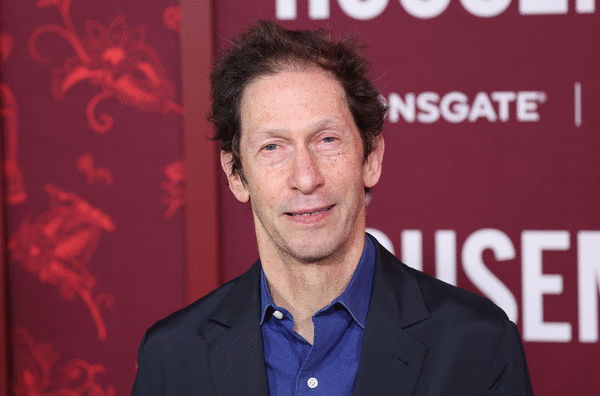


Although he’s found success as a producer, director and writer (more on that in a sec), Tim Blake Nelson might be best known as an actor who steals scenes with his ability to convey depth and complexity in even the – let’s just say it – weirdest secondary characters.
Think dunderheaded Delmar in “O Brother, Where Art Thou?,” cruel Dr. Pendanski in “Holes,” the singing, smiling, sociopathic title character in “The Ballad of Buster Scruggs,” and most recently, ill-fated Dale Washberg in the FX series “The Lowdown.” We could go on – after all, he has more than 100 screen credits to his name.
But in Hollywood, Nelson is also known as an actor so serious about his craft that he asks even big-name directors like the Coen Brothers to see the script before he agrees to take a role – for no other reason than he wants to make sure his thespian skills are up to the demands of the part.
When you understand this, you understand why Nelson says he didn’t even try to write a novel until he felt he had read enough of them to be up to the task.
“I’ve always wanted to write novels, but I didn’t feel I was ready until my 50s,” Nelson says in the upcoming March 20 episode of the virtual program Bookish, produced by the Southern California News Group.
On the program, he will be discussing his writing process for his second novel, “Superhero,” a propulsive read and a wicked satire, that, like his debut novel “City of Blows,” delves into the absurdities of modern filmmaking. But while the first novel was a send-up of indie filmmaking, this one takes on the bloated enterprise of superhero franchises.
“While I was writing plays and screenplays, I mused about writing a novel but never dared try it, just because I didn’t feel I was ready. I hadn’t read enough,” says Nelson, speaking via Zoom from his guitar-and-book-filled home office in Manhattan.
To put his amount of book reading in perspective: He has a bachelor of arts in the classics from Brown University, and then went on to study at Juilliard. But as he tells it, his real literary education started much earlier – at the dining room table of his childhood home in Tulsa, Oklahoma.
“I grew up in a kind of intellectual boot camp, all because my oldest brother received an A on a paper that, when my mother read it, she concluded that he should have received, at best, a C. And that, therefore, we weren’t being taught to write sufficiently,” he recalls. “And this was a really good school in Tulsa, and even that wasn’t good enough for our mother.”
From there on out, says Nelson, he and his siblings were assigned to read books outside of school, “and asked to deliver concise talks, short summaries of them at the table – both in terms of plot and theme.” On top of that, the Nelson children were also assigned five paragraphs a week on the topics of their choice, which were then read by their parents. “There were four of us, so they alternated; each took two a week and would critique the writing. And if you didn’t get a passing grade, then that was one of your paragraphs for the next week, and you had to rewrite it.”
With that kind of hardwiring, no wonder Nelson says, “Personally, when I set out to write a book, I want to pursue that as deeply as possible. I also want to challenge the reader with language.”
That’s important, he believes, because contrary to what we might see in the culture at large (think online memes and such), among people who enjoy reading “there’s a vestige of an appreciation for language” that still exists.
Nelson is quick to point out not only how difficult making a living in the arts is, but how fortunate he is to have had the chance to do it all his life. He says he “never hides” his good fortune.
“I got to go to school until I was 26, and graduated without any debt, which is an incredible, incredible advantage,” he says. “And I’m grateful to have grown up in a family that not only had the wisdom, and I think the smart values in terms of prizing education, but also the means to support our pursuit of it, no matter how far we wanted to go. So I did four years of college, and then four years of actor training.”
He knows that kind of consistent support is rare, yet necessary for any long-term success in the arts.
“I think the difficult aspect of the arts, and this includes writing novels, is that you also need other people to believe in what it is you’re up to,” says Nelson. “You need to get hired as an actor, and certainly as a playwright and a filmmaker; I’ve needed theaters to want to put stuff on, and financiers to want to put money into the movies.”
As a playwright, his works include “Eye of God,” “The Grey Zone” and “Anadarko.” He also directed film versions of two of his plays, as well as the 2001 film “O,” a modern-day retelling of Shakespeare’s “Othello.”
“I’ve been very blessed to find the people who’d wanted to hire me and support the work – and in terms of the novels, it’s not a big-money game so much anymore for contemporary fiction and literature, which is the pool in which I’m really trying to swim. And so, getting somebody to invest in you and publish your book is also something, and I’m just very grateful for the opportunities I’ve had.”
But even as hard as it is to build a career out of writing books or making movies, Nelson believes that for people who feel the calling, there’s nothing else as satisfying – a theme that shows up in both of his novels. It’s also a lesson he’s imparted to his son, Henry, with whom he collaborated to make the 2023 film “Asleep in My Palm.”
“I used to bring him onto sets when he was growing up, and then he started to crew on movies on which I worked, so he really worked his way up,” says Nelson, who remembers telling Henry, “One thing I can say about movie sets, more than any other work environment I’ve encountered, is that pretty much everyone you see is exactly where they want to be. They’re living the life that they want to live. And it is very self-selective in that way, because there’s not a lot of glamour in making movies.”
Well, there is glamour for certain people in the movie-making business, but it comes with a lot of complications, as his novel “Superhero” astutely details.
“But for most, for 98% of the people working on a movie, they’re very long days,” Nelson says. “The work is tedious … you’re putting up with a lot during those 12-, and for many of the crew, 14- to 16-hour days. And so the people who end up on movie sets doing that work really want to be there.”
In the end, Nelson says you have to “really love the process, in spite of all the other stuff.”
“Superhero” sits at the intersection of Nelson’s love both of movies and of novels: “Every story, everything that happens in the novel, is something I either experienced myself, or heard tell from a very reliable source who experienced it. Even though it has satirical elements, and maybe a little bit of exaggeration, it’s as true a book about the making of movies as I know how to write at this particular moment.”
©2026 MediaNews Group, Inc. Visit ocregister.com. Distributed by Tribune Content Agency, LLC.







Comments