Two Salvadoran soldiers killed, two hurt in Haiti explosion
Published in News & Features
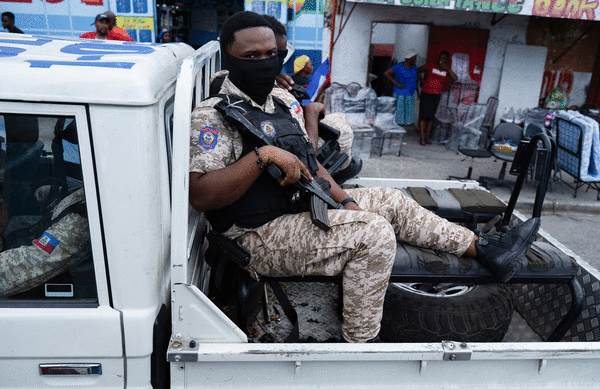
Two Salvadoran soldiers were killed on Friday and two more were injured in Haiti in the first casualties since El Salvador President Nayib Bukele deployed 2,500 troops in an unprecedented military buildup in the Caribbean nation.
The incident resulted from an explosion, the Armed Forces of El Salvador said in a post on X, confirming the deaths and injuries.
“We regret to report that four Salvadoran personnel deployed to Haiti were affected by an explosion while working with explosive material at one of the camps,” the El Salvador Armed Forces said. “Two lost their lives and the other two were injured. The latter are receiving medical care.”
The circumstances remain unclear, including whether the incident occurred at the national stadium near downtown Port-au-Prince, where Salvadoran forces have been stationed since last week, or further north at the Toussaint Louverture International Airport in Tabarre, where the sound of an explosion was also heard.
Since last month’s arrival of the Salvadoran troops, who report to their own command in Port-au-Prince, Haitians have seen an intensification of anti-gang security operations — especially those using explosive drones.
With operations increasingly targeting gangs’ strongholds, some of the country’s most powerful gang leaders have been forced to abandon their territories and seek refuge in territories controlled by other armed groups. One such area is Carrefour, the sprawling suburb at the southern edge of Port-au-Prince.
To get there, gang leaders often travel along National Road 2 and transit through Martissant, a strategic corridor that has been under gang control since June 2021 when the Grand-Ravine and Village-de-Dieu gangs attacked the Ti-Bois gang.
On Thursday, residents in Martissant and other nearby neighborhoods reported hearing heavy gunfire and explosive drones. Haiti National Police soon posted a video on X showing officers conducting an operation in the area. They announced that at least 34 suspected gang members had been killed. It was the first major police operation since the community fell under gang control.
The operation was carried out by the Haitian police task force that uses explosive drones and receives support from private contractors working for Vectus Global, a company founded by former U.S. Navy SEAL and Blackwater founder Erik Prince. The task force is run out of the prime minister’s office and operates separately from a United Nations-authorized Gang Suppression Force that is backed by Washington.
The day before the Martissant operation, Bukele posted his own video on X accompanied by an announcement that his forces in Haiti had demolished the lavish mansion of a powerful gang leader, Jeff Larose — known as Jeff Canaan, Jeff Gwo Lwa and Taliban— on the northern edge of Port-au-Prince.
Friday’s explosion marks the second major incident involving Salvadoran forces deployed to Haiti by the Central American country. Four aviation technicians deployed under the Washington-backed, United Nations-authorized Gang Suppression Force remain unaccounted for after they were ambushed by armed gangs outside the capital on Oct 18.
The men were returning to camp from a supermarket in Santo, Croix-des-Bouquets, when they were surrounded by members of the Chen Mechan gang, which received back up from another armed group, 400 Mawozo. The ambush prompted Bukele to deploy troops to Haiti, the vast majority of whom are operating outside the command structure of the GSF and the U.N. Haiti Support Office set up to provide logistical support to the international forces.
On social media, Bukele boasted about deploying “attack” helicopters to Haiti to aid in what he described as a search-and-rescue mission for his four missing technicians.
Although the extent of his equipment remains unknown, he has also shown the use of robotic dogs armed with automatic rifles in a video showing his troops inside the Sylvio Cator stadium after Haitian police, with the help of the task force, reclaimed the facility from gangs and turned it over to the Salvadoran forces to secure.
These images, along with the troops’ presence, have helped fueled concerns among human rights advocates that amid the fight to root out criminal gangs and reclaim territory from their tightened grip, Haiti is increasingly becoming a testing ground for new security models of intervention outside international law.
Human rights observers for example, regard the deadly drone strikes, which have led to the deaths of not just suspected gang members — including the head of the “Boston” gang, Mathias Saintil — but also civilians, as extrajudicial killings in violation of international human rights law.
On Thursday, as the U.S. Senate Foreign Relations Committee heard testimony from President Donald Trump’s new nominee to be ambassador to Haiti, Austin Holmes of Florida, Sen. Tim Kaine, D-Va., raised concerns about ensuring that U.S. support for the Gang Suppression Force doesn’t enable or lend legitimacy to private actors that may not be following standards the U.S. finds appropriate.
Holmes said he was committed to supporting “the coordination, transparency and accountability of all actors, including ensuring that they’re following the law of armed conflict and that those civilian protections are in place.”
Holmes owned his own private security company, which he told the committee was dissolved earlier this year.
_____
©2026 Miami Herald. Visit miamiherald.com. Distributed by Tribune Content Agency, LLC.






Comments