South Carolina parole board unanimously denies Susan Smith's request for release
Published in News & Features


COLUMBIA, S.C. — Susan Smith begged for a chance at a new life where she could do good.
“I know what I did to Michael and Alex was horrible,” she told six members of the S.C. Board of Paroles and Pardons at a parole hearing on Thursday. She said she was sorry, remorseful and is not now the person she was. “I just want to do good and give back.”
Smith, 55, continued, “They were infant children. They did not deserve to die.”
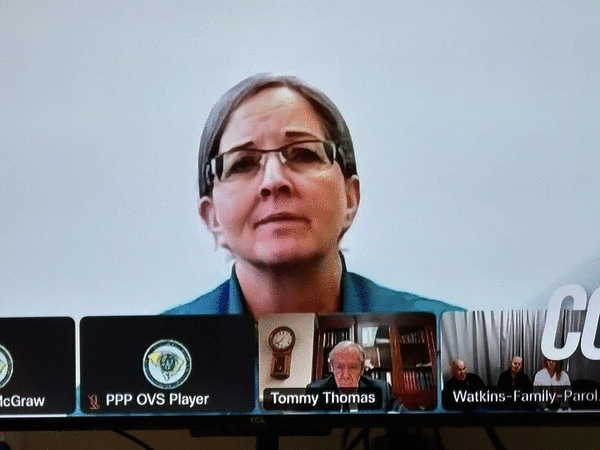
She spoke from Leath Correctional Institution in the Upstate with her head and shoulders image appearing on a flat screen video in the third floor Parole boardroom.
Minutes after Smith spoke, her husband David Smith appeared in person before the board.
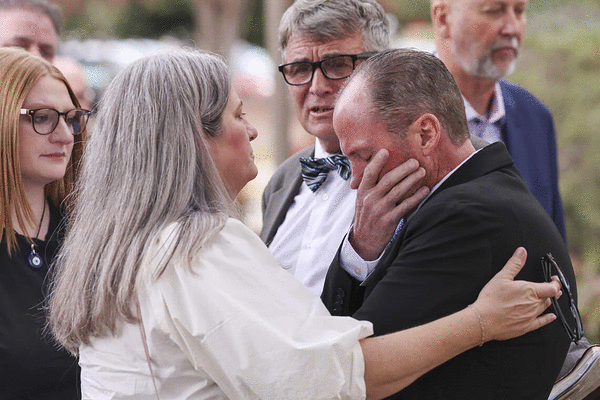
“Please don’t grant her parole, please,” he pleaded, telling the board his ex-wife “deliberately” killed their two children, Michael, 3, and Alex, 14 months.
“It’s been 32 years since I buried Michael and Alex. Thirty-two years is a long time. But for me, it’s yesterday.”
At the end of the hourlong hearing, where emotionally-charged testimony was given by more than a dozen witnesses on both sides, it took the board less than two minutes to reach a decision on one of South Carolina’s most horrific crimes in the modern era: Smith’s 1994 deliberate drowning of two children strapped into a car that then rolled into the dark waters of a Union County lake.
“Susan Smith will be denied parole. The vote is unanimous,” announced board chair Mollie DuPriest Taylor, who tallied the votes.
At the end of Thursday’s hearing, Taylor indicated that future sympathies of the board will be with Smith’s husband and others who suffered from Michael and Alex’s deaths.
“We are so sorry you have to endure this every two years,” Taylor told David Smith.
In 1995, after a trial in which prosecutors sought the death penalty, Smith was given two life sentences for killing her children. At that time, South Carolina convicted killers who received life sentences were eligible for parole after 30 years. Under current law, a life sentence means life without possibility of parole.
These days, convicted killers serving life sentences for murder under the old law can seek parole every two years. She was denied parole two years ago.
During the hearing, Rep. Tommy Pope, R-York, who was one of Smith’s prosecutors at the 1995 trial, told the board that he will explore introducing legislation in the S.C. General Assembly to change the law so that someone like Smith cannot seek parole as frequently as every two years. Pope is Speaker Pro Tem, or the number two ranking majority member in the House.
“She needs to stay there the rest of her life,” Pope told the board.
Under the old law, jurors were not told that convicted killers given life sentences would be eligible for parole after serving 30 years, Pope said.
Here’s what they said
Smith’s lawyer told board members that she had “lost touch with reality” at the time she strapped Michael and Alex into car seats and let the vehicle roll into the lake.
“She didn’t understand she would never see her children again, she didn’t understand the finality of what was going on,” Thomas says. “She said, ‘I thought Jesus could take better care of them than I could.’”
A “perfect storm” of traumatic events in Smith’s life, including years of molestation by her now-deceased stepfather, caused her to be in such a distressed mental state that she allowed the car with her children in it to roll into the lake, Thomas said.
In recent years, Smith has completed all kinds of mental health-related programs in prison and if released, she can do good helping raise peoples’ consciousness about mental issues, Thomas said. She already is helping her fellow inmates, Thomas said.
“She is trying to make things better for folks,” Thomas said.
Dr. Jessie Hill, a forensic psychiatrist who has spent time with Smith, told the board that the suicide of her beloved father when she was a child was devastating to the development of her character and she suffered bouts of depression along with a “borderline personality disorder.” She came to think “the world was not safe for her children,” Hill said.
With changes in medication and growing older, Smith’s mental health condition has improved markedly, Hill said.
Cynthia Stone, a former prison guard who knew Smith before leaving the department in 2016, told board members that Smith made it a point to help other inmates and she was “absolutely remorseful” about what happened to her sons.
“She loved those boys,” Stone said.
Regardless of what Smith does, “she will always carry a sort of prison with her,” Stone said.
Besides David Smith, a half dozen others spoke against his ex-wife’s release.
“Why should she be given the opportunity to walk free,” said Tiffany Smith, David’s wife. “Michael and Alex deserved a lifetime — they never got one.”
Rebecca Smith French, David’s sister, told the board that “In the last two years, we had a sense of peace knowing she would stay behind bars. I can’t fathom the thought of her walking free.”
Addressing Susan Smith, French said, “Okay, so you’re sorry. Don’t ask for parole. Serve your life sentence.”
Kevin Brackett, current 16th Judicial Circuit solicitor, which includes Union County, told the board that he was at the lake when they pulled the car with the two children’s bodies from the waters.
David Smith “is still a ball of grief,” Brackett said.
Brackett predicted that should she be released, Smith will be everywhere on social media, making money in internet ventures that did not exist at the time of the killings.
“She will attempt to capitalize on her fame,” Brackett said. “She will be out there selling the story of Susan Smith.”
The two young boys were not Smith’s only victims, Brackett said.
Other victims include the emotionally wounded dive team that located the bodies and the FBI units that searched nationwide for the boys before Smith confessed some eight days that she had drowned them, Brackett said.
Brackett reminded the board that Smith had told law officers that a Black man had kidnapped her sons, so police were contacting African Americans about the kidnapping, Brackett said.
“The lie she told gave eight days for the country to fall in love with Michael and Alex,” Brackett said, explaining why the case gained such notoriety. “When the truth was revealed, she inflicted grief and damage on everybody who followed this case.”
Officially, Smith’s parole was denied on two bases: the nature and seriousness of the offense, and the indication of violence in the offense, the board has ruled.
The board received a petition with 10,844 signatures from the public opposing Smith’s release and only a handful of letters favoring her release, a spokesman said.
The board met on the first floor of the agency’s offices on Greystone Boulevard outside Columbia. Media covered the proceedings from a separate room by remote video on the agency’s second floor.
One member of the seven-member board, Geraldine Miro of Orangeburg, recused herself from the Smith hearing. She was a staff member in one of the prisons where Smith was housed.
Smith will eligible to seek parole again in 2028.
©2026 The State. Visit at thestate.com. Distributed by Tribune Content Agency, LLC.






Comments