Michigan dam fixes were urged by experts. Lawmakers did 'almost nothing'
Published in News & Features
DETROIT — Before widespread flooding threatened homes and businesses across northern Michigan this spring, lawmakers failed to act for five years on recommendations by a government task force that concluded the state's aging inventory of dams required "immediate attention."
Members of the Michigan Dam Safety Task Force, which released a final report in February 2021, said the Legislature hadn't followed through on the vast majority of the guidance their panel provided. Their report came after the high-profile failures of a pair of dams in central Michigan in 2020.
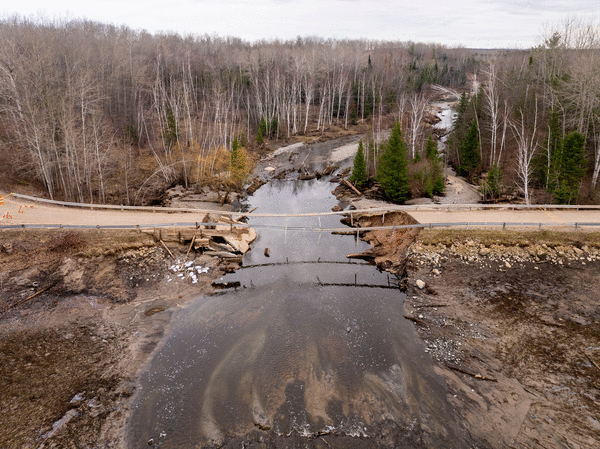
Inaction by Michigan's leaders to safeguard water infrastructure made the state less prepared than it could have been for severe flooding, road washouts and the threats of multiple dams failing this month, past task force members said. The comments came after a privately owned, 94-year-old dam burst Monday in Alcona County, washing away Buck's Pond, a small lake that the structure held back.
"We are in crisis mode all over, partly because of the weather and partly because we did not proactively take the steps to prevent the frequency, occurrence, severity or just the magnitude of how many places we're struggling with at this moment," said Bryan Burroughs, executive director of Trout Unlimited.
Burroughs was on the safety task force with 18 others, including Bill Rustem, who was an adviser to multiple Michigan governors.
"The Legislature has done almost nothing,” Rustem said of the lawmakers' reaction to the 2021 recommendations, which included making a long-term financial investment in reducing risks and ensuring owners have enough money to maintain their dams.
"It’s kinda like you were in a big accident and the Legislature just wants to hand you a Band-Aid," Rustem said.
The task force's 59-page report specifically asked state officials "to take meaningful action to advance all the recommendations."
"The potential human and economic costs of business as usual are far too great to ignore," the report added.
Hundreds of high-hazard dams need nearly $1B in fixes, report says
There are 2,552 dams of different sizes scattered throughout Michigan, according to the Michigan Dam Inventory. Most are small, low-hazard dams, meaning they likely won't cause damage to property or the environment if they fail.
There are 247 dams considered high or significant hazards, meaning they could cause major damage if they were to fail. They need almost $1 billion in spending to bring them up to snuff, according to a 2025 report by the Association of State Dam Safety Officials.
The 2021 task force report said, at that time, more than 80% of Michigan's dams were "older than the nominal 50-year design life."
Unlike some dams in the U.S., those in Michigan are not primarily intended to protect against major floods, Burroughs said. They often hold water in impoundments, but those impoundments are usually kept mostly full. They can hold some additional water during heavy rain or snowmelt, but they can't keep up with major water flows.
That's when dam safety teams have to open gates to let additional water downstream or into emergency spillways, Burroughs said ― one of the moves officials took this past week at the Cheboygan Dam and Lock Complex. Otherwise, water can overtop and damage the dam.
"Then you're not just going to have the (water) coming down because of rain, you're going to have that plus the entire volume of water behind that dam catastrophically causing a wave downstream that would be far worse than the flood waters coming into the dam," Burroughs said.
When Buck's Pond Dam in Alcona County failed, it sent water into Hubbard Lake. The road above the dam washed away. The dam is small and privately owned, but was rated in satisfactory condition during its last inspection in 2017, according to state records.
Although the dam was not at risk of failing, Newaygo County emergency officials on Thursday told residents downstream of Consumers Energy's Croton Dam to evacuate as water levels rose on the Muskegon River.
Michigan Department of Natural Resources workers have been shoring up the Cheboygan Dam all week, where water was mere inches from the top of the structure. Residents were told on Thursday to be ready to evacuate. But on Friday, the U.S. Army Corps of Engineers and Consumers Energy helped the state get the hydroelectric equipment at the dam operating again for the first time in three years, allowing more water to pass through the facility, resulting in an immediate drop in water levels.
Flooding follows warmer climate, more severe weather
The flooding in northern Michigan is setting streamflow records, according to the U.S. Geological Survey's monitoring.
Infrastructure like dams and culverts that pass water under roadways isn't capable of handling that much water, said Jonathan Overpeck, a University of Michigan climate scientist.
Climate change has increased the likelihood of major rain events like the one walloping Michigan this week because warm air holds more water, he said. Climate forecasts say Michigan is likely to see both extended periods of drought and more major dumps of precipitation, with an overall trend toward wetter weather and worse storms.
"When you get the meteorological conditions ripe for storms, you can get more intense storms and more intense precipitation," Overpeck said. "It's all because of the warming, and the warming we know with really high confidence is due to human activities, mainly the burning of fossil fuels. As long as we continue to burn fossil fuels, it will get worse, and warmer and warmer. As it does, the atmosphere will be able to hold more and more moisture.
"What we're seeing now is certainly going to get worse before we stabilize it."
What did and didn't happen after Midland dam failures
Dam safety in Michigan was in the national spotlight after the Edenville and Sanford dams failed in 2020, causing dramatic flooding in downstream Sanford and Midland.
Gov. Gretchen Whitmer's administration created the Dam Safety Task Force following the 2020 Midland-area dam failures. The group's final report included 86 recommendations for improving dams in Michigan, such as helping fund dam improvements and removals, adopting legislation to give dam safety workers more power, and requiring dam owners to prove they are financially capable of maintaining dams.
The Association of State Dam Safety Officials reviewed Michigan dam safety in September 2020 and determined "Michigan has not invested in the safety of its dams for many decades, and the needs have accumulated as the dams have aged." The association said Michigan should increase dam safety staffing, strengthen enforcement, help fund dam safety projects and more.
The Michigan Department of Environment, Great Lakes and Energy has since reshaped its dam safety unit, spokesman Jeff Johnston said. The unit now has nine safety workers and an administrative assistant — far more than the two people working in dam safety when the Edenville and Sanford dams failed nearly six years ago.
The department also has taken a tougher stance on problem dams, Burroughs said, and gives owners less leniency if their dams don't meet safety standards.
That effort wasn't matched by lawmakers. Former Republican state Sen. Rick Outman of Six Lakes introduced a bipartisan bill in 2021 to beef up the state's dam safety law, including increased inspection requirements and requiring dam owners to coordinate with local emergency management officials, keep maintenance records and provide financial assurances for their projects.
The bill didn't gain traction in the Legislature.
Likewise, the safety task force called for a $20 million annual spending commitment in a loan fund for dam improvements, maintenance and removals.
"The task force’s goal is to minimize dam safety risk and provide viable avenues for dam rehabilitation, maintenance or removal," the report said.
But lawmakers only temporarily funded a program to help dam owners pay for maintenance and safety upgrades.
Between 2021 and 2022, they put $56.2 million into the Dam Risk Reduction Grant Program to help bring dams into compliance with state safety standards, improve relationships between state dam safety staff and private dam owners, and protect against the downstream threat posed by aging dams.
The grant program ran for three years from 2022-25. Requests for grants far outstripped the money lawmakers put into the program. The state granted $44.3 million to 56 projects, but received 198 requests totaling $219.7 million.
The grant total was far less than the $400 million in spending over 20 years that the task force envisioned and came as lawmakers directed hundreds of millions of dollars in surplus spending toward other priorities.
"Legislatively, the record shows there has been very, very little action" since the task force released its recommendations, Burroughs said. "Dam safety management statutory reform did not occur."
Dam fixed get 'kicked down the road,' state senator says
Sen. Jon Bumstead, R-North Muskegon, said he wasn't surprised the Legislature had failed to act on many of the 2021 recommendations. Over time, new people get elected, and they forget the past lessons lawmakers learned, he said.
"It’s an issue that we need to get serious about because these dams aren’t getting any younger," Bumstead said.
State Sen. John Damoose, a Harbor Springs Republican whose district includes the flood-stricken Cheboygan County, said the crisis in his district has challenged his "pre-existing assumptions" that the private sector can manage dams capable of damaging property upstream or down if not properly managed.
"I'm a conservative Republican, I believe in private ownership, but I had three of my Democratic colleagues come over (on the Senate floor) and really question the validity of having public infrastructure like this owned by private companies," Damoose said Thursday during a press conference in Cheboygan with Whitmer. "And I couldn't put it back to them. They really made me think, and especially when it's something like this that ... is easily predictable in a lot of ways."
The vast majority of Michigan's dams — 1,916 of 2,552 — are privately owned, according to the state's dam inventory. Most of them are small dams that pose low downstream hazards, and some are owned by county drain commission offices.
Some privately owned dams pose a high or significant downstream threat, such as the Portage Plant Dam, a retired hydropower dam owned by Portage Power Company in Saint Joseph County. The Portage Plant Dam is in poor condition, according to the inventory.
Damoose noted Cheboygan city officials have been trying for years to get the hydroelectric equipment fixed at the Cheboygan River dam.
"It keeps getting kicked down the road, down the road, down the road," Damoose said, "and now we've got a whole community in peril because it was just managed by a certain private corporation."
State Rep. Bill Schuette, R-Midland, introduced a dam safety proposal in January that was referred to the state House Natural Resources and Tourism committee.
Schuette said he expects a hearing on the bill to take place in the coming weeks.
“I think you’re going to see a significant step toward investments,” Schuette said of Michigan's water infrastructure.
DNR owns hundreds of dams, but got $51M over 5 years for upgrades
The Michigan Department of Natural Resources manages 201 dams, department spokesman Ed Golder said. The DNR built many of them to create recreational opportunities, create floodings for wildlife or prevent invasive sea lamprey from moving upstream. The DNR acquired some of its dams for the same purposes, Golder said.
The department has spent $51 million on its dams in the last five years. Whitmer requested $15 million from the state general fund for DNR dam costs in 2025, but the department received $1.45 million from the general fund and $2.5 million from the Game and Fish Protection funds in the final budget, Golder said.
"We continue to seek sources for additional funding for department-managed dams," he said.
Director Scott Bowen criticized the Legislature's approach to funding state dams at the March 11 Natural Resources Committee meeting.
"We keep getting 'no,'" Bowen said. "We just have to have an honest conversation with serious people about what we're going to do with these dams."
Bowen was responding to a presentation from critics of Consumers Energy's plan to sell its 13 hydropower dams to a Maryland private equity firm for $13. He said he predicts those dams will eventually fall into state ownership. He said the bigger dams will have "bigger problems."
The DNR has intervened in the sale proceeding before the Michigan Public Service Commission.
Executives from Consumers and Confluence Hydro, the potential buyer, pitched their dam sale plan to the Natural Resources Commission on April 8. Consumers Energy executives said the move would offload future operating and maintenance costs to the private firm, while a Confluence executive said the company planned to use the revenues from Consumers Energy's purchase of power to invest in the dams and operate them.
©2026 The Detroit News. Visit detroitnews.com. Distributed by Tribune Content Agency, LLC.






Comments