Trump administration to offer more leases for drilling in Arctic refuge
Published in News & Features
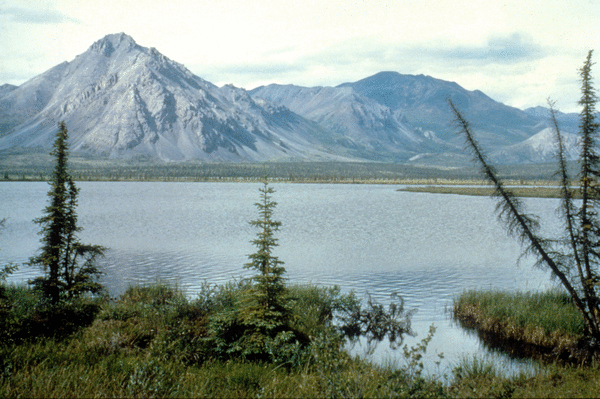
The Trump administration will soon offer leases to oil and gas companies in the Arctic National Wildlife Refuge, angering critics who say efforts to drill there will face court challenges.
The Bureau of Land Management said in a statement Friday that it will sell leases for tracts in the refuge’s 1.6-million-acre coastal plain. The bids for the leases will be opened in June.
The plans comes on the heels of another recent lease sale, in the National Petroleum Reserve-Alaska to the west of the refuge, that drew heavy interest from oil companies. That sale raises questions about how much bidding might occur in the refuge.
The agency did not say what tracts in the coastal plain, located along the U.S. Arctic Ocean, will be available for bidding.
A sale notice will be published in the Federal Register on Monday, the agency said. Sealed bids must be received by June 3, it said.
“The record-breaking success of last month’s lease sale in Alaska’s National Petroleum Reserve sent a clear signal: There is robust and continuing demand for Alaskan energy, underscoring the need for more opportunities like the Coastal Plain sale," Bill Groffy, acting director of BLM, said in the statement.
Alaska’s top political leaders, and many Alaskans, have wanted to see drilling in the refuge for decades. Voice of the Arctic Iñupiat, a group representing Iñupiaq leadership on the North Slope where the refuge is located, has also expressed support for development there.
But it wasn’t until 2017 that a Republican Congress and President Donald Trump passed the Tax Cut and Jobs Act requiring lease sales.
Conservation groups and the Gwich’in people, who hunt the refuge’s declining caribou, had long argued that oil and gas activity would threaten subsistence hunting, wildlife such as polar bears, and the environment.
“We condemn these efforts by the Trump administration to exploit the calving grounds of the Porcupine Caribou herd for short-term gain, and we know that the majority of Americans stand beside us in opposing development in this cherished and irreplaceable landscape,” said Kristen Moreland, executive director of the Gwich’in Steering Committee, in a statement Friday.
Two previous lease sales in the refuge, in 2021 and 2025, attracted little to no bidding, amid statements from banks that they would not finance activity there.
The lone lease-holder is the Alaska Industrial Development and Export Authority, a state agency that purchased seven 10-year leases, covering 365,000 acres, in the first sale.
The agency, which hopes to team up with companies to explore the area for oil, says it has spent $13 million on the leases.
That’s well below the Congressional Budget Office projection that the sales would yield more than $1 billion in federal revenues over a decade to help offset the 2017 law’s tax cuts.
But the refuge could be the subject of new attention in the upcoming sale, at a time when the U.S. war on Iran has boosted oil prices and led to shipping concerns in the Middle East.
The oil industry is increasingly eyeing prospects outside the refuge.
A federal geologist familiar with Alaska’s North Slope says the refuge could host underground formations that are similar to those that sparked the industry’s interest in the petroleum reserve.
Elizabeth Manning, a spokesperson with Earthjustice, said in an email Friday that any new leases will be subject to a lawsuit brought by Natural Resources Defense Council, Center for Biological Diversity and Friends of the Earth.
The lawsuit challenges the Trump administration’s decision last fall that puts the full coastal plain on the table for potential leasing.
“A reckless few should not be allowed to destroy this sacred place to line the pockets of oil companies and billionaires,” said Hannah Foster, Earthjustice attorney.
_____
©2026 Anchorage Daily News. Visit at adn.com. Distributed by Tribune Content Agency, LLC.






Comments