'The children lose': Catholic leaders say Trump shelter closure will scar migrant kids
Published in News & Features
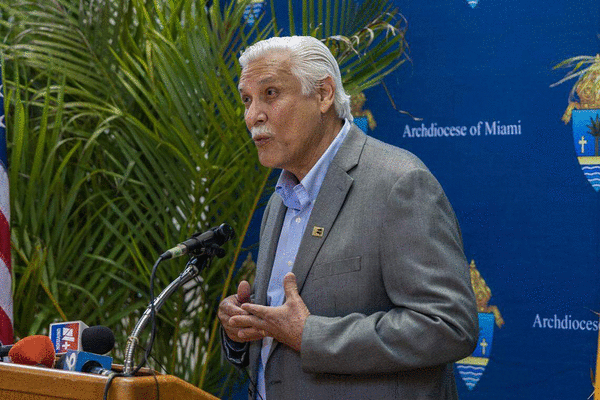
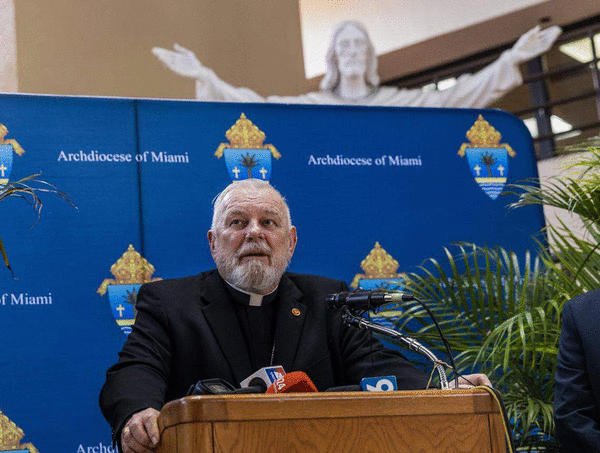
The Trump administration’s decision to shut down a refuge run by the Catholic Church in Miami for migrant children who come to the U.S. alone will traumatize kids who have already experienced extreme hardship on their journeys here, Catholic leaders said on Thursday
During a press conference, Miami Archbishop Thomas Wenski and Catholic Charities CEO Pedro Routsis-Arroyo asked the federal government to reconsider its decision to abruptly end an $11 million contract that funds the at the Archdiocese of Miami’s unaccompanied minors program — the longest-running of its kind in the country.
“You don’t cross several borders, you don’t walk across Mexico if you are 10 or 12 years old without being exposed and suffering trauma of one type or the other,” Wenski said.
They emphasized the impact that the closure of Msgr. Bryan Walsh Children’s Village, formerly known as Boystown, would have on its current residents — children fleeing poverty and conflict across the world. The kids will remain in the custody of the Office of Refugee Resettlement, an agency within the U.S. Department of Health and Human Services, which will relocate them to other shelter programs that remain funded.
The instability will likely result in more trauma for the children, Routsis-Arroyo said: “Who loses? The children lose. The government loses.”
The federal government notified Catholic Charities in late March that it would end the organization’s program to house unaccompanied minors, which spans nearly seven decades, back to the arrival of more than 14,000 unaccompanied Cuban children to the United States in the 1960s as part of Operation Pedro Pan. The Trump administration says the decision responds to a dramatic decline in the population of unaccompanied kids in their care, who are first processed by the Department of Homeland Security before ending up in refugee-resettlement custody.
In an April 2 letter to the Office of Refugee Resettlement, Routsis-Arroyo called the unaccompanied minor shelter a “core program” and said the contract represents over a quarter of Catholic Charities’ total annual budget. He described how the residential facility Catholic Charities runs has long been a model for other programs of its kind. The Office of Refugee Resettlement has previously asked the church to train other organizations and received visits from agency leaders, who have praised the program as a blueprint for unaccompanied minor programs.
“Consistent with the Gospel, Matthew 25:35, ‘For I was hungry and you gave me food, I was thirsty and you gave me drink, I was a stranger and you welcomed me,’ Catholic Charities wishes to continue to operate this program and looks forward to the opportunity to continue to serve this vulnerable population,” Routsis-Arroyo said.
As many as 112 people will lose their jobs due to the contract’s termination, Routsis-Arroyo wrote, which will also affect Catholic Charities’ ability to run their other programs, which include adult daycare centers, substance-abuse programs and affordable housing.
Children will suffer
Thousands of children have been helped by Catholic Charities through the Children’s Village program, which has provided legal services, educational services, psychological and medical care. It also helps locate appropriate sponsors, such as relatives and parents, once in the United States.
“We don’t feel there’s anyone who can provide the compassionate and quality services that we can … and we still don’t understand why we were not funded going forward,” Routsis-Arroyo said.
The Archdiocese is asking the federal government to reverse its decision and reinstate funding — an action that’s gained support from at least two members of Congress from Miami-Dade. U.S. Reps. Maria Elvira Salazar and Carlos Gimenez wrote to the U.S. Administration for Children and Families and the Office of Refugee Resettlement asking leaders to reinstate the contract.
Otherwise, the children are the ones who will suffer the consequences, Wenski said, especially those who are still navigating a legal system in a language that is not their own and that many adult immigrants consider nearly impossible to understand.
“All these children have difficult journeys ahead of them. Some of them do not have a determined legal status and so some of them still are subject to possibly being deported,” Wenski said.
Routsis-Arroyo and Wenski acknowledged that social and political circumstances in the Caribbean and Latin America have driven massive migration to the United States in recent years. There has been instability in the region as a result of a more-aggressive foreign policy by the United States. In January, the Trump administration conducted a military operation in Caracas that forced leader Nicolas Maduro out of power. In recent months, the administration has blockaded Cuba’s oil supply at a time the island is undergoing a profound humanitarian crisis. Trump himself has hinted that Cuba’s government could be the next to fall.
“It would be prudent to be prepared to protect the best interests of children that might arrive here,” said Wenski. “We live near areas that are very unsettled. And as we’ve experienced in the last 60 years, there are different times we have waves of migrants. If the government does away with our program, it would be hard-pressed to replicate it in the future.”
Pedro Pan kids
The Catholic Church has a long tradition of taking care of unaccompanied children who came to the United States alone. The modern version of the program has its roots in Operation Pedro Pan, in which Miami Msgr. Bryan Walsh worked in coordination with the federal government to bring about 14,000 children from Cuba in the aftermath of Fidel Castro’s communist revolution. About half ended up in the care of the Catholic Church.
Many Pedro Pan kids became important community leaders in South Florida and went on to become doctors, businessmen, academics, teachers, local officials and more. On Thursday at the Archdiocese of Miami, two former unaccompanied minors who fled Cuba in the 1960s through the secretive airlift shared their stories.
“Catholic Charities gave us the jump start we needed to proceed to become productive members of society,” said Graciela Anrrich. She came to the United States in 1961 with a younger sister. The siblings spent three weeks at a refugee camp in Kendall before being relocated to Syracuse, New York. There, they were taken in by an American family that she said treated them as their own children. “We are still in touch with them,” said Anrichh, who went on to study at Georgetown University and earned a doctorate. A retired professor, she teaches part-time at St. John Vianney College Seminary in Miami.
Javier Llorens arrived at age 11 with an older brother. He spent five years at a refugee camp, a chapter of his life that despite experiencing family separation he remembers with warmth. Catholic Charities took him and his brother on excursions to the Everglades, Vizcaya and all over South Florida, he said. The children were split up into small groups, cared for by “house parents,” said Llorens. There, he met Walsh, and later went on to become a dentist — even counting the monsignor among his patients.
“He was always taking care of the children. He was an amazing icon of a man,” said Llorens.
But now, Walsh’s legacy — which has survived multiple presidencies and migration waves — is coming undone.
“The city of Miami loses one of the most important parts of its history, Operation Pedro Pan and the program that took them all in,” Routsis-Arroyo said.
_____
This story was produced with financial support from Trish and Dan Bell and donors in South Florida’s Jewish and Muslim communities, including Khalid and Diana Mirza and the Mohsin and Fauzia Jaffer Foundation, in partnership with Journalism Funding Partners. The Miami Herald maintains full editorial control of this work.
_____
©2026 Miami Herald. Visit miamiherald.com. Distributed by Tribune Content Agency, LLC.




Comments