Boston Mayor Michelle Wu's Mass and Cass summer plan emphasizes treatment diversion over crime crackdown
Published in News & Features
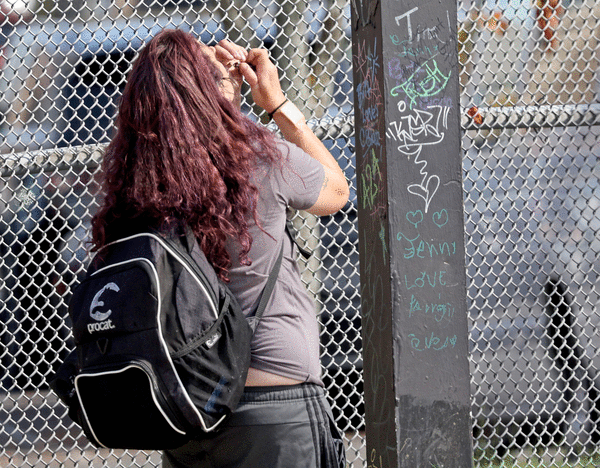
BOSTON — Boston Mayor Michelle Wu’s warm-weather plan for tackling the open-air drug market and related crime at Mass and Cass puts a heavy focus on diverting drug users breaking the law into addiction treatment programs.
The plan was laid out by the mayor’s coordinated response team Monday in a memo filed with the City Council. It calls for expansion of the Boston Police Department’s new Neighborhood Engagement Safety Team, or NEST, strategy citywide to “enhance diversion and co-response efforts on the ground.”
The memo states that the coordinated response team and NEST diversion model will “be the primary frontline engagement strategy” this year, as the city aims to curb the crowding and chaos that is seen each summer at and around Melnea Cass Boulevard and Massachusetts Avenue, commonly referred to as Mass and Cass.
“In the warm-weather season of 2026, the CRT/NEST diversion model will lead on-the-ground proactive outreach, ensuring that individuals engaged in unlawful conduct are not permitted to remain in the area and are directed into treatment pathways,” the city memo states.
The memo states that CRT and NEST began the city’s warm-weather initiative for Mass and Cass on March 30. Since that time, the coordinated response team has engaged with more than 200 people in the area, and diverted 125 “into a recovery pathway” for addiction.
“This initiative aligned additional BPD resources under NEST’s leadership, alongside coordinated support from State Police and Transit Police partners from the MBTA,” the memo states. “This cross-sector initiative works across two shifts, alongside CRT recovery specialists, and is producing measurable results on our city streets.”
The police department’s new NEST initiative launched by the Wu administration last September, as part of the mayor’s shift in approach for Mass and Cass that is aimed at ending outdoor congregate drug use.
This week’s memo states that the BPD initiative will be expanded and deployed citywide this year “to support CRT-led diversion, enhance quality of life, strengthen community-focused policing, and respond to community feedback.”
Since March 30, NEST has supported the city’s coordinated response team in engaging more than 160 people and directing 90 people into recovery, the memo states.
The NEST deployment expansion will target “designated impact zones,” for Mass and Cass, the memo states, likely referring to hot-spot spillover neighborhoods that have been identified in the past as the South End, Nubian Square in Roxbury, and Andrew Square in South Boston, among other areas.
“The BPD will supplement dedicated (Street Outreach Unit) deployments by expanding training in the NEST strategy for officers in districts throughout Boston, ensuring more consistent, neighborhood-based application of NEST/CRT practices across the city, fostering sustained community engagement, trust, and improved public safety and quality of life outcomes,” the memo states.
The mayor rolled out her warm-weather approach for Mass and Cass after announcing last Thursday that the state House of Representatives budget for next fiscal year will include $4 million to fund various city and state initiatives aimed at tackling homelessness, addiction, and related crime in the troubled area.
The funding is aimed at supporting a three-pronged plan put forward by a South End, Roxbury, and Newmarket community working group in February that focuses on getting addicts off the streets, out of jail, and into recovery to avoid the chaos and crowding that worsens there each summer.
House Ways and Means Chair Aaron Michlewitz, an ally of the mayor who joined her for the announcement, said that while the funding was guaranteed in this week’s House Ways and Means budget, it wasn’t necessarily a lock to make it into the Senate or final state budget.
“We’ll see where it goes as far as the funding process,” Michlewitz said, in response to whether he anticipated support from the Senate for his proposal.
The open-air drug use, dealing and related crime that has long plagued Mass and Cass and surrounding neighborhoods has worsened in the past several summers, officials have said, leading to a shift in the city’s response to the problem.
Wu said last Thursday that the city’s “sustained and coordinated effort grounded in public health, safety, and accountability” has led to “meaningful progress toward the goal of ending outdoor drug use in our neighborhoods.”
The mayor said violent crime at Mass and Cass is down 33% year-to-date compared to last year, and quality-of-life service calls are down 20%. Violent crime decreased 7%, property crime fell by 6%, and arrests increased by 54% for 2025 compared to 2024.
“As Boston enters the warm weather season of 2026,” the city memo states, “residents, businesses, health providers, and partners in government continue to work with the city to address the serious impacts on public safety, public health, quality of life, and business sustainability stemming from outdoor substance use and addiction.”
------------
©2026 MediaNews Group, Inc. Visit at bostonherald.com. Distributed by Tribune Content Agency, LLC.






Comments