Zelenskyy's top aide sees Ukraine nearing a deal with putin
Published in News & Features
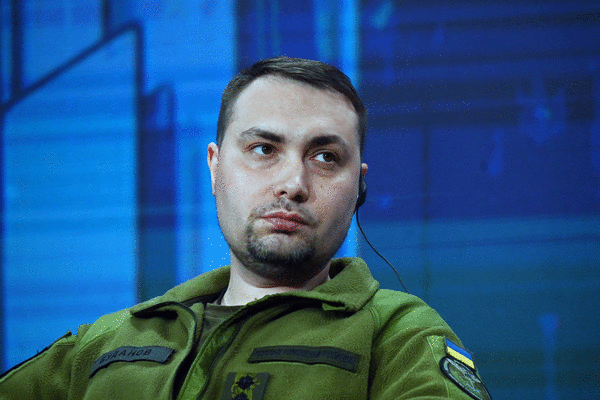
Ukraine’s top negotiator with Russia said he sees progress toward a potential peace deal with the Kremlin, adding that a resolution to the war may not take long to achieve.
While negotiations to end Europe’s bloodiest conflict since World War II have publicly yielded few results, Kyrylo Budanov expressed optimism that the talks are evolving toward a settlement. Ukraine’s former top military spy said he believes Russia also wants to stop the war.
“They all understand the war needs to end. That’s why they are negotiating,” Budanov said in an April 4 interview with Bloomberg. “I don’t think it will be long.”
Budanov earned a reputation for plotting and sometimes leading daring raids on Russian forces as head of Ukraine’s military intelligence from 2020 until January this year, when President Volodymyr Zelenskyy appointed him as chief of his presidential office. He’s a key figure in Ukraine’s negotiating team in three-way talks with the U.S. and Russia aimed at bringing an end to the war that’s now in its fifth year.
He also plays a leading role in overseeing prisoner exchanges with Russia that have brought hundreds of Ukrainians home from captivity. While he has moved to civilian administration, Budanov retains his army rank as a lieutenant general, giving him a rare perspective on the political and military challenges facing Ukraine.
Ukraine dollar bonds extended their rally, rising the most in emerging markets on Friday. The country’s debt security due in 2034 rose almost 4 cents on the dollar to around 62 cents, the highest in a month.
German bonds pared declines to leave 10-year yields three basis points higher at 3.02% after the comments from Ukraine. Money markets also trimmed wagers on European Central Bank interest-rate hikes, but continue to see between two and three quarter-point increases this year. The euro pared earlier losses on the news, jumping to the day’s high of $1.1711.
“Clearly the end of the war in Ukraine would be a positive driver for the euro and the confirmation of the end of the war would provide tailwind to the common currency,” said Roberto Cobo Garcia, head of G-10 FX strategy at BBVA in Madrid.
Budanov acknowledged that both sides have maintained “maximalist” positions in the U.S.-mediated negotiations so far, but said he believes they’ll move closer together in the search for a compromise.
Russia has a clear incentive to reach a deal, he said. “Unlike us, they are spending their own money,” Budanov said. “These are enormous sums — already in the trillions.”
Still, he declined to say how a possible compromise would look like on territory, the thorniest issue at the talks.
“No final decision has been made yet,” he said. “But, in principle, everyone now clearly understands the limits of what is acceptable. That’s enormous progress.”
Budanov stood out with Ukrainians in the early years of the full-scale invasion for his notably optimistic forecasts about the course of the war.
His upbeat assessment now about the state of negotiations doesn’t appear to be shared by some Russian officials at least.
There’s been little real progress in the negotiations, with discussions largely stalled over security guarantees for Kyiv, two people close to the Kremlin said, declining to be identified as the talks aren’t public. Resolving the conflict would require broader agreement beyond Moscow and Kyiv involving the U.S. and Europe, though their leaders aren’t aligned on how the war should end, according to the people.
The only tangible outcome of the talks this year is that both sides have outlined positions unacceptable to the other, one of the people said.
The two sides offered a brief respite from the conflict to mark the Orthodox Easter this weekend. Russian President Vladimir Putin late on Thursday ordered his forces to halt combat operations from 4 p.m. on April 11 in a ceasefire that will run through April 12. Zelenskyy, who had earlier proposed an Easter truce, said Ukrainian forces would “mirror” the actions of Russia’s military.
Budanov argued that a key achievement of the peace negotiations was keeping U.S. President Donald Trump’s administration engaged as a mediator. He said Ukraine expects the top White House envoys at the talks, Steve Witkoff and Jared Kushner, to lead a U.S. delegation to Kyiv, possibly next week, in what would be their first visit to Ukraine of the war.
A visit to Kyiv has been discussed but the White House hasn’t scheduled a date for it so far, according to a U.S. official with knowledge of the matter, speaking on condition of anonymity.
Ukraine is seeking clarity on the nature of U.S. security assurances to prevent future Russian aggression as part of any deal to end the war. That’s likely to be a key issue at talks with the envoys.
Putin wants Ukraine to withdraw troops from the Donetsk region in the nation’s east, including from areas that Russian forces have never controlled in fighting going back to 2014. Ukraine argues for halting the conflict along the current front line, while the U.S. has proposed establishing a so-called free economic zone there.
Ukraine remains heavily reliant on military and financial aid from its foreign allies, led by the European Union, and risks running out of money in the next two months unless vital funding can be unlocked. It has yet to receive the first disbursement of a promised €90 billion in E.U. financing following a veto by Hungarian Prime Minister Viktor Orban, and hasn’t implemented all the commitments required by the International Monetary Fund to release further aid.
Russia’s economy faces growing strain with a widening budget deficit amid massive spending on the military and to aid businesses affected by western sanctions. The surge in global oil prices in response to the U.S.-Israeli war in Iran has given Putin a financial windfall that may ease some of the pressures of funding the war.
The benefit may be short-lived as the war in Iran may end soon, according to Budanov. There are signs of de-escalation in the Middle East, including a two-week ceasefire agreed by the U.S. and Tehran.
Budanov acknowledged that Russia isn’t facing any lack of troops and he said it can mobilize a potential reserve of 23.5 million if needed. That’s far beyond anything Ukraine can muster as it wrestles with its own shortages of soldiers.
“That’s an estimate from when I was head of military intelligence, based on a report prepared toward the end of 2025 on Russia’s mobilization capacity for Putin,” Budanov said. “I read it in the original. No, there are no problems — and there won’t be any in the coming years.”
Even so, Russia’s manpower advantage isn’t translating into real battlefield gains as Ukraine resorts to innovation in drone warfare to maintain a balance of forces. Ukrainian troops have carried out several effective operations this year.
Asked what happens if the negotiations with Russia fail to reach a deal that ends the war, Budanov was frank.
“Do you think there is some kind of magic wand?” he said. “There are only two options — war or peace. Not just continuing the war, but continuing negotiations. If they agree to that — because they might not.”
---------
—With assistance from Kate Sullivan, James Hirai, Naomi Tajitsu and Peter Laca.
©2026 Bloomberg L.P. Visit bloomberg.com. Distributed by Tribune Content Agency, LLC.






Comments