Maryland budget 'nibbles' at affordability concerns, economists say
Published in News & Features
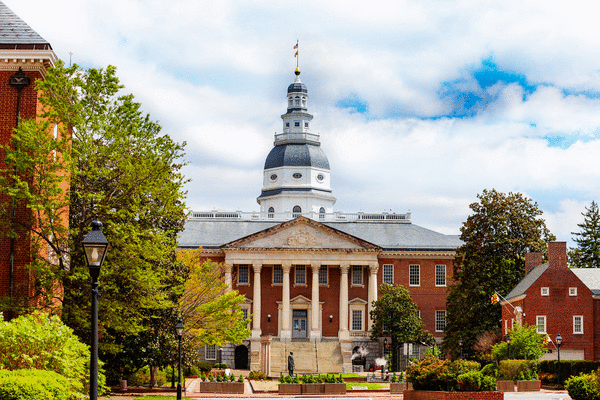
Maryland leaders pledged to lower costs through the state budget, but economists say affordability isn’t actually easing for Marylanders.
When the cost of living is affordable, research shows, household income is equal to or greater than the price of essentials such as groceries, energy and housing. Economists noted that while budget funds address poverty by financing housing vouchers, for example, that doesn’t go far enough to alleviate widespread affordability concerns. Looking to the future, economists added, pressure on Marylanders’ pockets can only be softened when the state eases on how much it taxes households while also pumping revenue into the state.
“(The budget) kind of nibbles at the edges, but perhaps doesn’t provide a full solution,” Daraius Irani, vice president of business and public engagement at Towson University, said. “I think the only thing one could say is: (with) this budget, we didn’t see an increase in taxes, so that keeps Maryland affordable.”
But, Irani added, projected budget shortfalls in the next four years could also bring bad news for Marylanders’ pockets: potential tax increases. A shortfall is when the state doesn’t have enough funds to cover its projected expenses.
Kali Schumitz, vice president of external relations at the Maryland Center of Economic Policy, noted that not enough money is coming in to give the state a softer landing when future shortfalls hit. “It’s lost a lot in the conversations about public spending that the bulk of public spending goes to hire people to do a lot of different things to serve our community, and if we’re pulling that back, that does hurt our economy,” Schumitz said, rreferring to how the state may have to cut funds to some it’s programs to make sure its spending keeps up with how much money it’s bringing in.
Gov. Wes Moore, Senate President Bill Ferguson, and House Speaker Joseline Peña-Melnyk did not return requests for comment.
Schumitz said that the state budget provides tax cuts to businesses by increasing how much they can deduct from their private research and development spending. The cuts mirror the President Donald Trump administration’s guidelines on deducting business interest and allowing small manufacturing businesses to claim more money for office equipment, vehicles and machinery on their tax returns.
“We are in this budget effectively giving tax breaks to corporations and wealthy investors that are worth hundreds of millions of dollars, which could have been set aside to address the deficit for next year, or could have gone in to do more on some of those programs that help with affordability,” Schumitz said.
These tax cuts came from Moore’s proposal to adopt tax provisions in Trump’s “One, Big, Beautiful Bill,” which the president signed into federal law in 2025. States can independently write their own tax policy, but in certain cases, they can choose to conform to federal approaches — meaning that when Maryland adopts tax cuts authorized at the federal level, Maryland residents and businesses would receive the benefit on their federal and state tax returns.
Approached with criticism of this proposal when introduced, Moore, in February, said that certain parts of Trump’s policy help diversify and grow Maryland’s economy. But academic research has shown that such tax incentives rarely yield the profit margins state officials often tout.
Irani highlighted the lack of tax relief in the budget. Maryland lawmakers in 2025 broadly increased taxes to close a $3.3 billion budget shortfall, enacting fees on businesses that use digital services as well as raising tax rates on the state’s highest earners.
Still, some affordability concerns were addressed in the governor’s budget. It commits millions toward alleviating poverty in Maryland. The Engaging Neighborhoods, Organizations, Unions, Governments, and Households (ENOUGH) Grant Program, for example, will receive $32 million. This money will go toward improving health care access, public safety and creating jobs in areas of the state with historically high poverty rates.
Moore’s budget also puts $20 million toward ending an enrollment freeze in the Child Care Scholarship Program, which gives low-income families vouchers to pay for child care, as well as $11 million toward helping low-income families and students enrolled in community schools with emergency financial support if they’re at risk of eviction, experiencing homelessness, or need help finding housing.
©2026 Baltimore Sun. Visit baltimoresun.com. Distributed by Tribune Content Agency, LLC.




Comments