US asks allies for quick plans to secure Hormuz after pact
Published in News & Features
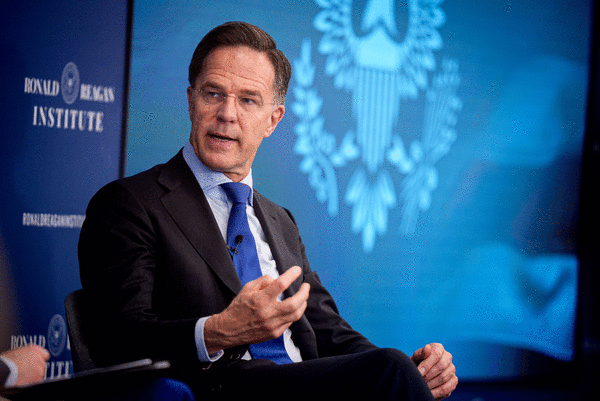
BRUSSELS — The U.S. wants specific commitments from European allies on their pledge to help secure the Strait of Hormuz after the fighting in Iran stops, requesting that countries present concrete plans to ensure navigation through the waterway within days, according to a senior NATO official.
The request was presented during discussions between American and NATO officials at the White House — where President Donald Trump met with North Atlantic Treaty Organization Secretary General Mark Rutte — as well as at the Pentagon and State Department, according to the official.
Trump does not have any expectations for NATO and did not ask the alliance for anything, even though those nations rely on the strait more than the U.S., a White House official said Thursday.
A UK-led coalition of more than 40 countries, which includes many European nations, Japan and Canada, has pledged to help re-open the Strait of Hormuz, through which about 20% of the world’s oil and natural gas flows, after active combat in the Middle East stops. The closing of the strait has sent global energy prices soaring and raised concerns about imminent fuel shortages.
Rutte told reporters Thursday that the coalition was discussing the “what, the when and the where” including “what they can do in pre-positioning some assets, assets already in the region for when the time comes.”
Asked whether this could be a NATO-led mission as opposed to one organized by an independent coalition of countries, he said it was “unclear.”
“If it can be helpful to give it a NATO flag, fine,” he said, adding that speed rather than structure was paramount.
Trump, Iran and Israel announced a fragile, 14-day ceasefire agreement on Tuesday, contingent upon the cessation of attacks and the reopening of the strategic waterway. About a dozen mostly European leaders issued a statement following the accord promising they would “contribute to ensuring freedom of navigation in the Strait of Hormuz.”
However, strikes from Iran and Israel have continued and the Strait of Hormuz has remained effectively closed since the announcement. Tehran has said Israel’s attacks on the Iran-aligned Hezbollah militia in Lebanon constitute a violation of the ceasefire agreement.
That raises questions about whether the latest request from the U.S. will spur members of the Hormuz coalition to present plans quickly and whether they consider the U.S. timeline of a few days realistic.
Assistance from NATO members — or lack thereof — in the Iran conflict has led to acrimony between Trump and allies in recent weeks. Some member states declined to let the U.S. use military bases to carry out strikes on Iran and refused the American president’s calls to help reopen the Strait of Hormuz as long as fighting was ongoing.
Following the meeting with Rutte on Wednesday, Trump posted on social media that “NATO WASN’T THERE WHEN WE NEEDED THEM, AND THEY WON’T BE THERE IF WE NEED THEM AGAIN.”
Often referred to as the “Trump Whisperer,” Rutte has frequently been dispatched to ease tensions between Washington and the military alliance during moments of crisis, including when Trump was pressing member states to escalate defense spending and earlier this year when he threatened to seize the Danish territory of Greenland.
The Iran war, though, may pose the biggest test yet for Rutte. While Trump has long criticized NATO, questioning its relevance and countries’ willingness to shoulder the costs of collective security, he’s demonstrated increasing hostility toward the military alliance in recent weeks, deriding member states as “cowards” and the alliance as a “paper tiger.”
In a recent interview with the UK’s Telegraph, Trump said he was considering pulling the U.S. out of NATO altogether. During a press conference on Monday, Trump revisited his grievances with the organization over Greenland that he wants for the U.S., suggesting that rift had never healed.
Trump administration officials including Secretary of State Marco Rubio and U.S. NATO Ambassador Matthew Whitaker have said member states must do more to demonstrate their value to the U.S., indicating that Washington would rethink its relationship.
Rutte met Rubio earlier Wednesday, and they discussed Iran, efforts to end Russia’s war in Ukraine as well as “increasing coordination and burden shifting with NATO Allies,” according to the State Department.
Vice President JD Vance is slated to lead a U.S. delegation to Islamabad to hold direct talks with Iran on Saturday.
_____
With assistance from Courtney Subramanian, Michelle Jamrisko, Courtney McBride, John Harney and Meghashyam Mali.
_____
©2026 Bloomberg L.P. Visit bloomberg.com. Distributed by Tribune Content Agency, LLC.






Comments