Chicago's US Attorney Andrew Boutros defends handling of Operation Midway Blitz after a year on the job
Published in News & Features
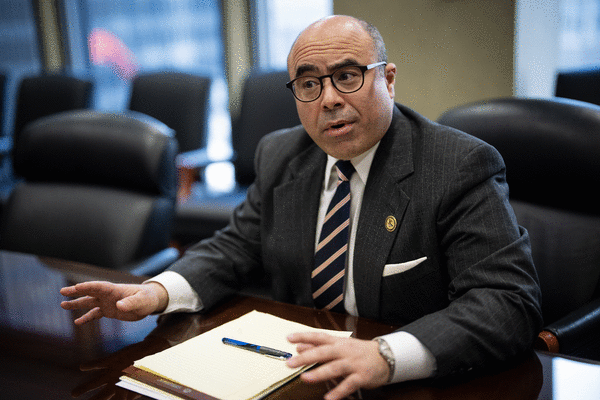
CHICAGO — One year into his tenure as Chicago’s top federal law enforcement officer, U.S. Attorney Andrew Boutros is defending his handling of Operation Midway Blitz cases and says a changeover of the old guard and influx of new prosecutors has reinvigorated an office that aims to get back to bread-and-butter targets like violent crime, public corruption and fraud.
And with accusations front and center that President Donald Trump has used the Justice Department to go after political enemies, Boutros is adamant it hasn’t happened in Chicago.
“There is not a single case involving politics in our decision-making, full stop. Period,” Boutros said last week, jabbing a finger into the conference table adjacent to his fourth floor office. “And anyone who says otherwise is misstating reality, and anyone who says otherwise is an armchair expert who doesn’t know what they are talking about.”
Boutros made the comments as part of a lengthy interview with the Tribune and Sun-Times to mark his tumultuous first year at the helm, which he described as an “invigorating” opportunity to turn around a storied office that had been stagnating in recent years.
“I’ve been super-focused identifying what have been issues, what have been the problems, dealing with either productivity or efficiency, with our numbers, with morale, and then addressing it,” Boutros said. “And so it’s been fantastic.”
A former assistant U.S. attorney who came back to lead the office after a decade in private practice, Boutros, known as a hard-charging, up-before-dawn workaholic, was characteristically intense during the hourlong discussion, punctuating many of his answers with military language and sports references, including the 1985 Bears.
Since moving into the top spot, he’s decorated his office at the Dirksen U.S. Courthouse with accolades from his days as a line prosecutor and section supervisor. He has a large, framed photo montage honoring “Da Coach,” Mike Ditka, on one wall, and a portrait of a 1930s-era FBI agent with a Tommy gun on another.
At one point, he gestured to an American flag behind him and said he’d ordered it put there, along with another near a window behind his desk. “I got two flags in my office,” said Boutros, a first-generation American whose parents immigrated from Egypt. “I love the United States of America.”
There’s no question it has been a difficult year. Since Boutros was sworn in on April 7, 2025, on an interim basis, the U.S. attorney’s office has endured a never-before-seen exodus of leadership and talent, with every single section chief departing within a span of 10 months. The office has also been buffeted by downsizing, a hiring freeze and a lengthy government shutdown.
Then, shortly after Boutros was confirmed by a judicial panel as the permanent U.S. attorney in July, the office was thrown headlong into the largest immigration enforcement surge in Chicago history — one that seemed to lurch from one crisis to another and turned the city into a national spectacle of tear gas and violent clashes on neighborhood streets.
Tough response
Critics have blasted Boutros’ office for bringing a series of charges against Midway Blitz protesters and others accused of assaulting agents, only to have them fall apart in court in various ways, either by a grand jury refusing to return an indictment, new evidence prompting prosecutors to issue rare dismissals, or, in one high-profile case that actually went to trial, a swift jury acquittal.
Many watching from the outside — including U.S. attorney’s office veterans and former supervisors — see an office in free fall, with a devastating loss of institutional knowledge walking out the door, coupled with heavy-handed directives from Washington that belie the office’s traditional role as a nonpolitical, equal opportunity crime-buster.
“It is not primarily Andrew Boutros, but it is his responsibility because he has the power to say, ‘No, we will not revise our agenda to fit the political will or personal will of the president of the United States,'” said Ron Safer, a former federal prosecutor who has been raising the alarm about the direction of the office.
At the height of Operation Midway Blitz last fall, U.S. Magistrate Judge Gabriel Fuentes memorably summed up the frustration that many were feeling with the role Boutros’ office had played, writing in an opinion granting the dismissal of charges against a protester that bringing a case should be “undertaken with the utmost care.”
Fuentes, a former assistant U.S. attorney and journalist, closed by saying, “doing the right thing has been a mantra of the Chicago U.S. Attorney’s Office for generations.”
“Let it remain so,” Fuentes wrote.
Boutros acknowledged that his office made missteps during Midway Blitz, but said many of them came early on in the surge when they were still trying to figure out how to deal with the influx of out-of-town agents and the onslaught of arrests suddenly being referred for prosecution.
He said part of the problem included the law enforcement tactics behind the blitz itself, with hundreds of agents unaccustomed to Chicago pouring into the city and suburbs, tasked with making arrests in territory completely foreign to their normal jurisdiction at the nation’s borders.
“It would be like taking a soldier who has extraordinary training in doing desert warfare and then dropping them into cold winter conditions,” Boutros said. “They know how to fire their guns, but it’s a different environment.”
Boutros said that less than two weeks into the blitz, it was clear that the traditional methods the office applied were not working. So his office pivoted, he said, from bringing “reactive” charges based on arrests in the field to shifting “to an investigate-and-then-evaluate” decision-making process, which he said greatly boosted the “accuracy” of cases and led to fewer dismissals.
He also noted that his team declined to press charges against hundreds of others arrested by immigration agents during the 64-day blitz — ultimately bringing criminal cases against only 32 people. So far, none has resulted in a conviction.
Less churn in Chicago
While Chicago’s U.S. attorney’s office has seen turnover and some turmoil during Boutros’ first year, it pales in comparison to what’s gone on in many other federal districts, where Trump installed his former personal attorneys and, in some cases, literally ordered them to prosecute political enemies. Among them: former FBI Director James Comey, who was indicted last fall for perjury only to see the case tossed out of court two months later.
The mounting controversies have led to a crisis of morale and a nationwide exodus of talent from the Justice Department, including career attorneys who’d served under both Democratic and Republican administrations and, in the traditions of the office, saw themselves as distinctly nonpartisan public servants.
In Chicago, there were no questions about Boutros’ competence to lead the U.S. attorney’s office. Still, it was not immune to the controversies swirling in other areas of the country. By late in the year, nearly all of the section chiefs in the office had departed, including Public Corruption and Organized Crime, National Security and Cyber Crimes, and Violent Crimes. Many other mid-level, trial-tested assistants also chose to leave the office.
The turnover was completed this year with the resignations of Andrew Erskine, who headed the Narcotics and Money Laundering section, Christine O’Neill, the longtime leader of General Crimes, and Melody Wells, who had recently taken over National Security.
In his interview, Boutros bristled at criticism over the exodus of supervisors and mid-level prosecutors, saying there were myriad reasons for people to leave.
“You know, some people left because I told them I was going to demote them,” he said. “Some people left because they came into my office and they said that they strongly disliked (the Trump) administration. They cannot work for this administration. Some had tears in their eyes, as they were saying that, literally, tears beading down their cheeks.”
Boutros said the controversy surrounding Operation Midway Blitz was another factor that many cited in their decision to move on from the office, and that some of those decisions were political in their own right.
“Some told me, ‘Andrew, I need to think about my future down the road when there is a Democratic president, or when I want to become a judge or U.S. attorney,'” he said. “‘And I don’t think being associated with this is going to help me right now, in my career down the road.'”
Boutros said there isn’t much to say to someone who feels strongly about it. “You say, ‘Look, thank you for your service. It’s time to leave.’ It’s very straightforward,” he said.
At its nadir earlier this year, between the resignations and hiring attrition, the office was down to fewer than 90 criminal prosecutors — a huge dip for an office typically budgeted for about 140. Critics have said the outflux is noticeable in the lack of big, complex cases that have been brought in recent months, in favor of one-off gun cases, Social Security fraud or cases against previously deported individuals.
New direction
But Boutros said he’s excited with the new team of managers in place. He touted several initiatives during his first year in office, including the first-ever expansion of the Project Safe Neighborhoods program to include sections of downtown and the CTA and the creation of a health care fraud section that has already charged nearly $2 billion dollars in fraud in recent months.
And unlike other areas of the country, Chicago has been cleared for a surge in hiring. Late last year, the office added about a half-dozen new prosecutors, Boutros said. But more recent funding that he said is tied to productivity has now been announced that will lead to “close to 50” new hires in the coming year.
“We are on a major hiring spree,” Boutros said. “And what’s been really terrific is that the applications that we’re getting have been incredible …. We’ve hired (experienced prosecutors) from other districts, from California, from New Jersey, from New York, from Georgia, from D.C., and from a lot of other jurisdictions as well. We’ve really become a magnet.”
He also noted that he inherited an office that was at historic lows when it came to key metrics, with some prosecutors filing only one or two indictments a year. “I just hired someone who started a month ago, and he indicted four cases in one day,” he said.
Boutros also addressed criticism from some circles that there has been a “litmus test” for new hires that requires them to adhere to the president’s agenda. He called that a “false and inaccurate narrative.”
“This is the litmus test: You got to love America,” he said. “You got to love this job, and you got to be tough on crime. If you don’t fit those criteria, you’re not going to get hired into this office.”
Like almost all aspects of the Trump administration, the turbulence in the Justice Department has gone all the way to the top. Last month, Trump fired Department of Homeland Security Secretary Kristi Noem, who implemented the president’s aggressive deportation policies and oversaw Midway Blitz before an even more disastrous operation in Minneapolis resulted in the killing of two U.S. citizens.
Noem’s departure was followed last week with the abrupt dismissal of Boutros’ ultimate boss, Attorney General Pam Bondi.
Asked about Bondi’s firing, Boutros had nothing but praise for her, saying she “was very good to the Chicago U.S. attorney’s office” when it came to supplying resources and never tried to micromanage. “We’ve been left to do our work,” he said.
As for her questionable moves, including orchestrating the indictment of Comey at the president’s behest, Boutros declined to comment.
Broadview Six
Boutros also declined to talk about specific cases his office has brought, including the pending “Broadview Six” indictment against a group of local Democratic elected officials, candidates and others accused of conspiring to impede an ICE agent during a protest in September.
More than any other case, the Broadview Six indictment has drawn accusations of political interference, particularly from attorneys for the defendants who have sought any communications from the White House or other officials in the Trump administration about the charges.
Charges against two of the defendants were recently dismissed, leaving four, including former congressional candidate Katherine “Kat” Abughazaleh, to face trial in May.
Last month, Boutros’ office blasted the defense’s “reckless” insinuations of undue political influence as “the product of fevered paranoia and delusional speculation,” arguing in a motion that it was preposterous to believe that the White House would care about a group of low-level, local politicians.
In response, the defense said their request was no fishing expedition, but based on the documented track record of the Trump administration of bringing criminal prosecutions to satisfy “personal vendettas.”
U.S. District Judge April Perry is scheduled to hold a hearing on the defense request on Tuesday.
While declining to speak about the case, Boutros noted in his interview that his office has been open to reviewing new evidence as it comes in and has dismissed several cases when body-cam video or other considerations changed the calculus.
“We’re willing to receive them, and we’re open-minded to them and I think that that is a testament to how much we care to get it right,” Boutros said.
He also said that his office’s investigations into Midway Blitz cases isn’t over yet.
“We have other cases that we’ll probably be bringing soon coming out of the blitz that are some very serious cases,” Boutros said, declining to elaborate.
But for the most part, Boutros said he’s looking forward. In the coming year, he said, his office will be focused on a “buffet” of traditional investigations like fraud and violent crime, as well as one of Chicago’s oldest and most entrenched professions: public corruption.
Boutros said the work didn’t end with the recent convictions of political heavyweights like Ald. Edward Burke or House Speaker Michael Madigan.
“Public corruption is a very special part of this office, and our work is not done. So stay tuned,” he said.
Like the homage to Ditka hanging in his office, Boutros said he sees himself as a head coach of a team with new players, new leadership and a lot of potential.
“I want the office to be back to being the ’85 Bears,” he said. “I feel really good about the future. I feel really good about where we’re headed.”
____
©2026 Chicago Tribune. Visit at chicagotribune.com. Distributed by Tribune Content Agency, LLC.





Comments