A taste of the outdoors: National Geographic cookbook features National Parks-inspired recipes
Published in News & Features
What do America’s national parks taste like?
In Northern California, perhaps it’s the earthiness of forest mushrooms and sweetness of crab meat. Along the Southern border, maybe the basso of pine nuts and tang of cactus paddles. And in the East, how about … a whole lot of country ham?
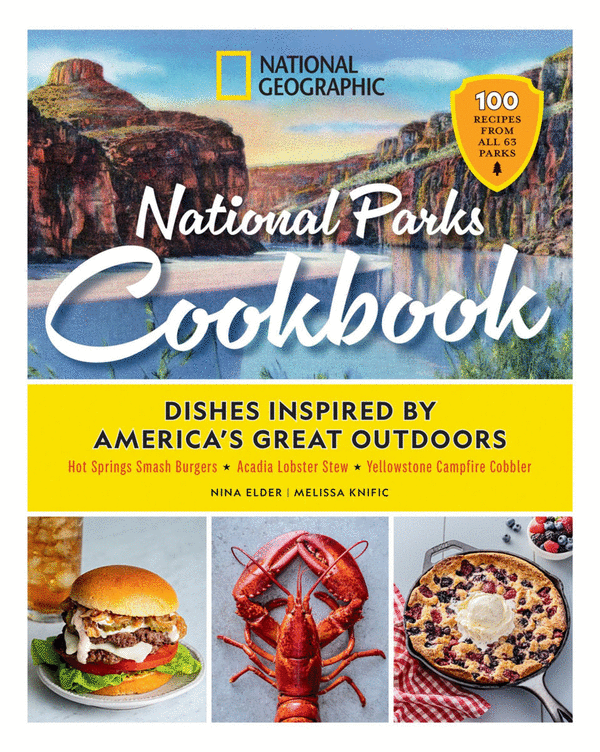
That delicious thought came up while Nina Elder and Melissa Knific were researching their 2026 book, the “National Geographic National Parks Cookbook: Dishes Inspired by America’s Great Outdoors” (National Geographic, $32.50).
“I found this little tidbit that Shenandoah (National Park) is part of something called the ‘Ham Belt,’ which I had never heard of before,” Knific says. “It’s a strip of latitude around the globe that has the perfect conditions for curing a ham — parts of Spain fall into that area. That was really fun, and I feel like it’s now a party fact I can reveal to anyone.”
Knific and Elder are food writers and recipe developers who have split time among Bon Appetit, Parade and Rachael Ray’s In Season magazine. About two years ago, they started to design a cookbook inspired by all 63 national parks in the U.S. – the flora and fauna endemic to the regions, as well as each’s unique history and culture.
The result is a love letter to America’s protected wilderness that should make readers part hungry, part rarin’ to explore.
There’s trout almondine with rice pilaf from California’s Sequoia National Park – golden trout live in those high-elevation lakes and streams – and cast-iron rib eyes from Lassen Volcanic National Park, which has a history of cattle ranching. The Grand Canyon contributes blue-corn pancakes with pine nut-honey butter, and Wyoming’s Grand Teton a Signal Mountain wild-game chili.
Up in Alaska, Denali is honored with pork tenderloin with lingonberry gastrique and spruce-top shortbread cookies. From over in Florida’s Dry Tortugas, there’s four-marlins salad with Key West pink shrimp and Key lime-coconut bars.
Ideas for recipes flowed from the local ecosystems of national parks – in the book, you’ll find lots of berries and game meat like caribou and bison – as well as Indigenous cultures and old-timey inns and restaurants. Back in the day, it was fairly common to have a big eatery catering to visitors inside a park, such as one serving “gourmet fare” in Yosemite in the early 1900s.
“We’d dig into the flora or the fauna at a park, and would look around the area for lodges,” says Elder. “We would look at towns near the park and see what people were enjoying — people were loving a milkshake at this place or a sandwich at this other spot, or they loved getting to-go items from a particular place to take hiking.”
There are some sandwiches and energy-rich treats to stuff in a backpack, and a few things that can be prepared in an RV or over an open flame. But sleeping bags and mosquito repellent are not required, at all, to enjoy the book.
“We didn’t want it to be a book that just focuses on camp cooking,” explains Knific. “We wanted to make this something that people could use in their home kitchen. You know, it’s a taste memory, right? If they have been to a particular park and want to cook something from it, they can do every one of these recipes in their own kitchen.”
In that way it’s almost like astral traveling to a park you’ve always been fascinated by, experiencing its sensuous delights in the comfort of your abode. Here, Knific and Elder have shared four recipes inspired specifically by the national parks of California: a Spinach Salad With Prickly Pear Vinaigrette inspired by Death Valley; Dungeness Crab Cakes and Wild Mushroom Pasta inspired by Redwood National and State Parks; and slow-cooked Beef Barbacoa Flautas inspired by Pinnacles National Park.
The authors hope people keep these special places in mind, while they’re sauteing and saucing their way through the cookbook.
“I had some appreciation for national parks before I started this project,” Elder says. “But certainly after digging in on this level – the breadth and depth and history of these spaces – I really felt the importance to our country to protect and preserve them. To be able to celebrate them was a real honor.”
©#YR@ MediaNews Group, Inc. Visit at mercurynews.com. Distributed by Tribune Content Agency, LLC.






Comments