Column: In defense of $23 nonalcoholic cocktails
Published in News & Features
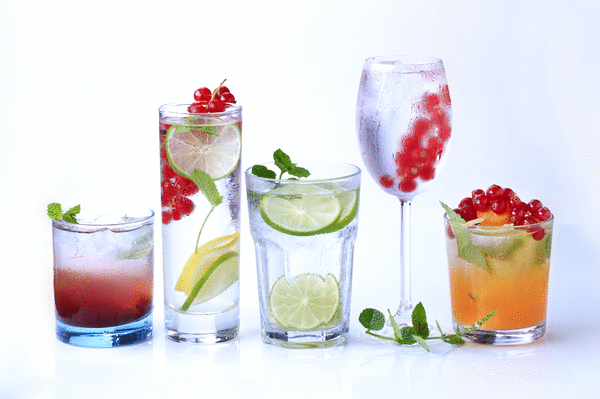
It happened a few years ago, but I still remember it clearly. I was seated at a white-tablecloth fine-dining restaurant in Brooklyn, the now-shuttered Clover Hill. In need of a break from booze, I ordered a nonalcoholic cocktail. After the server recited the drink’s composition — beet, oolong tea, tonka bean and a few other carefully articulated ingredients — I ordered it.
Moments later, a rocks glass arrived holding an oversize ice cube that occupied the bulk of the vessel. At best, there was room for three ounces of liquid splashing around. I looked at my husband in disbelief. I’ve consumed plenty of mocktails in my life, and this was the stingiest pour I’d ever encountered. Three sips later, my glass was empty, and I shifted to water.
When the check arrived, my disbelief turned to indignation: That thimble of juice cost $24, which, as I recall, was about the cost of the drinks that contained alcohol.
It’s understandable why a sensible person would swear off nonalcoholic cocktails. They’re too precious — and too expensive, especially for a drink with no booze. But writing them off altogether because of a high price tag would be a mistake. There are plenty of good reasons why those N/A drinks command a price on par with that of their boozy siblings: The cost of research and development, as well as the expenses for labor and the ingredients that go into the drinks, is often the same for alcoholic and nonalcoholic versions.
What’s more, a well-made nonalcoholic drink that’s thoughtful and genuinely delicious can be just as compelling as one with booze. And maybe more so, as it lets designated drivers, pregnant women and other nondrinkers feel as if they’re in on the party.
It’s getting easier and easier to find a spirit-free cocktail. More US restaurants are serving them because they don’t have a choice. Americans are drinking less than they used to, younger consumers in particular. Beverage sales are one of the few areas where restaurants can make money, and a table ordering spirit-free drinks instead of full-proof cocktails or a bottle of wine still needs to make financial sense.
But just because N/A drinks are available doesn’t mean people will order them. Most of the pushback comes down to price. Remove the alcohol from a Negroni, the thinking goes, and what’s left — the “no-groni,” as you’ll see on some menus — shouldn’t cost nearly as much as a conventional one with its time-honored combination of gin, sweet vermouth and Campari.
But unless you’re crafting drinks with rare or vintage spirits, the alcohol — around 1.5 ounces to 2 ounces in most cocktails — isn’t typically the most expensive part. Labor costs more. So does time. The hours spent creating and testing a well-balanced drink, plus making the juices and bases, which often come from pricey produce, add up. That’s especially true if there are technical components like clarification involved — not to mention the fancy ice cubes that cost $1 apiece. Those expenses don’t disappear because the drink won’t get you drunk.
If you still believe the liquor drives the price, you should know that many modern mocktails are made with nonalcoholic spirits whose bottle costs rival those of full-proof spirits. I’ll give you an example.
Over at Shinji’s, a playful, technique-driven bar in New York’s Flatiron district, beverage director Jonathan Adler offers the Sumac Society, a $23 spirit-free take on the classic Clover Club, a tart raspberry-lemon, egg-white-frothed cocktail. It took his team six months to perfect the drink with an ultrasonic homogenizer (a device that uses sound waves to extract and emulsify liquids) and a mix of citric, malic, tartaric and oxalic acids (to mimic the brightness of lemon juice).
The drink also calls for Everleaf Forest, a bittersweet nonalcoholic spirit that costs him $19 for a 500-milliliter bottle. For reference, he pays about the same for the Botanist gin, ($37.61 for a 1,000ml bottle) and uses roughly the same volume of each in the respective nonalcoholic and alcoholic drinks.
Happily, it’s getting easier to find no-alcohol cocktails that are worth the price. Many operators have come to learn that if their drinks aren’t good and customers switch to water, as I did in Brooklyn, it’s not going to help their bottom line.
One of my favorite mocktail spots is Golden Ratio. The recently opened Brooklyn bar treats its nonalcoholic program with the same degree of attention as it does its full-proof one. Each of its 15 cocktails is convertible: There’s a full-proof version and a spirit-free counterpart. Most beverages cost $16 and include no less than 5.5 oz — and up to 8 oz — of the drink, just a bit less than the alcoholic offerings.
Consider the bar’s nonalcoholic Parsnip. Co-owner Piper Kristensen tells me it takes roughly six hours to prepare the drink’s components, which includes making a parsnip syrup mixed with enzymes to bring out the vegetable’s natural sugars, clarifying that liquid, and then blending it with Douglas fir syrup and centrifuge-spun purple carrot juice. The creamy magenta-hued drink, which has a very crushable vegetal and subtle raspberry-like flavor, is akin to a tiki-style cocktail, served over pebbled ice in a hurricane glass for $16.
At the new Stone & Soil in New York’s NoMad, led by Rio Azmee and Hirotomo Akutsu, an alum of Toyko’s esteemed Bar Trench, the nonalcoholic Pink Tango takes more than a week to prepare. This $18 reinterpretation of the classic grapefruit-and-tequila paloma is a requisite order for any spirits abstainer. The drink stars a koji-fermented version of the Mexican pineapple drink tepache. It’s blended with Everleaf Marine (a gin-like nonalcoholic spirit) and Campari-esque Lyre’s Italian Orange, plus lime juice and grapefruit soda. The cocktail tastes like a souped-up, complex Capri Sun fruit punch in the best possible way.
If you think about today’s beverage landscape in which some alcoholic craft cocktails without specialty spirits are pushing into the $30s, paying $16 or $18 for a labor- and technique-intensive nonalcoholic drink with special ingredients hardly feels like a rip-off.
Does this excuse lazy bartending or inflated pricing? No. Many places still pour saccharine-sweet juice mixtures into a rocks glass and charge $20 or more. Those drinks deserve the backlash.
The real problem isn’t that mocktails cost too much. It’s that too many places still haven’t learned how to make them worth it.
©2026 Bloomberg L.P. Visit bloomberg.com. Distributed by Tribune Content Agency, LLC.




Comments