Artemis II astronauts launch on historic moonbound mission
Published in News & Features






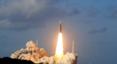



CAPE CANAVERAL, Fla. — NASA on Wednesday sent four astronauts on the most powerful rocket to ever launch humans, flying the Artemis II mission that aims to send them past the moon.
The Space Launch System rocket with the Orion spacecraft named Integrity lifted off from Kennedy Space Center's Launch Pad 39-B at 6:35 p.m. Eastern time.
The SLS blasted off the pad with 8.8 million pounds of thrust besting the power seen by the space shuttle and Apollo program’s Saturn V rockets. Its rumble barreled over crowds gathered at KSC’s press site, drowning out cheers, hollers and the clicking sounds of cameras snapping pics of the liftoff.
Minutes later, the crew made it to space.
“We have a beautiful moonrise and we’re headed right for it,” said NASA commander Reid Wiseman.
Wiseman is traveling with fellow NASA astronauts Victor Glover and Christina Koch as well as Canadian Space Agency astronaut Jeremy Hansen.
Astronaut Nichole Ayers, who flew to space on Crew-10 in 2025 and was part of the NASA broadcast team, became emotional after liftoff having witnessed the launch surrounded by the cheering crowd at the press site.
“The energy was wonderful,” she said. “We’ve got four friends and family members headed to the moon. It’s pretty amazing. ... We don’t have the words in the English language to describe this kind of event. Pride. Love. So many emotions. They are truly breaking some barriers.”
They are the first humans to fly on Orion, which had an uncrewed test flight in 2022 that orbited the moon. The quartet won’t be on the same trajectory, simply flying by Earth’s biggest satellite, but they will potentially break the record held by Apollo 13 of the farthest any humans have flown from Earth.
Glover will be the first Black man, Koch the first woman and Hansen the first non-American to travel to deep space.
Their 10-day mission will feature one day flying close to Earth to ensure Orion’s life support systems work as planned. They will also perform a proximity test of Orion’s propulsion engines to circle the SLS rocket’s upper stage, the interim cryogenic propulsion stage, once it does its job, getting Orion to a higher Earth orbit, and separates from the astronauts’ spacecraft.
Ahead of launch NASA Administrator Jared Isaacman laid out what he thinks is most important about the mission.
“After ignition, to me, the moment that I’m going to be most excited for is splashdown. There’s no question about that. Good chutes coming down off the West Coast,” Isaacman said. “But look, I think that, I think the takeaway from this is gaining extreme comfort in the Orion spacecraft, right? I mean, this is very different than what we’ve done for more than a half century. I mean, the velocities that that spacecraft is going to reenter at, it’s going to be new territory for us. We want to get our arms around that completely. So I would say the performance of SLS plus Orion is everything on this one. We want to make sure we do it in as safe way as we possibly can, understanding what we are undertaking right here. Bring our crew back, learn as much we can from the vehicle, set up for Artemis III in 2027.”
It won’t be until flight day 2 that they’ll punch their moonbound ticket, arriving more than three days later. Their closest approach will come on flight day 6 flying within 4,000 to 6,000 miles from the moon. An April 1 launch could mean it will reach a projected distance of 252,799 miles from Earth, which exceeds Apollo 13’s distance set in 1970 by 4,144 miles.
Weather remained clear for launch, which came only 11 minutes later than the original target at the opening of the launch window soon after Artemis launch director Charlie Blackwell-Thompson gave the go for launch.
One issue that arose with about two hours before the launch window opened was from the Eastern Range, which was having issues communicating with the SLS’ flight termination system. Teams were able to clear the issue after verifying a fix that involved Blackwell-Thompson approving an FTS console operator at the firing room to go over to the Vehicle Assembly Building to find some heritage Space Shuttle Program hardware to help confirm the range’s attempted fix for the problem. It worked.
Propellant load began before 9 a.m. and teams had no issues loading both the core and upper stages with the 755,000 gallons of liquid hydrogen and liquid oxygen, completed before 1 p.m.
The quartet are were suited up at KSC’s Operations & Checkout Building, and headed to the pad just after 2 p.m. By 3:30 p.m. they had taken their last breaths of fresh air donning helmets and taking up their seats in the capsule.
“That’s certainly something that we’ve been waiting for a very long time to see. It’s going to very exciting I think certainly for our team,” Charlie Blackwell-Thompson said. “It will be exciting for our country and it will be exciting for people all over the world who are watching our crew head to the pad knowing that we are just about five hours or so from launch.”
The astronauts’ proximity to the moon will mostly be devoted to visual observations of the far side, some of which has never been seen by human eyes before, while also taking photos and videos.
The main purpose of Artemis II is to prove Orion’s safety for human passengers and set up future Artemis missions.
U.S. Rep. Mike Haridopolos, who represents Florida's Space Coast, was at KSC, heading down to wave at the astronauts as they drove by the press site in front of the Vehicle Assembly Building.
“Artemis II is the linchpin,” he said. “This is a progression, just like we did with the Apollo program. We need to gear up before we land on the moon, and this will be a great dress rehearsal as we get geared up for that.”
Artemis III was recently changed to be a mission close to Earth, aiming to launch as early as mid 2027, during which astronauts will perform docking operations with one or both of NASA’s two commercial lunar lander providers. Both SpaceX and Blue Origin are working to complete usable versions of their landers in time to launch for that mission.
It won’t be until Artemis IV targeting early 2028 and Artemis V potentially by late 2028 that NASA will be sending astronauts to the lunar surface. No human has set foot on the moon since the end of the Apollo 17 mission in 1972.
Only four of the 12 men who ever walked on the moon are still alive, and it will have been at least 55 years between missions.
_____
©2026 Orlando Sentinel. Visit at orlandosentinel.com. Distributed by Tribune Content Agency, LLC.






Comments