Senators worry about 'historically dangerous' strategic threats
Published in News & Features
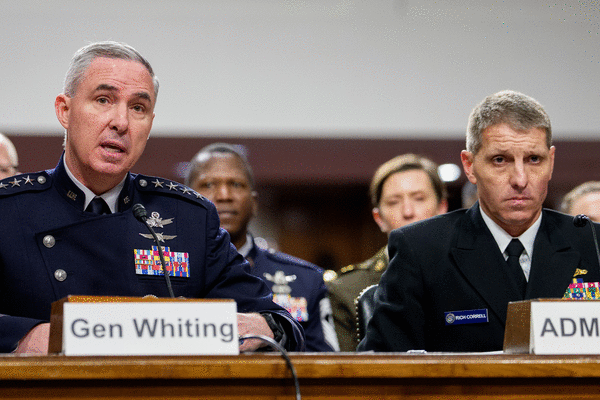
WASHINGTON — A Senate Armed Services Committee hearing Thursday laid bare concerns in both parties about alarming advances in Russian and Chinese missiles, nuclear weapons and antisatellite capabilities.
Sen. Roger Wicker, R-Miss., the committee’s chairman, said at the hearing that these dangers are advancing by “leaps and bounds.”
Sen. Jack Reed of Rhode Island, the committee’s top Democrat, said: “We are operating in a historically dangerous strategic environment.”
The hearing’s purpose was to review the posture of U.S. space and nuclear forces. The witnesses were Space Force Gen. Stephen Whiting, the commander of U.S. Space Command, and Adm. Richard Correll, the commander of U.S. Strategic Command.
Beijing bulks up
Wicker reiterated Strategic Command’s 2023 finding that China now has more land-based intercontinental missile launchers than the United States, though America still has more submarine-launched ballistic missiles.
As for the nuclear warheads that those missiles can deliver, America is still far ahead, but China is advancing, building about 100 more per year, the Pentagon has said. As of last year, China had about 600 warheads, versus more than 5,000 each for Russia and America, according to the Arms Control Association. But the Pentagon has reported that China is expected to attain 1,000 warheads by 2030.
And its missiles are in a launch-on-warning hair-trigger status, the Pentagon has said.
Meanwhile, China has grown its constellations of satellites in orbit to 1,300, including 510 “intelligence, surveillance and reconnaissance” satellites — a 667 percent increase since 2015, Whiting of Space Command testified.
China recently conducted an operational first in space: refueling a satellite more than 22,000 miles above the equator, potentially giving China a new capability to take adverse actions against U.S. satellites, Whiting said.
‘We need to be able to deliver our own maneuver capability,” he said.
Moscow’s moves
Russia, meanwhile, remains “a major strategic threat to the United States,” Wicker said.
Moscow has developed — but not yet launched — a nuclear-capable antisatellite weapon, which Whiting called “the single greatest threat” in space and a “very, very significant” development — not just for U.S. satellites but to all satellites in space, commercial or military, regardless of national owner.
Wicker said Russia has also developed “new weapons unlike anything in the U.S. inventory,” including “nuclear-powered, trans-oceanic, autonomous torpedoes and intercontinental cruise missiles.”
Russia possesses, too, a substantial arsenal of lower-yield nuclear weapons that could be used in a regional scenario, as opposed to striking the United States.
Wicker said Russia has a 10-to-1 numerical advantage in these tactical nuclear weapons.
Looming over the separate risks from Russia and China is the fact that they are increasingly coordinating their strategic efforts, including with joint bomber patrols off Alaska and in the Western Pacific, Reed said.
Perilous times
The strategic security environment is perilous not just because of the growing technical capabilities of U.S. adversaries but also for other reasons, Reed and other Democrats said.
The New START Treaty’s nuclear weapons limits expired in February, something Wicker said was needed to “reset the strategic balance.” China was not a party to that treaty, and efforts to create a follow-on pact involving Russia or China have proven fruitless.
The upshot is there is no verifiable agreement to cap nuclear arms for the first time since the early 1970s.
At the same time, as President Donald Trump distances the U.S. government from its traditional allies, particularly in Europe, other nations are reconsidering their strategic relationship with the United States, according to press reports.
If America’s so-called extended deterrence umbrella is no longer considered reliable, it could trigger a wave of nuclear proliferation, potentially by such countries as Sweden, Germany, South Korea and Japan, some experts have said.
Correll of Strategic Command said, under questioning from Sen. Jeanne Shaheen, D-N.H., that he regularly emphasizes to his military counterparts in allied nations that U.S. deterrence remains solid.
Still, Reed said allies’ confidence in U.S. nuclear protection is “eroding,” and this has “profound implications for weapons proliferation.”
Democrats, including Reed and Sen. Jacky Rosen, D-Nev., expressed concerns about Trump’s recent proposal to resume U.S. nuclear weapons tests for the first time since 1992, as opposed to continuing to use simulations.
Upgrading the triad
The U.S. military responses to these threats are several.
For one, the three legs of the U.S. nuclear triad are all being modernized.
But two of those programs, the Columbia class of submarines and the Sentinel land-based missiles, are behind schedule and over budget. The witnesses said the lives of the current generation of weapons — Ohio class subs and Minuteman missiles — are being successfully extended to account for the delays.
The replacement program for the third leg of the triad, the B-21 bomber initiative, appears to be performing relatively better than the other two on cost and schedule and is projected to enter service in 2027.
But Correll echoed his predecessor’s position that at least 145 B-21s are needed just for U.S. strategic requirements, not just the 100 in the current plan.
At a cost of nearly $700 million per B-21 just for acquisition, let alone operations, growing the inventory by 45 percent would add to the Air Force’s budget pressures.
The B-21 program’s estimated acquisition cost is about $92 billion in constant fiscal 2025 dollars. The comparable Columbia figure is $126.5 billion and Sentinel is $141 billion.
Those figures exclude not just support costs but also the price of developing and building the warheads, which is a National Nuclear Security Administration duty.
Sen. Joni Ernst, R-Iowa, said the Pentagon “needs to demonstrate it can deliver capabilities on time and on budget.”
Correll said the Pentagon is “laser focused” on the issue but added: “I acknowledge there have been some significant challenges there.”
Another nuclear weapon in development is the Sea-Launched Cruise Missile, which Correll said would give the United States a way to counter lower-yield nuclear weapons in the Russian and Chinese arsenals.
The Pentagon is bolstering its strategic defense as well as its offense.
The president has called for deployment before his term is up of a Golden Dome antimissile shield for the U.S. homeland, an enhanced version of the current set of interceptors in Alaska and California.
It is not clear yet to key lawmakers what that system will entail, and the witnesses on Thursday did not offer more of an idea.
Sen. Mark Kelly, D-Ariz., said he is concerned the Pentagon will spend $500 billion to $1 trillion “on a system that does not work well enough.”
©2026 CQ-Roll Call, Inc., All Rights Reserved. Visit cqrollcall.com. Distributed by Tribune Content Agency, LLC.





Comments