CDC dilemma: Nominee may need both MAHA and science chops
Published in News & Features
WASHINGTON — As a deadline arrives this week to nominate a Centers for Disease Control and Prevention director, some Republicans are skeptical the administration will find someone who can check all the boxes necessary for confirmation.
The candidate will need the “Make America Healthy Again” mindset of Secretary Robert F. Kennedy Jr.’s Health and Human Services Department, while also appeasing a set of stick-to-science senators increasingly unhappy with Kennedy’s direction.
After a year of chaos in the public health agency, key senators say they want a moderate public servant, but also someone who will last longer in the job that the administration’s initial choice, who was fired shortly after confirmation.
“It hasn’t been a very encouraging track record thus far,” said Sen. Lisa Murkowski, R-Alaska, in a hallway interview when asked about the administration’s commitment to confirming a long-term agency head. “So you know, we need strong, smart men and women that are there that I think can help bring credibility back to the institutions.”
Senate Health, Education, Labor and Pensions Chairman Bill Cassidy said he wants to confirm “somebody who has a strong clinical and scientific orientation, [someone] non-ideological.”
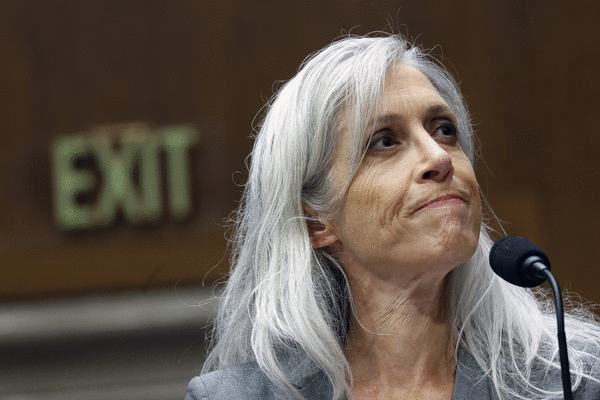
That’s after the administration’s first pick, Susan Monarez, was confirmed last year on party lines following two long hearings and weeks of consideration, only for Kennedy to fire her less than a month into the job.
That started a clock ticking on a statutory 210-day deadline to name a successor by Thursday — though loopholes could buy the administration some time.
Murkowski and Cassidy are crucial votes on the HELP Committee, where the nomination will land, and where Republicans have a slim 12-11 majority.
Monarez’s firing was the beginning of Cassidy and other Republicans questioning the direction of health policy in the Trump administration. Monarez said in a hearing that she was dismissed for not signing off on recommendations of Kennedy’s vaccine advisers ahead of time and for refusing to fire career officials who disagreed with him. Kennedy later told the Senate Finance Committee that Monarez was removed because she told him she was not trustworthy.
Republican Sen. Thom Tillis of North Carolina admonished Kennedy for the firing and wasting the Senate’s time.
Since then, former Deputy HHS Secretary Jim O’Neill and now National Institutes of Health Director Jay Bhattacharya — pulling double duty — have led the CDC.
Since the Monarez firing, the United States has seen a surge in measles, whooping cough and flu infections, all of which are vaccine-preventable.
Paul Offit, a former CDC and Food and Drug Administration vaccine adviser and current infectious disease doctor at the Children’s Hospital of Philadelphia, said he’s seen the impacts of Kennedy’s CDC policies in his own hospital in the form of more preventable illnesses and vaccine hesitancy.
He said a new CDC director could help reverse that, but he’s not very optimistic.
“I think it’s you’re loyal to him, or you’re loyal to science,” Offit said of Kennedy. “Those are the two options. And if you can’t be loyal to the science, then you’re not going to be a very good CDC director.”
Statute and loophole
The law determining vacancies at agencies limits how long a vacant “advice and consent” position may be filled by a non-permanent official to no longer than 210 days once the vacancy is created, or 210 days from when a nomination is submitted to the Senate. The law also allows a qualified person to serve for 210 days after the first or second nomination is rejected, withdrawn or returned.
Loopholes offer ways around this limit. For one, these periods of 210 days are generally understood to run independently, so the submission and pendency of a nomination allows an acting officer to serve beyond the initial 210-day period. Therefore, nominations to the vacant office can extend the periods for acting service for years, according to the Congressional Research Service.
If the Trump administration has not yet picked a permanent nominee, or wishes to delay the process for any reason, it could quickly submit, then withdraw, a nominee. That would restart the 210-day clock, explained Richard Besser, who served as an acting CDC director during the Obama administration.
The HELP Committee will have to approve, and the Senate will have to confirm, any nomination — a relatively new requirement thanks to the 2023 omnibus.
“I remember the debates about whether this position should be one that required Senate confirmation, and I have to tell you, at the time, I was not supportive of that,” Besser said. “I thought it would lead to politicization of a position that should not be political.”
But he said he’s since changed his mind. “We are in a very different situation now,” he said.
HHS senior adviser Chris Klomp, in an interview last week with Stat News, said the agency has interviewed “dozens” of potential candidates. Though there is a structured process to name top candidates, Kennedy will ultimately make the final decision.
Klomp also said that if the White House hasn’t named a nominee Wednesday, HHS would shift to delegate responsibilities, but getting a qualified nominee “is a top priority.”
©2026 CQ-Roll Call, Inc., All Rights Reserved. Visit cqrollcall.com. Distributed by Tribune Content Agency, LLC.






Comments