Trump backs off from Iran threat, citing talks to end war
Published in News & Features
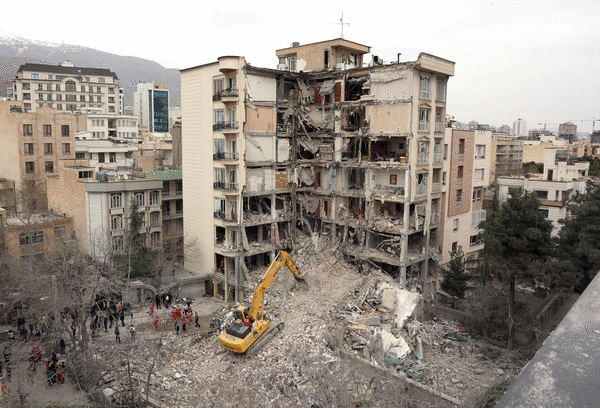
U.S. President Donald Trump postponed threatened strikes against Iranian energy infrastructure and power plants for five days, pending the outcome of what he said were talks with Iran to end the 24-day war.
Both sides are keen to “make a deal,” he told reporters on Monday, adding that there are already “major points of agreement.” The chief goal remains stopping the Islamic Republic from having a nuclear weapon, he said.
Iranian media was quick to pour cold water on Trump’s claims, which were first aired in a social-media post. The semi-official Fars news agency reported that there hasn’t been “direct or indirect communication” with the U.S. leader. Government officials have yet to comment.
Oil plunged more than 14% immediately after Trump’s comments, which came out of the blue as fears were growing of an escalation in the conflict. Crude pared about half those losses after the Fars report, with some traders skeptical about the accuracy of Trump’s statement.
Trump said talks are being led on the U.S. side by envoy Steve Witkoff and son-in-law Jared Kushner, his main pairing for conflict negotiations. “A top person” is representing Iran, though not Supreme leader Mojtaba Khamenei, he said.
The U.S. and Iran could jointly control the Strait of Hormuz — a vital waterway for oil and gas flows — while Washington could take possession of Iran’s uranium, Trump said.
Talks will continue throughout the week, he said on social media.
The U.S. leader has made wildly varied comments on the state of the war since it began, suggesting his priorities have sometimes skewed toward taming prices rather than sharing accurate information.
Various Middle Eastern countries, including Turkey, Saudi Arabia and Oman, have been involved in backchannel talks with Iran in the past two weeks to try to contain the war and, ideally, to find a way for the Islamic Republic and the U.S.-Israeli coalition to agree to a ceasefire.
Trump had given Iran until Monday evening New York time to reopen the Strait of Hormuz or the U.S. and Israel would start bombing the country’s power plants. Iran had vowed to hit energy, information technology and water facilities across the Middle East in response.
Iran also said it would mine the “entire Persian Gulf” in the event of further attacks on its coastline, the country’s National Defense Council said on Monday.
Iran effectively closed the Strait of Hormuz at the start of the conflict, which the U.S. and Israel began with a wave of airstrikes on Feb. 28 that killed former Supreme Leader Ali Khamenei. The blockage to the waterway, a conduit for about a fifth of global oil and liquefied natural gas exports, has seen oil and gas prices surge, with fears growing of an inflation and food crisis.
Iran has retaliated to the ongoing bombardment with strikes on Israel and around the Persian Gulf. At least 4,200 people have been killed in the war to date, more than three quarters of them in the Islamic Republic.
Israel is not seeing an imminent end to the war, and plans to continue operations while avoiding energy assets, according to an Israeli official, who asked not to be identified discussing private matters. Israel was told about Trump’s social media post ahead of time, two officials said.
The Israeli military said Monday it’s targeting Iranian infrastructure and conducting strikes in the heart of Tehran. Iran continued to respond, with Israel, the United Arab Emirates and Saudi Arabia reporting drone and missile attacks, though there were no reports of major strikes.
Israel is also preparing to expand ground operations in Lebanon, where it’s fighting a parallel war against Iran-aligned Hezbollah.
Stocks and bonds rebounded after Trump’s comments about the start of ceasefire talks, having tumbled over the course of the conflict.
Trump has given numerous reasons for starting the war, including the need to eliminate Iran’s ability to build nuclear weapons. Iran has long denied pursuing atomic arms, though hasn’t allowed United Nations inspectors into the country since before an earlier round of Israel and U.S. strikes in June last year.
While it’s not clear what the war has achieved so far, Trump has been under increasing pressure domestically to wrap up the conflict — particularly due to rising gasoline prices. Midterm elections are scheduled for November.
Israeli airstrikes on a key Iranian gas field last week triggered a wave of reprisals, damaging some of the region’s main energy-producing assets, including Qatar’s giant LNG plant in Ras Laffan.
International Energy Agency Executive Director Fatih Birol said more than 40 energy sites across nine countries in the Middle East have been “severely or very severely” damaged, potentially prolonging disruptions to global supply chains once the conflict ends.
The damage means it will take some time for oil fields, refineries and pipelines to be brought back online, Birol said. That’s on top of the blockage to the Strait of Hormuz, which Iran has kept closed to all but a selected few ships. Two Indian-flagged vessels carrying liquefied petroleum gas are making their way through the waterway on Monday, ship-tracking data show.
Iran’s missile strikes against Israel had picked up in recent days. On Saturday, about 115 people were injured in the southern cities of Arad and Dimona, the latter of which lends its name to a nearby nuclear-research facility. Iranian media said the strike was in retaliation for an attack on its Natanz nuclear facility.
Israeli Prime Minister Benjamin Netanyahu reiterated his country’s military objectives on Sunday, telling reporters the aims are to “break completely their nuclear program, break completely their missile program.” He added that Israel has “a goal of creating conditions” for Iranians to overthrow their leaders and called on other countries to join the war.
The U.S.-based Human Rights Activists News Agency said at least 3,231 people have died in Iran. Of those, 1,407 were civilians, 1,167 were members of the military and the status of the rest has yet to be ascertained.
In Lebanon, where Israel has intensified its offensive against Hezbollah militants, the death toll exceeds 1,000. Dozens have been killed in Israel and Arab states.
--------
—With assistance from Golnar Motevalli and Dana Khraiche.
©2026 Bloomberg L.P. Visit bloomberg.com. Distributed by Tribune Content Agency, LLC.






Comments