Therapeutic ketamine grows in popularity
Published in News & Features
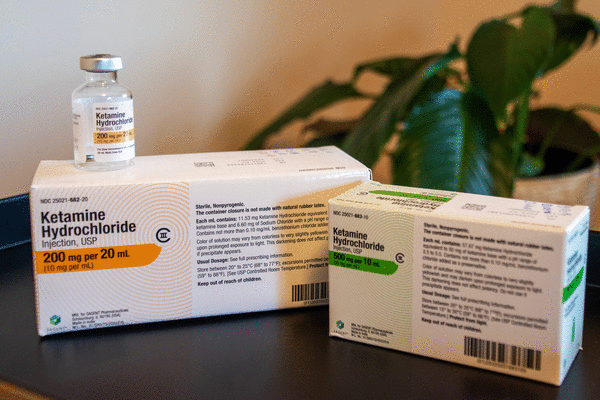
In a cozy room at New Directions Mental Health in O’Hara, Pennsylvania, patients show up with warm blankets or soft pillows they bring from home. They dim the lights or use a provided Northern Lights-like projector to set the mood as they settle in for ketamine therapy, a rapidly growing treatment for stubborn depression.
“We’ve seen it do wonders for our patients in a really quick time frame,” said Ryan Wakim, New Directions’ chief medical officer.
Ketamine was developed as an anesthetic in the early 1960s, used for both humans and animals during medical procedures. Around 25 years ago, researchers started investigating its potential to help depression, administering the drug through IVs to do so.
Providers such as Wakim set up clinics to allow patients to use ketamine intravenously, driven by research showing its effectiveness almost immediately after use.
In 2019, the U.S. Food and Drug Administration approved a form of ketamine called esketamine as a nasal spray.
In that form, the drug is easier to administer and more likely to be covered by insurance. And, after a slow start, esketamine is catching on through a combination of research, regulatory changes and even hype from social media and reality shows.
Johnson & Johnson, the maker of the esketamine drug Spravato, said that the drug surpassed $1 billion in sales in 2024 and grew more than 50% in both 2024 and 2025.
At New Directions Mental Health, the practice built two “Spravato rooms” when it remodeled its O’Hara location in 2024. The demand is such that both rooms are frequently in use, and the clinic will soon expand from offering four days of ketamine therapy per week to five.
Esketamine is approved for patients with treatment resistant depression, meaning that they have tried two different antidepressants without relief from their symptoms. About 30-50% of those with depression fall into that category. In January 2025, the FDA approved esketamine as a standalone therapy, so that it no longer has to be used in conjunction with an oral antidepressant.
It is regulated as a controlled substance, and must be tracked through the federal Risk Evaluation and Mitigation Strategy, or REMS, system.
For treatment, patients arrive at a clinic and self-administer the nasal spray, similar to Flonase. They may go into a dream-like state, and must be monitored for side effects such as nausea, high blood pressure and disassociation. They generally stay in the clinic for monitoring for about two hours, and need to have a ride home, similar to an outpatient anesthesia procedure.
Typically, patients start on esketamine twice a week, and then drop to once a week or once a month. It can be used in conjunction with talk therapy or oral antidepressants, or just on its own.
And its effects can be nearly immediate.
“Its real differentiation with other antidepressants is its very rapid onset of effects,” said Steve Forman, medical director for the AHN Center for Psychiatric Neuromodulation. “You get prescribed Prozac, and it can take weeks and weeks to take effect. With ketamine or esketamine, you can see it in those two hours, and that’s a big separation between that and other forms.”
One study in 2024 gave three IV ketamine infusions over 11 days to 74 patients with severe depression. Just over half of the participants achieved complete remission of depression, and an additional 15% had some response.
Another recent study compared esketamine and IV ketamine over a treatment period of four to five weeks, finding that esketamine reduced depression scores by about 40%, and IV ketamine reduced symptoms by about 49%.
Since Spravato was approved in 2019, esketamine has become increasingly popular versus IV ketamine, though both are still used.
Because of the ease of administering Spravato, Wakim has closed the IV ketamine clinic that he used to operate in Monroeville, Pennsylvania.
“We’ve completely moved on at this point,” he said. “Spravato is FDA approved, in many respects it’s safer and less complicated and it’s covered basically ubiquitously. For us it just made more sense.”
At the University of Pittsburgh Medical Center, doctors use both IV ketamine and esketamine, depending on the circumstances.
Allegheny Health Network does not currently use either form of ketamine for psychiatric treatment, though Forman has experience with it from his time working at the VA Pittsburgh hospital, where he saw some impressive results.
“I was always kind of skeptical when I heard that this happens, and people get better in two hours,” he said. “I had a patient who was referred to us, and their clinicians were thinking that this patient was state-hospital bound. A year later, doing esketamine, that patient was doing spectacularly well — it was astonishing.”
For some patients, the downside of ketamine can be the side effects, or simply that it doesn’t work as they hoped. For the industry as a whole, there is concern about rapid growth of a drug that is also used and abused recreationally.
The death of “Friends” star Matthew Perry from a ketamine overdose in 2023 brought scrutiny to ketamine use. Perry was using ketamine therapeutically in supervised settings, but was also buying it and injecting it in much larger doses, leading to his overdose.
“It can be a drug of abuse,” said Marie Anne Gebara, medical director for ketamine services at The Center for Interventional Psychiatry at UPMC Western Psychiatric Hospital. “There is concern, and that’s something we counsel our patients about before starting the treatment in terms of the risk and benefit discussion. We look at certain criteria in terms of substance use to see if someone is appropriate or not.”
While Spravato use is tracked and regulated, IV ketamine use has fewer safeguards, because it is not FDA approved as a depression treatment and is being used off label.
Ketamine therapy is also spreading on social media and in popular culture. One episode of the Hulu reality show “The Secret Lives of Mormon Wives” shows an IV ketamine session in the context of marriage therapy. Celebrities such as Kristen Bell, Michael Phelps and Ryan Reynolds have all said that they found ketamine therapy helpful.
For Gebara at UPMC, part of counseling patients is balancing the hype that they may have heard versus that fact that ketamine is not necessarily a miracle cure.
“Compared to some of the other treatments we offer, also for treatment resistant depression, there definitely seems to be more interest from the patients who are coming to us to receive ketamine,” she said. “Just because it’s talked about doesn’t mean that this is the treatment that will fix everyone’s depression — we do need to set realistic expectations.”
Wakim said that ketamine therapy was once thought of as a last resort, for patients where nothing else has worked. Now, he said, it’s often part of a standard treatment course.
“We really think about it early in the treatment plan, even if they are not yet a candidate,” he said, noting that many of the patients at New Directions have already tried one antidepressant prescribed by a PCP before making an appointment with a psychiatrist there. “For us, almost everyone who walks in the door is a candidate.”
For Wakim, Spravato can be a far superior treatment to oral antidepressants. The nasal spray works faster, often with fewer side effects, he said, and doesn’t depend on daily compliance.
“Depression is a life-threatening condition, and we have an opportunity to impact that much more quickly,” he said. “When I first saw what these treatments could do, I couldn’t unsee it.”
_____
© 2026 the Pittsburgh Post-Gazette. Visit www.post-gazette.com. Distributed by Tribune Content Agency, LLC.


Comments