Minnesota's caregiving workforce was already short-staffed. Then ICE came
Published in News & Features

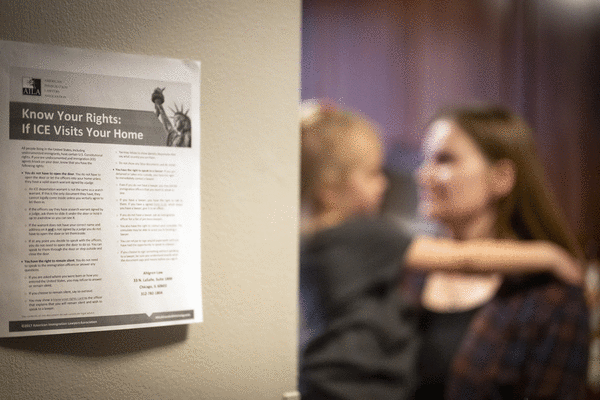





MINNEAPOLIS — Ekaterina’s husband was taken by immigration officers on a Sunday morning as he warmed up the family car. Three months later, he still hasn’t come home.
The Eagan, Minnesota, couple, who left Russia and sought asylum in the U.S., have valid work permits and spent the past year providing support for people with disabilities in Twin Cities group homes.
They did hard sometimes physically demanding work, including helping people bathe and changing their clothes. But Ekaterina said the couple — who have a daughter with spina bifida — felt they were doing valuable work, and made deep connections with people they served.
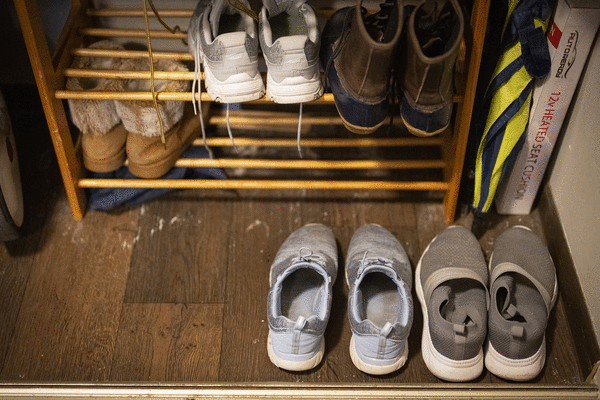
Neither is working now, as her husband, Bogdan, remains in a Louisiana detention center and Ekaterina stays at home with their two children, terrified she will be taken too. She asked not to be identified with their last name for fear of retribution.
Their story is an extreme example of how Operation Metro Surge shook Minnesota’s already short-staffed caregiving workforce.
Immigrants and refugees make up a substantial portion of the workers in industries that care for vulnerable people, including services for people with disabilities, older adults and children. Federal immigration activity in the state has diminished. But people in the caregiving fields say the crackdown — paired with the increased scrutiny on social services programs due to widespread fraud concerns— could have long-term consequences for Minnesotans who need the most help.
Organizations were starting to rebuild from pandemic-era staffing shortages, said Julie Johnson, who leads the disability service provider MSS. Then Congress approved Medicaid cuts last year, and the Trump administration launched Operation Metro Surge and pointed to fraud in Minnesota as a reason for the largest immigration enforcement deployment in U.S. history.
“We’re at a teeter-totter point where this is really going to destabilize the system,” Johnson said. “We can’t keep running into these big things.”
Large immigrant workforce
Roughly 30% of the long-term care workforce is made up of immigrants, said Nicole Mattson, with the association Care Providers of Minnesota.
People who provide such services must go through background checks and be authorized to work in the United States.
Nonetheless, Mattson described widespread anxiety in the field during the ICE operation. She heard of a couple of providers that were visited by agents. There were stories of staff being stopped before or after work. Some employees said they continued going in because they had to pay rent, but they were scared.
Minnesota was already facing a critical workforce shortage in caregiving jobs, she said, noting it is one of the only sectors with persistent high job vacancy rates.
“Demographically, we just don’t have enough workers, period, to do all of the jobs in Minnesota,” Mattson said. “Now we’re exporting talent? It doesn’t make a lot of sense.”
Disability service providers told the Minnesota Star Tribune that while their workers were generally still coming in during the immigration crackdown, some were carpooling because they were afraid to travel alone. And once employees arrived at work, they were worried about taking people out into the community, often a key part of their job.
Child care center employees also have been afraid to come to work, said Carol Luo, vice president of human resources for New Horizon Academy, noting a staff member was picked up during their lunch break and temporarily detained.
An employee who worked at New Horizon for more than 10 years didn’t want to live in fear so, the employee uprooted their family and returned to their home country. Another didn’t show up for new employee orientation. The center discovered she was detained and later decided to leave Minnesota and return to another state.
While the individual stories seem small, they are compounding to reduce staffing, Luo said.
“There isn’t a single HR peer that I talked to in the care industry in general that isn’t experiencing staffing shortages,” Luo said. “This definitely has made it worse.”
Fraud adds to hiring challenges
The immigration crackdown coupled with the attention on social services fraud has been a “double whammy,” said Clare Sanford, with the Minnesota Child Care Association. Providers in various caregiving fields lament that a small subset of bad actors have sowed broad distrust.
While recent fraud investigations in Minnesota have focused on Medicaid and child nutrition programs, a viral video conservative influencer Nick Shirley posted in December about Somali-run daycare centers thrust the child care sector into the public eye.
“It’s just cast a chill over the whole industry,” said Sanford, who also works for New Horizon. She fears that someone who, for example, wants to move from a retail job to working with children will now question whether they want to leave a field “where no one is going to accuse me of fraud or being a criminal, and go work in an industry where all the spotlight seems to be on it.”
Over the past couple of weeks, Luo said they haven’t heard stories of child care workers being picked up by ICE agents. But she said the fear of that possibility has contributed to difficulties recruiting qualified employees this year.
Immigrants and refugees have also been an essential part of the workforce for seniors, with staffing demands continuing to grow as baby boomers age. LeadingAge Minnesota, an association of organizations that help older adults, recently put out a five-part video series in eight languages to try to help recruit new Americans to provide senior care.
Ekaterina said it can be hard to find people to cover shifts in the home where she worked. She said many employees have green cards.
“Caregiving, it’s a tough work. It’s not a dream job,” she said, but she thinks about her daughter as she does it. “When I take care of all these people, I am thinking, I am paying it forward ... I don’t know what her future will be, but if she will be in a house like that, that will be not so bad.”
And while the work can be difficult, Ekaterina liked her job and misses the connection with clients, including one woman who has been asking why she is not coming to work.
“It’s just breaking my heart,” she said.
©2026 The Minnesota Star Tribune. Visit at startribune.com. Distributed by Tribune Content Agency, LLC.






Comments