Expand the House, shrink the Senate? Minnesota lawmakers debate changes to avoid another tie
Published in News & Features
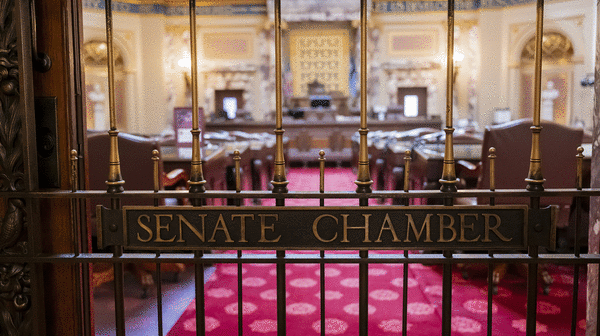
MINNEAPOLIS — A longtime state representative wants to solve a problem in the Minnesota House — a tie of 67 Republicans and 67 Democrats — in part by drastically shrinking the state Senate.
The likelihood that senators would vote to eliminate 22 of their own seats is slim.
But state Rep. Paul Torkelson, R-Hanska, says it’s the best way to avoid the kind of headache created by lengthy negotiations and drama over a special election that stopped business in the House for weeks in 2025.
“We came in with a tie, and we had a very difficult time even starting the session,” said Torkelson, who has been in office since 2009 but is not seeking re-election.
Torkelson’s proposal would add one lawmaker to the House, growing that chamber to 135. It would cut the size of the state Senate from 67 to 45 members. The change in the Senate would be necessary to meet legal requirements for drawing legislative districts, Torkelson said.
While the bill stirred up jokes during a committee hearing on Tuesday, March 17, it shows some lawmakers view the House tie as a serious enough problem to warrant real attention.
In the fall of 2024, voters sent a tied House to the Legislature that forced Republicans and Democrats to figure out how to run an evenly divided chamber.
But the balance of power was quickly upset. A judge ruled a newly elected DFLer was ineligible to take office because he didn’t live in the Roseville-area district he was supposed to represent, giving Republicans a temporary 67-66 advantage before a special election.
When the GOP attempted to run the House before that special election, Democrats boycotted the Legislature, denying the GOP a quorum of 68 members required to conduct business. Republicans also suggested they could refuse to seat Rep. Brad Tabke, a Democrat who won by 14 votes in a race where election officials lost 20 absentee ballots.
Eventually, the two parties hashed out an agreement that made Republican Lisa Demuth the House Speaker and seated Tabke. The DFL then won the special election in Roseville, restoring the tie.
But the standoff stalled the House for weeks, and a year later, lawmakers are still debating who was at fault.
Torkelson said Democrats “refused to show up for work” and that the episode was “really damaging the reputation of the House, and if that had gone on longer could have actually made it impossible to get our work done.”
Rep. Ginny Klevorn, DFL-Plymouth, responded by saying “half of the House was supporting the vote of the voters” who initially selected a tied chamber, not GOP control.
The House has been tied once before, in 1979, after the size of the chamber was reduced from 135 to 134. Republicans and Democrats fought for control of the House that year, too, in often dramatic fashion.
“Both times, we very nearly had a crisis,” Torkelson said.
Any changes to the House would also require changes to the Senate, though. The state Constitution requires that “both houses shall be apportioned equally throughout the different sections of the state.” Torkelson said a House district can’t be split between multiple Senate districts, and each Senate district must have the same number of House districts contained within it.
Torkelson’s bill would result in three House districts in every Senate district, rather than two.
That would mean big changes for what is now the largest state Senate chamber in the U.S., though Minnesota is closer to the middle among legislatures in the number of people represented per senator when adjusted for population.
Torkelson said he “shared this idea with some senators,” but the panel of other representatives interrupted his sentence, laughing. While lawmakers in the House and Senate have to work together to pass bills, the two chambers have a friendly rivalry and often tease each other.
“I think [the laughter] was all sharing the joy of potentially seeing less senators roam our halls,” said Rep. Jim Nash, R-Waconia.
Still, Klevorn said she had some concerns about the dilution of voter representation by shrinking the Senate and increasing the workload for the remaining lawmakers.
House DFL Leader Zack Stephenson has been pondering the bigger picture at the Legislature, too. He told the Minnesota Star Tribune he has been reading a book about former House Speaker Martin Sabo, which explains how districts have changed over the years after legal battles.
“Hey man, fewer senators sounds good to me,” Stephenson quipped. But then he suggested the idea to untie the House wouldn’t go far as long as DFLers share power.
“I don’t know, I think this is working fine for a once in a blue moon occurrence,” Stephenson said. “I don’t know that we need to change the structure for it.”
©2026 The Minnesota Star Tribune. Visit at startribune.com. Distributed by Tribune Content Agency, LLC.

Comments