Funeral for Rev. Jesse Jackson draws former presidents, throngs of Chicagoans to send off civil rights icon
Published in News & Features
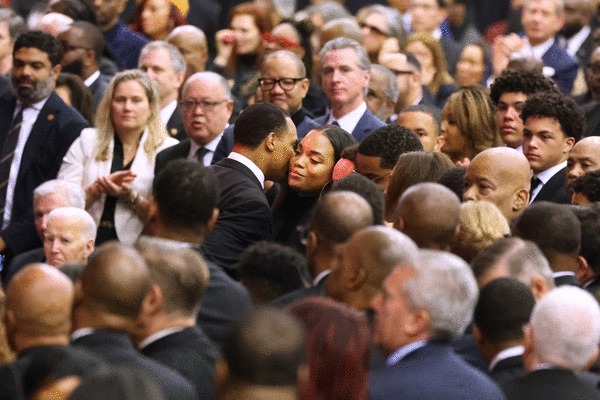
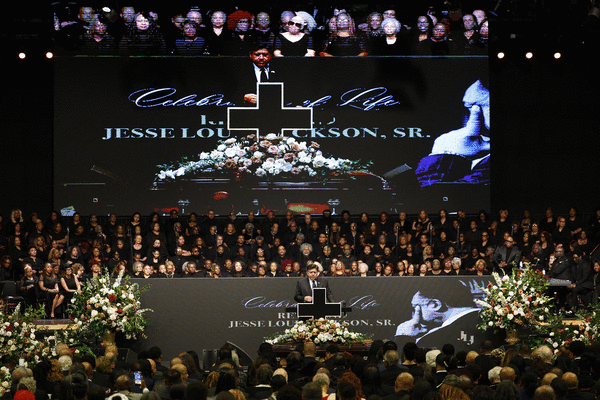

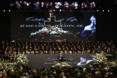
CHICAGO — A crescendo of voices from the worlds of religion, politics, business, sports and entertainment converged Friday at the South Side’s House of Hope, providing a requiem to the vast reach of the leadership, inspiration and teachings that made the Rev. Jesse Jackson a national civil rights icon.
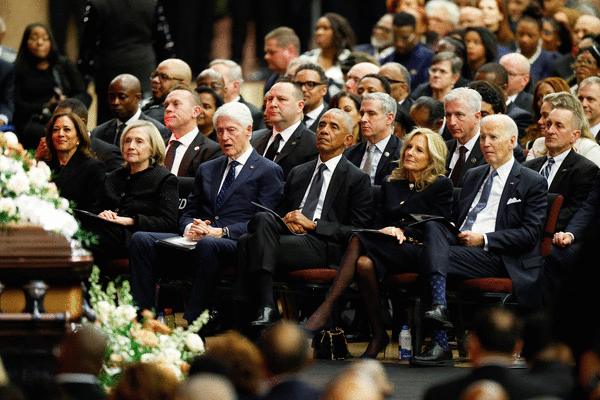
More than 1,000 people attended the public celebration of life ceremony for Jackson, including former Presidents Bill Clinton, Barack Obama and Joe Biden, who were accompanied by former first ladies Jill Biden and Hillary Rodham Clinton, as well as Gov. JB Pritzker, Chicago Mayor Brandon Johnson, NBA Hall of Famer Isiah Thomas and Chicago Cubs owner Tom Ricketts.
Award-winning singer and actress Jennifer Hudson performed “A Change Is Gonna Come” and gospel singers Benjamin “Bebe” Winans and his older brother, Marvin Winans, contributed to the daylong music-filled event.
Jackson, a Baptist minister whose charismatic rhetoric made him a key leader in the nation’s Civil Rights Movement for more than six decades — picking up the baton of civil justice and equality left by the assassination of the Rev. Martin Luther King Jr. — as well as a two-time contender for the Democratic nomination for president, died Feb. 17 at age 84.
A private homegoing service, set to include a special musical tribute by Stevie Wonder, will conclude the memorials for Jackson on Saturday.
Religion and politics often mixed throughout the ceremony with speakers frequently citing Jackson’s mantras of “I am somebody” and “Keep hope alive” as a counterbalance to the turbulent, divided political times under President Donald Trump.
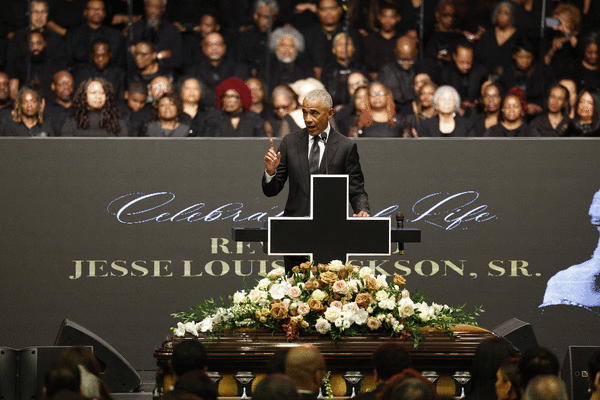
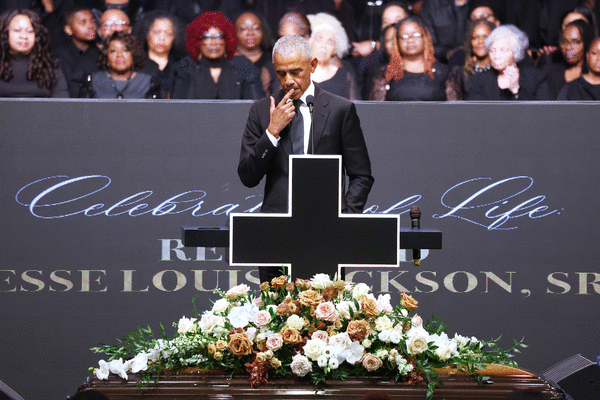
Obama, who rose from a community organizer to the state legislature and U.S. Senate before becoming the nation’s first Black president, credited Jackson’s first run for the presidency and Harold Washington’s election as Chicago’s first Black mayor with drawing him to Chicago.
But Obama said Jackson’s legacy of hope is needed now more than ever.
“Each day we wake up to some new assault on our democratic institutions, another setback to the idea of the rule of law, an offense to common decency,” Obama said, adding that “we’re told by those in high office to fear each other and to turn on each other, and that some Americans count more than others, and that some don’t even count at all.
“Everywhere we see greed and bigotry being celebrated and bullying and mockery masquerading as strength, we see science and expertise denigrated while ignorance and dishonesty and cruelty and corruption are reaping untold rewards. Every single day, we see that, and it’s hard to hope in those moments,” he said.
“So it may be tempting to get discouraged, to give in to cynicism,” Obama said. “It may be tempting for some to compromise with power and grab what you can, or even for good people, maybe just put your head down and wait for the storm to pass. But this man, Rev. Jesse Lewis Jackson, inspires us to take a harder path. His voice calls on each of us to be heralds of change, to be messengers of hope.”
Clinton recounted a phone call he received from Jackson in the midst of the 1998 impeachment proceedings against him, asking to speak with his daughter Chelsea, who was then around 18.
“He called me to talk to my daughter to make sure she had her head in the game, and he prayed with her on the phone,” Clinton said, adding, “those are the things you remember.”
“He was faithful to the scripture, which said we have all sinned and fallen short of the glory of God. But unlike a lot of people in politics, he didn’t go around looking down his nose at other people,” Clinton said. “He hated the sin and not the sinner. He was always trying to lift people up.”
And Biden called Jackson “an optimist at his core.” But he warned “we’re in a tough spot, folks. We’ve got an administration that doesn’t share any values that we have.”
“Jesse kept hope alive for us in his lifetime, and we’ve got to continue to do it in our lifetime, for our children,” Biden said.
The Rev. Otis Moss III of the South Side’s Trinity United Church of Christ called Jackson a “Son of the South, practitioner of good trouble and acolyte of holy mischief” who was a “spiritual artist who painted upon the canvas of democracy with a rainbow coalition of colors that had been marginalized by antebellum myths that dismissed human dignity.”
“May we honor him by daring to keep hope alive? May we honor him by daring to speak truth to power? May we honor him by daring to call out corruption, moral malfeasance, political narcissism, autocratic action, authoritarian behavior and cult-like oligarch spirits masquerading as civic duty?” Moss said. “We offer these prayers of farewell this day and all those who gather in this space, who seek to keep hope alive and know you are somebody may say, ‘Amen.’”
Johnson delivered a rousing sermon-like tribute that recounted a visit he made with Jackson to the Edmund Pettus Bridge in Selma, Alabama, the site of violent police action against peaceful protesters in 1965 seeking voting rights. He said Jackson understood the bridge was a metaphor for “what’s waiting for us on the other side.”
“We are in the midst of a choice to choose hope over despair, light over darkness, love over hate, because he knew there was too much to gain on the other side of the bridge,” Johnson said, blending his tribute to Jackson with his own political agenda items.
“On the other side of the bridge, affordable housing as a human right. On the other side of the bridge, health care for all. On the other side of the bridge, safe and affordable cities, accessible transportation, finally, fully funding our public education system,” he said as the crowd jumped to its feet. “It is time to cross the bridge, to build an economy that works for all, Black, brown, white, Asian, young, old. It is time for the ultra rich to pay their fair share in taxes. … Reverend, you cross your bridge. We know our assignment. We’ll see you on the other side.”
Pritzker said that for Jackson, “each day, each day, was a new opportunity to bring justice in a too often unjust world.”
“Now to the world, Jesse Jackson was an ambassador of hope for the oppressed, who met with kings and queens and presidents and dictators and clergy of all the great religions, but here in Chicago, he was our neighbor. He was our friend,” the state’s two-term Democratic governor said.
“He was politically connected. He knew he shared an affliction common to all those in this room. He loved the political game all the way to the end, and while we know that we shared him with the whole world, Rev. Jackson belonged to Chicago, and Chicago belonged to him. He was ours and we were his,” Pritzker said.
The Rev. Al Sharpton urged attendees not to be content with honoring Jackson’s accomplishments when “people at the same time are killing illegal immigrants. People at the same time are cutting public funding. At the same time, the Affordable Care Act is not being renewed, and seniors have to deal with premiums. Don’t sit here so holy and sanctified and act like you have no assignment yourself.”
“There was a breakout in 2024 called Negro amnesia, where you forgot where you came from and forgot how you got where you got. Therefore they’re trying to take back everything you have. ... The problem is not Trump. The problem is us,” he said.
“We are allowing ourselves to be lowered and our children to feel inferior, because you don’t have an, ‘I am somebody’ person,” Sharpton said. “So what I’m urging you to do is leave here with some Jackson fire in you. Not just a program book, but to say, ‘I see the things the way they are, but I’m going to turn and change them.’”
Also in attendance was former Vice President Kamala Harris, the unsuccessful 2024 Democratic presidential nominee, as well as California Gov. Gavin Newsom and Gov. Wes Moore of Maryland, who, like Pritzker, are considered potential contenders for the 2028 Democratic presidential nomination.
Actor and filmmaker Tyler Perry was also at the service, along with television’s Judge Greg Mathis. Mr. T, who was wearing clothing displaying the American flag, said, “I’m here to honor the Rev. Jesse Jackson, the preacher’s preacher.”
Donna David of Burnham said she woke up at 5:30 a.m. to attend the services. Usually part of the church’s choir, she said she wanted to sit in the audience to take in the event.
“My father raised me under the mantra, ‘I Am Somebody.’ I carry that around in my spirit,” she said. “We got enough of everything else out here, but we don’t have enough love and togetherness. That’s what he stood for.”
Jackson was born and raised in South Carolina and it was during his attendance at North Carolina Agricultural and Technical College in Greensboro that he launched his role in the growing Civil Rights Movement of the early 1960s when he helped lead local demonstrations and sit-ins with a goal of integrating public institutions.
It was during his time at the Chicago Theological Seminary that Jackson organized students to take part in protests in Selma, where he met King, joined the Southern Christian Leadership Conference and became a King protege.
In Chicago, he opened the SCLC’s Operation Breadbasket with the aim of encouraging Black employment and entrepreneurship, using pickets and boycotts as negotiating tools.
Jackson was diagnosed with Parkinson’s disease in 2017 and in April of last year, he was diagnosed with progressive supranuclear palsy, a neurological disorder.
____
©2026 Chicago Tribune. Visit at chicagotribune.com. Distributed by Tribune Content Agency, LLC.






Comments