El Mencho killing: Maryland retirees see Puerto Vallarta in chaos after cartel violence
Published in News & Features
Monroe Davids, 79, and his wife, Donna, 81, of Germantown, Maryland, were sitting in the living area of a Puerto Vallarta condominium last Sunday, each reading a novel when their quiet routine was shattered by a series of explosions outside.
The Davids left their one-bedroom condo to find out what was happening, but maintenance workers at his building and other nearby structures were telling people to go inside, to shelter in place, Monroe told The Baltimore Sun in a phone interview from Puerto Vallarta.
“There were no police on the street,” Monroe said.
The Davids — retired public school geography teachers who worked in the Montgomery County public school system for 30 years and vacation in Puerto Vallarta — walked to the condo building’s top floor, where they joined dozens of other tourists, mostly Canadians and Americans, watching thick smoke rise from multiple fires. Some were blocks away; others were in the shadow of their building.
The couple, who have been married more than 36 years, said they watched the smoke for hours.
A private security officer working in their building slept in the lobby that night to keep guests safe, said Donna, who grew up in the Baltimore region. “He put a large chain and lock on the front double doors,” she said. “I thought that was very noble of him. People in the condo offered him a bed for the night, but he wanted to remain in the lobby.”
Arson attacks and assaults on Mexican security forces erupted after the Feb. 22 killing of notorious cartel leader Nemesio Oseguera Cervantes, known as “El Mencho.” He was fatally wounded in a shootout with Mexican troops in Tapalpa, a town about 180 miles from Puerto Vallarta, after authorities tracked him there using U.S. intelligence, Mexican Defense Secretary Ricardo Trevillo said.
El Mencho was the leader of the Jalisco New Generation Cartel, which boasts about 20,000 members and generates billions of dollars annually from drug trafficking, extortion, fuel theft, kidnapping for ransom, illegal logging, illegal mining, timeshare fraud and migrant smuggling, according to the National Counterterrorism Center.
After the killing, cartel operatives tossed Molotov cocktails into businesses, cars and buses. The cartels created roadblocks and engaged in gun battles with Mexican security forces. In addition to El Mencho, Mexican security forces killed about 42 organized crime operatives and the Mexican government said 27 Mexican soldiers were killed in clashes that broke out in 22 states, published reports said.
“It’s really impossible to overstate how shocking this was and how unprepared everyone was for this event,” Tomás Michael Carvallo, a senior intelligence analyst with McLean-based international security firm Global Guardian, told The Sun. “What’s important to note his how quickly the government regained control of the security situation. They surged security force deployments; 400 additional army soldiers arrived at the port and began patrolling. Within the first day, they were able to restore order.”
A day after El Mencho’s killing, the U.S. State Department urged Americans to shelter in place in Jalisco, Nayarit, Chiapas and Michoacán, although that advisory has since eased. Travelers are advised to reconsider visiting Jalisco due to terrorism, crime and kidnapping, but there are no restrictions for the Guadalajara metro area, Riviera Nayarit, Chapala or Ajijic. Mexico, however, remains under a Level 2 advisory, urging increased caution.
Traveling to Puerto Vallarta should be safe for spring break, Carvallo said, although he advised tourists to have a contingency plan. “(Travelers) need to have a way to contact their family back home and tell them they’re safe,” he said. “They need to find an alternative way back to the hotels, ways to get food or water if they … are stranded.”
Cartel leaders and operatives don’t typically target tourists because it’s bad for business, Carvallo said. They know that any violence against tourists would trigger a massive response from Mexican security forces — and many cartel members have businesses, like restaurants, that would suffer if tourists stayed away, he said.
“A lot of these criminal organizations, they think of themselves as businesses,” Carvallo said. “They tend to avoid harming civilians and tourists. It’s bad PR for them.”
Snapping photos instead of sheltering in place
The day after the Feb. 22 attacks, “we were told by (building) staff that we had been told to shelter in place,” Donna Davids said. “But tell a photographer to shelter in place!”
Monroe Davids, an avid amateur photographer, disregarded the order and slipped outside. Monroe wandered the streets around the condo building, snapping photos of a burned-out bus, a burned-out car, a torched mattress store and a pharmacy whose insides had been gutted by fire.
Local workers and businesspeople were busy cleaning up the streets and businesses that had been torched. Other than that, the day after the attacks the city seemed back to its typical, tranquil self, the Monroes said.
The Davids arrived in Puerto Vallarta on Jan. 4 and are scheduled to leave Feb. 28. They regularly vacation in the city — they have done so for 30 years — and the couple already has arranged to rent a place in the city next year. Monroe said he has no qualms about returning, though Donna called being so close to violence “unnerving.”
Despite that, she said she loves Puerto Vallarta.
“You can walk the Malecón (a seaside boardwalk), watch the whales play in the water,” Monroe said. “Fishermen bring in fresh fish. There’s a market in the city park, and a weekly art walk downtown. The food is remarkable and the people are wonderful.”
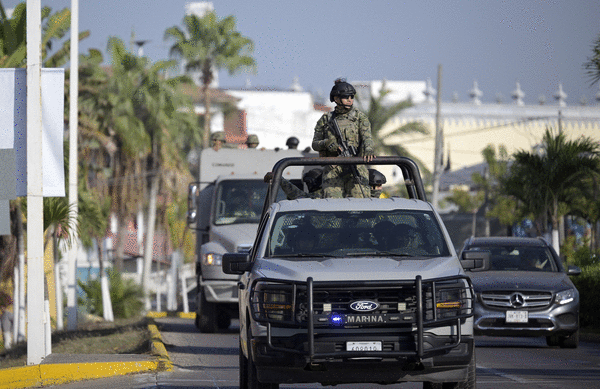
By Wednesday, caravans of police pick-up trucks with officers standing in the bed, holding AR-15 rifles, patrolled the streets of Puerto Vallarta, Monroe said.
“I believe that they are showing the people that they are safe,” he said.
_____
©2026 Baltimore Sun. Visit baltimoresun.com. Distributed by Tribune Content Agency, LLC.






Comments