UAE and Qatar urge allies to help Trump find Iran off-ramp
Published in News & Features
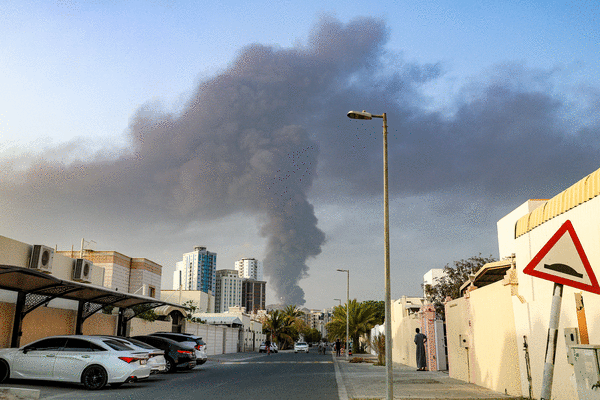
The United Arab Emirates and Qatar are privately lobbying allies to help them persuade President Donald Trump to reach for an off-ramp that would keep U.S. military operations against Iran short, according to people familiar with the matter.
The countries are seeking to build a wide coalition to advance a swift and diplomatic end to the conflict, the people said, in order to prevent regional escalation and a prolonged energy price shock. They were speaking on condition of anonymity discussing matters that have not been made public.
Countries in the Gulf region have expressed the need to strengthen their air defense capabilities, requesting Italy’s help with anti-drone and anti-aircraft systems, Italian Defense Minister Guido Crosetto told lawmakers on Monday.
Crosetto added that this was a very delicate matter “considering that these capabilities are already heavily strained and limited in light of European needs and the support provided so far to Ukraine.”
A Qatari assessment shared with Bloomberg News warned that if shipping lanes in the region remain severely disrupted by the middle of this week, they would expect to see a more significant market reaction for natural gas prices than Monday’s sharp spike.
Since the U.S. and Israel began striking Iran on Saturday, the conflict has widened fast — drawing in countries that say they aren’t part of it as their bases, infrastructure and citizens are exposed to retaliation.
Qatar shut down liquefied natural gas production at the world’s largest export facility after it was targeted in an Iranian drone attack, sending European gas prices surging more than 50%.
Privately, both the UAE and Qatar are working to quickly improve their air defense capabilities, the people familiar with the matter said.
The UAE has requested assistance from its allies with medium-range air defense, while Qatar has asked for help to counter drone attacks — which have emerged as a greater threat than ballistic missiles — the people added. Qatar’s stocks of Patriot interceptor missiles will last four days at the current rate of use, according to an internal analysis seen by Bloomberg News.
The UAE’s Ministry of Foreign Affairs released a statement rejecting what it called “false and misleading claims published by Bloomberg.”
“The Ministry reaffirms that the UAE’s advanced defense capabilities, institutional readiness, and integrated national security framework remain steadfast and uncompromised,” the statement said.
Qatar’s International Media Office also released a statement, which said: “The Qatar Armed Forces have repeatedly demonstrated their capability to defend the nation against external threats and remain at full readiness to protect all citizens, residents, and visitors for as long as necessary.”
The “inventory of Patriot interceptor missiles held by the Qatar Armed Forces has not been depleted and remains well-stocked,” the statement said in response to Bloomberg’s story.
Qatar said it downed two Sukhoi Su-24 warplanes from Iran and intercepted seven ballistic missiles. It also intercepted five drones. The threat was addressed immediately upon detection and all missiles shot down before they could reach their targets.
The defense ministry earlier Monday said Qatar was attacked by two Iranian drones, one targeting a water tank at a power plant in Mesaieed and another targeting an energy facility in Ras Laffan.
UAE President Mohammed bin Zayed Al Nahyan and Qatari emir Tamim bin Hamad Al Thani have held telephone calls with a number of European leaders in recent days including the U.K.’s Keir Starmer, France’s Emmanuel Macron and Germany’s Friedrich Merz.
Prior to the war, Gulf interlocutors — particularly the Qataris, who had cultivated close business ties with U.S. envoys Steve Witkoff and Jared Kushner over the years — had spent months urging restraint, Western officials and another person familiar with the talks said.
Before the strikes, the Gulf monarchies dangled visions of a post-sanctions Iran reopened to Western capital with energy partnerships, infrastructure investments and financial corridors stretching from Houston to Tehran, the officials said.
That pitch resonated with the Trump team’s instincts, with a grand accord potentially resembling the reopening of Venezuela’s oil industry following the U.S. special forces raid that seized Nicolas Maduro, they added. One Qatari official involved in the outreach has been Ali al-Thawadi, who sits on the Board of Peace and has attended some of the U.S.-Iran talks, two of the people said.
Inside Trump’s orbit, however, competing alliances were pressing from different sides. Qatar appealed to commerce, stability and the promise of historic economic normalization with Tehran, the people said, while Israeli officials invoked a shared political identity, security interests and the credibility of Trump’s peace through strength doctrine.
---------
—With assistance from Jon Herskovitz, Alberto Nardelli, Donato Paolo Mancini, Chiara Albanese and Flavia Rotondi.
©2026 Bloomberg L.P. Visit bloomberg.com. Distributed by Tribune Content Agency, LLC.





Comments