Renee Good's lawyer is fighting ICE. He learned civil rights law litigating against Chicago police
Published in News & Features
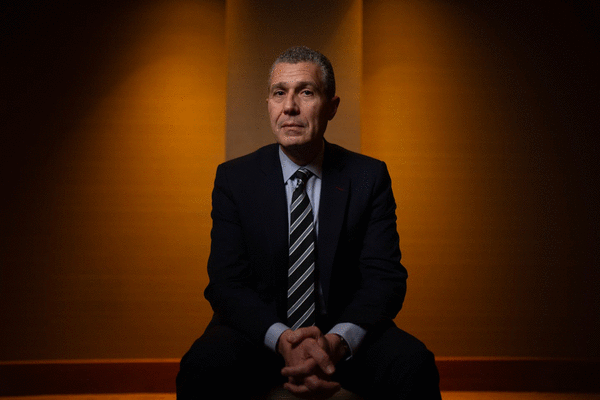
There is a statuette of a cheetah in Antonio Romanucci’s law office in a skyscraper overlooking the Chicago River. It sits next to a magazine cover of Romanucci, Chicago Lawyer’s “2021 Person of the Year.”
The cheetah is sleek and black. And, as the 65-year-old attorney explains, it represents a story he often recites to juries in civil rights cases after police car chases turn deadly.
Jurors weighing responsibility want to know: Why is it the police officer’s fault if a fleeing suspect crashes into an innocent third party?
Romanucci knows it’s a fair question, and he turns to nature for an answer. If the cheetah wants to eat, it must run faster than the gazelle. If the gazelle wants to live, it must outrun the cheetah.
Applied to a police chase, the metaphor means the officers who initiated the pursuit are responsible for its results. Had the cheetah not started the chase, “the gazelle would never run,” Romanucci points out.
Juries may not always agree with the argument, but it has served Romanucci well. For decades, Romanucci and his law partner, Stephan Blandin, have led a successful practice representing not just the victims in police chases, but also patients harmed by doctors and faulty product manufacturers. His practice has catapulted him into the national spotlight, and he’s represented some of the most famous plaintiffs in the country, including the families of George Floyd and Renee Good.
Together, Romanucci and Blandin have won more than $1 billion in verdicts and settlements.
The biggest settlement he won was for up to $800 million from MGM for victims of the 2017 Las Vegas mass shooting.
He won a $98.65 million verdict against former Dallas police Officer Amber Guyger for the 2018 murder of Botham Jean in a case that sparked nationwide outrage.
Most notably, Romanucci represented Floyd’s family in the historic lawsuit following his 2020 murder by a Minneapolis police officer that sparked protests, as Romanucci puts it, “from Sydney all the way up to Alaska.”
As the country enters year two of the second Trump administration, Romanucci continues to be a prominent figure in civil rights law. He is representing the family of Good, the mother of three who was shot in the head by U.S. Immigration and Customs Enforcement agent Jonathan Ross in Minneapolis.
Last month, Romanucci testified in front of a congressional forum in Washington, D.C., about abuses by federal immigration agents.
But where he learned to win cases was Chicago, where the city’s long-troubled Police Department provided practice and an opportunity to stand up for people whose constitutional rights have been violated by their government.
“Litigating against the city of Chicago is probably one of the greatest schools of learning you could go to,” Romanucci said.
Friends and opposing counsel describe Romanucci as a hard worker whose personal skills earn him the trust of clients and juries. He traces it back to lessons he learned from his family.
“I’m not loud, I’m not bombastic, I don’t get pissed off,” Romanucci said in a recent interview. “I don’t wear loud pink ties. I just tell the truth. I just speak from the heart.”
An immigrant story
Romanucci’s father, Dino, was born during the Great Depression in Hershey, Pennsylvania, but his parents took him to Italy when he was 2.
Dino Romanucci didn’t return to the United States until he was 19, when, according to his obituary, he came back with an “itch to finally see the America he saw only in film and see it in real life.”
He was drafted, served during the Korean War and was captivated by Antonio’s mother, Anna Maria, through love letters mailed across the ocean to Italy. They married and moved to Chicago, where they lived in Austin and Galewood before heading into the western suburbs.
Romanucci grew up speaking Italian at home, which later got him in trouble at school.
“My parents got the call early on that there’s something wrong with your son. ‘He doesn’t listen, he doesn’t pay attention. He ignores everybody,’” Romanucci said. “And so eventually they figured out that Sister Donna was calling me ‘Anthony,’ and I didn’t know that I needed to answer to ‘Anthony.’”
In the late 1970s, Dino and a partner bought Benvenuti’s Restaurant in Villa Park. They transformed the restaurant from a pizzeria that catered to local families into a gourmet spot.
Around the same time, Romanucci went to the University of Wisconsin for undergrad then came back to John Marshall Law School, where he graduated in 1985.
Although he didn’t go into the family business, the restaurant and his father played a big role early in his career.
Back then, Romanucci’s father would refer his employees to the son for help when they had car accidents or other issues.
“(He’d say) ‘Call my son,’” Romanucci recalled. “And so that’s how I got my start. I’m in private practice today because of my father, because he helped me with so many clients.”
Prominent family law attorney Enrico Mirabelli remembers Romanucci from his early days, when he was a young lawyer handling workers’ comp cases. He said he helped recruit Romanucci to a leadership position in the Justinian Society of Lawyers, a group founded in 1921 by Italian lawyers who were tired of being discriminated against.
“You just knew by the way he carried himself and the way he approached everything that he was going to be a successful person,” Mirabelli said.
Others also noticed Romanucci, with help from his family.
Harry Comerford was Cook County’s chief judge at the time and a patron of the family restaurant.
One day, Romanucci recalled, Dino told his son, “‘I think you need to come talk to this man. He sounds important.’”
Comerford recommended Romanucci for a job with the Cook County public defender’s office, which he said set him on a 40-year path of “defending people with Fourth Amendment cases.”
After the public defender’s office, Romanucci worked at different firms before teaming up with Stephan Blandin to open their own shop.
In the early days, Romanucci and Blandin started in a small office with a card table and a plastic bag for the garbage.
Changing practice
Now Romanucci’s office is filled with trial mementos.
A baseball bat from one of the earliest successful cases against a bat manufacturer, accusing them of making dangerous aluminum bats that hurt kids.
A turtle from the Supreme Court, underscoring how slowly the wheels of justice turn.
A rubber ball for Jake Tinman, a child who had a stroke and a leg amputation. To prepare him for trial, Romanucci visited him at home and brought him to the office for comfort and familiarity.
In the courtroom, Romanucci used the ball to roll back and forth so the jury could see his diminished physical abilities, he recalled. The jury came back with a $22.3 million verdict.
Going to trial, Romanucci said he likes to spend large periods of time with clients.
“I tell them, in order for me to do well for you, I have to become you. I have to know you. I have to understand you. I have to feel you, because I’m the one that’s going to spend 90% (of time) in front of the jury,” Romanucci said. “You only get to testify for one day, maybe one hour, maybe two at the most, and I’m going to be the one that they’re going to see the most.
“And if they don’t trust me telling your story, then neither of us wins.”
In 2020, Romanucci’s life changed.
He had gone to Florida to recharge when a friend texted to ask if he’d seen a video from Minneapolis of a man being killed by a police officer. He watched the footage of Derek Chauvin kneeling on George Floyd and said, “Holy s—, this is the biggest civil rights case in the world.”
Romanucci’s friend texted, “’Buddy, I hope you get the case.” Two hours later, attorney Ben Crump called to ask him to join him representing the family.
“I coalesced my team here and said that we must now prepare this case like we’ve never prepared another case, ever. The playbook is out,” Romanucci said. “We’re going to create one for the Floyd case, because this is the biggest case that will ever happen.”
In January, Romanucci was hired by Renee Good’s family. In that case, Romanucci said he launched a plan that, first, has involved dispelling the government’s claim that Good was a “domestic terrorist.”
“I promised the family I will never repeat that word or those two words,” Romanucci said, referring to the government’s phrase as “DT.”
Like with the Floyd case, Romanucci said he immediately grasped the importance.
“A woman killed in the middle of the street by a federal law enforcement officer during an occupation by our own government of a major American city,” he said.
The team set out to do a series of media interviews and push out information dispelling the government’s narrative. Romanucci released the autopsy results to make clear what happened. He said a strategy he often relies on is to let people have the facts and make up their own minds.
“So when we release the autopsy result, specifically the one where the shot to the head was to the side and it exited her right side, let the people make their own decision where Jonathan Ross was when he pulled the trigger,” Romanucci said. “And why is that important? Because a police officer should never shoot at a moving vehicle from the side. That is against reasonable and good police practices.”
A partnership
Blandin said the partnership works in part because they complement one another. Romanucci is charismatic and social, with a background in hospitality making him “service oriented.”
“I’m much crabbier,” Blandin quipped.
Their differences were clear from the start.
Early in their practice, the two had a slip-and-fall-case where they settled with a co-defendant before trial but lost the rest of the case in front of a jury.
“We’re both licking our wounds trying to figure out: How are we going to tell people we just lost this (case) that we tried?” Blandin recalled. “(Tony said) ‘What are you talking about? We didn’t lose the case, we won it.'”
They walked into the Justinians event and Romanucci put his spin on the story. Instead of leading with the loss, Romanucci came in and said, “‘Hey, we just had $300,000 on a not guilty.’”
Jim Ormond, a former attorney with the city of Chicago now in private practice, faced off with Romanucci twice in jury trials over the years and praised him as a worthy adversary.
“He’s really in a league of his own in terms of emotional intelligence and ability to connect with both the victims and family members to bring out testimony that’s helpful,” Ormond said. “I think jurors connect with him in the process as well.”
Law school classmate Eddie Wanderling remembers Romanucci as someone “willing to help anybody,” who would stop and give cash to a homeless person and didn’t have “a nasty bone in his body.”
The only time Wanderling recalled Romanucci losing his temper was after college. They were preparing for a trial in a lawsuit involving a car accident where a mother was killed and the rest of her family seriously injured. It wasn’t going well, and Romanucci vented.
“He demands perfection. Not only does he demand it from everybody else, he demands it from himself,” Wanderling said. “We may not notice something but if it didn’t go the way he wanted, it would bother him to no end. Almost to where I think he’s too compulsive about it. But he really cares about his clients. It doesn’t matter their race, their gender, their beliefs. If somebody’s civil rights are violated, he’d step up and defend them with all the ability he could.”
Another John Marshall classmate, Jim Sotos, became a top attorney representing police officers accused of misconduct. He said he was surprised when Romanucci began taking on civil rights cases as he had been “a personal injury lawyer” earlier in his career.
“I didn’t know Tony was doing this kind of work and didn’t know if he’d do much of it,” Sotos said. “But man, he took the area of law by storm. I was pretty blown away by that. I never saw it coming. He’s quickly developed a reputation as one of the very best police misconduct (and) civil rights plaintiffs lawyers in the country.”
Although Romanucci is known for civil rights litigation, he didn’t have his first big break in the field until 2005.
The case involved Vernon Hudson, who was driving westbound on I-290 in May 2001 on his way to help a friend jump-start his car, the Tribune reported at the time. A cop car hit him, caused him to roll over, and paralyzed him. The case was what Romanucci calls a “zero offer” case, meaning the city offered no settlement.
“They said we could never win it,” Romanucci said.
Instead, they got a $17.6 million verdict.
_____
©2026 Chicago Tribune. Visit chicagotribune.com. Distributed by Tribune Content Agency, LLC.






Comments