Cuba and US take calm approach to investigating deadly boat incident
Published in News & Features
A chaotic encounter between Cuban security forces and a boatful of men who had set out from Florida this week could have lit a fuse at a time of increased tension between the U.S. and Havana. Instead, calmer heads are prevailing, for now.
Cuban officials have said that the men were terrorists who had planned and trained for an attack on the country in the U.S. But Deputy Minister of Foreign Affairs Carlos Fernandez de Cossio said in a statement Thursday that U.S. authorities had “shown their willingness to cooperate in clarifying the facts,” despite years of defiant posturing toward Washington by the communist regime.
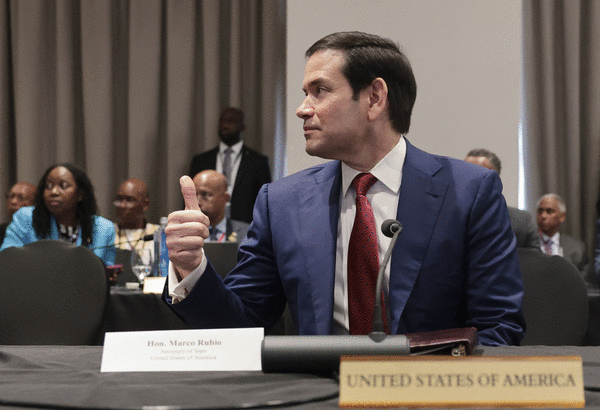
Meanwhile, Secretary of State Marco Rubio — an outspoken critic of the government in Havana during his years in the U.S. Senate — said that the U.S. would investigate the matter before taking any action.
Relations between the U.S. and Cuba are at their most delicate in decades. The Trump administration has imposed a near total blockade of the island and cut off fuel shipments to the cash-strapped government.
After snatching Cuba’s top ally, Venezuelan President Nicolas Maduro, last month, President Donald Trump mused that the island and its 67-year-old regime would collapse. On Friday, Trump said, “maybe we’ll have a friendly takeover of Cuba,” in response to a reporter’s question about the country.
Earlier, Cuba had warned that the U.S. was pushing the country into a humanitarian crisis and that some sort of terrorist attack was imminent.
Much remains unknown about what drove the group to make the 90-mile trip from Florida to Cuba in a 24-foot single-engine fishing boat that was reported stolen in the Florida Keys. The Monroe County Sheriff named a man Cuba had identified as being killed in the shootout as a suspect in the theft.
Cuban officials said that the men were carrying sniper rifles, night-vision goggles, body armor, Molotov cocktails and combat rations, intending to topple the government, and that when Cuba’s border patrol approached the boat, the men opened fire, wounding a Cuban military commander.
Attackers detained
Four of the alleged attackers were killed in the firefight, and the others — including an 11th individual who had previously traveled to Cuba to meet the landing party — were detained, Cuba’s interior ministry said.
At least two of the men, including one of the deceased, are U.S. citizens, according to a U.S. official. A third man had a K-1 “fiancé visa,” and some of the rest may be permanent U.S. residents, said the official.
There has been confusion about the identities of some of the men that Cuba said it apprehended. One man initially named by the Cuban authorities as being detained later turned out to be free in southern Florida, a mistake de Cossio acknowledged.
Earlier this month, Trump extended a national emergency decree prohibiting unauthorized U.S. vessels from entering Cuban waters. It isn’t yet clear how the small pleasure boat carrying the 10 men might have escaped detection and made it from Florida to Cuba’s territorial waters.
The U.S. military has long feared “that some rogue elements in Florida would take matters into their own hands and try to accelerate a collapse” in Cuba, said Christopher Sabatini, a senior research fellow at Chatham House, an international affairs think tank.
Among the men that Cuba has said it detained is Amijail Sanchez Gonzalez, a 47-year-old Florida resident who claimed to be a member of a group called Auto Defensa del Pueblo, or the People’s Self-Defense, known as the ADP.
A Facebook page that people familiar with the matter said belonged to Sanchez shared a communique attributed to ADP, calling on people in Cuba to “join the definitive battle against the dictatorship.” In a video posted Feb. 11, Sanchez said it was time to take action in Cuba.
Family members of Sanchez couldn’t immediately be reached for comment.
Terrorism charges
De Cossio, the deputy minister, said Sanchez and another man, Leordan Enrique Cruz, were wanted by Cuba on terrorism charges. He said Cuba had shared the names of both men with U.S. authorities. Sanchez and ADP are on a government list of 67 individuals and 20 organizations accused of financing or engaging in terrorism.
“The Cuban government is still awaiting responses to requests for information about them and the other individuals and organizations included in the list issued,” de Cossio said.
South Florida was a staging ground for the 1961 Bay of Pigs invasion — a U.S.-backed coup attempt that failed to depose Fidel Castro — followed by multiple sabotage operations and small armed incursions. In 1976, Luis Posada Carriles, who had deep Miami ties, helped mastermind the bombing of a Cuban airliner that killed 73 people.
Posada Carriles, who died in 2018, is still considered a freedom fighter by some Cuban exiles in Miami, while Cuba and the FBI have named him as a terrorist.
Wednesday’s clash came just a day after the 30th anniversary of a fatal incident between the Cuban government and two unarmed U.S. aircraft that Havana claimed had violated its national airspace.
The death of the four pilots, all part of Brothers to the Rescue — a Miami-based anti-Castro group — soured ties between the U.S. and Cuba, and led then-President Bill Clinton to sign the Cuban Liberty and Democratic Solidarity Act, which tightened the economic embargo on the island.
“This is not an isolated incident,” de Cossio said. “Cuba has been the victim of attacks and countless terrorist acts for more than 60 years, most of which have been organized, financed, and carried out from the territory of the United States.”
_____
(With assistance from Stephen Wicary.)
_____
©2026 Bloomberg L.P. Visit bloomberg.com. Distributed by Tribune Content Agency, LLC.


Comments