Why Florida lawmakers want to expand the school guardian program to universities
Published in News & Features
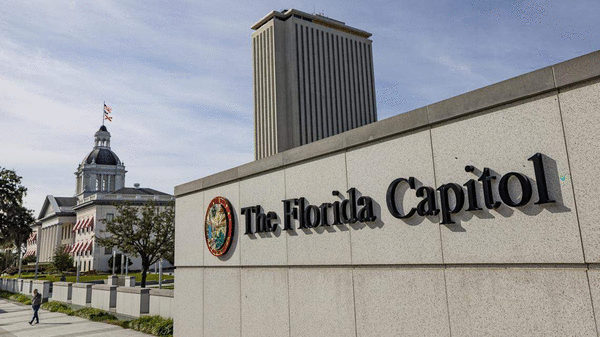
TALLAHASSEE, Fla. — Faculty at Florida’s colleges and universities may soon be able to carry guns on campus as part of state lawmakers’ planned expansion of the school guardian program.
Lawmakers first created the program after the 2018 shooting at Marjory Stoneman Douglas High School, in which a gunman killed 17 people, including students and faculty. Under the program, select staff or an employee hired for security can be trained to carry weapons for school defense.
State lawmakers this year are moving forward legislation to expand that program to colleges. The measure is in response to the April 2025 shooting at Florida State University that left two people dead.
Rep. Michelle Salzman, R-Escambia County, was a student at Florida State University during the shooting.
As the shooting unfolded, texts came into Salzman’s phone from classmates sharing their hiding locations.
“The question was, what are we going to do, what’s next?” Salzman said. “How many times is this going to happen before we make it a safer place?”
Salzman is sponsoring the House legislation, which she said gives higher education institutions more tools to prevent danger.
The Florida House passed the legislation Wednesday. The Senate’s version of the bill, which has small differences, is ready for a final vote.
Florida’s colleges and universities would not be required to participate in the program. The president of a university or college would be able to appoint the school guardians.
The bills keep Florida’s existing prohibition on guns on campus for all other people besides law enforcement and school guardians.
To become a school guardian, staffers need to complete at least 144 hours of training, including 132 hours of firearm training, according to the Florida Department of Education.
The guardian program is named after the three faculty members who died in the Parkland shooting — Chris Hixon, Aaron Feis and Scott Beigel.
Sen. Barbara Sharief, D-Davie, said Hixon’s widow, Debra Hixon, told her that she could not support the program allowing teachers and faculty to carry guns on campus.
Hixon, who is also a member of the Broward County School Board, said she preferred the program be limited to trained security personnel, according to Sharief.
At the Senate bill’s most recent committee hearing on Tuesday, some professors from Florida State University said having more guns on campus would not make their campus safer.
Charles McMartin, a professor in FSU’s English department, said he has survived three school shootings, including a 2024 shooting at the University of Arizona and a shooting at his high school in Greeley, Colorado.
McMartin said it was disappointing that lawmakers would write bills without the input of faculty and students.
“Since the FSU shooting, despite the proactive measures of the university, my students and colleagues have struggled to feel secure,” McMartin said. “Introducing more guns into these environments increases the risk of accidental shootings, misidentification and escalation, not safety.”
Robin Goodman, a professor of English at FSU and the president of the faculty union, noted that it took around two minutes for campus police to stop the shooter last April.
“After the shooting, we met with them and the police told us that if there had been other guns on the scene when they arrived, they would not have been able to neutralize the shooter that expeditiously,” Goodman said.
If passed, the legislation would make it a second-degree felony for someone to fire a weapon within 1,000 feet of a school during school hours or during a school event.
It also would require higher education facilities to adopt active shooter and family reunification plans and to create assessment teams to intervene with students whose behavior “may pose a threat” to the safety of the school’s faculty and students.
Florida high schoolers who have behavioral health threat assessment records in their file would also have those records transferred to their higher education institution.
©2026 Miami Herald. Visit at miamiherald.com. Distributed by Tribune Content Agency, LLC.





Comments