Cuba says those killed in US boat encounter planned uprising
Published in News & Features
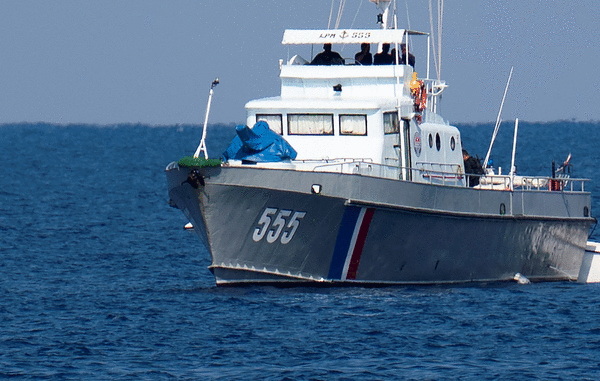
Cuba says a boat with 10 people near its coast early Wednesday was carrying weapons, and its occupants — Cubans living in the U.S. — were intent on entering the country to fight against the government.
The Cuban Coast Guard shot and killed four of the passengers while another six were injured and detained after the Florida-registered boat opened fire, according to an Interior Ministry statement.
Cuba’s government said most of the passengers had a known criminal record. An 11th person who had arrived earlier from the U.S. and planned to meet up with the group was detained within Cuba, according to the statement.
Those with previous records “are wanted by Cuban authorities for their involvement in promoting, planning, organizing, financing, supporting, or carrying out acts of terrorism within the national territory or in other countries,” the interior ministry said.
Seven of the 10 occupants were identified by name in the statement, which listed supplies on the boat that included assault rifles, Molotov cocktails, bullet-proof vests, telescopes and camouflage uniforms.
The incident threatens to escalate an already tense standoff, with President Donald Trump’s administration seeking to topple Cuba’s communist government after capturing its main patron, Venezuelan socialist leader Nicolas Maduro, at the start of January.
Asked about the deadly confrontation, Secretary of State Marco Rubio said earlier Wednesday that U.S. agencies are conducting their own investigations to figure out what happened before commenting further.
The White House is trying to squeeze the regime, which has ruled the Caribbean nation of 10 million people 90 miles south of Florida, for 67 years since Fidel Castro led a revolution that toppled a U.S.-backed dictator. Trump has imposed an energy blockade and the Cuban government is digging in even as its electricity grid buckles and its citizens struggle to meet basic needs.
“We are going to find out exactly what happened here and we will respond accordingly,” Rubio said Wednesday evening before leaving St. Kitts, where he attended the Caricom summit. “We’re going to have our own information,” the secretary added. “Suffice to say, it is highly unusual to see shootouts in the open sea like that.”
The vessel in question is a 24-foot Pro-Line fishing boat built in 1981 with an outboard engine, according to Boat History Report, based on the registration number provided by the Cuban government.
The Pentagon, U.S. Southern Command and the U.S. Coast Guard didn’t immediately respond to requests for comment.
Cuba has long depended on economic benefactors to sustain its one-party system, dating back to the Soviet Union and more recently Venezuela under the late Hugo Chavez. But the U.S. detained Maduro, who succeeded Chavez, in Caracas on Jan. 3 and has ordered other nations to cut energy exports to Cuba.
At the same time, countries who paid for the services of Cuban doctors, historically a source of revenue, have begun to sever those contracts at the behest of Trump and his officials. The fuel shortages have also hit the key tourism industry, shuttering some resorts, while also prompting airlines to suspend flights since they’re unable to refuel.
The U.S. president, who says his administration is talking to elements of the Cuban regime and argues that it may fall under its own weight, had appeared to be providing some relief for the island as recently as Tuesday, when the government signaled it would allow fuel imports for private businesses on the island.
Cuban President Miguel Diaz-Canel has said he’s open to talk with the U.S. but is unwilling to compromise the country’s system of government, which is dominated by the military, intelligence officials and state-run companies.
Wednesday’s altercation also comes just a day after the 30-year anniversary of another fatal incident between the Cuban government and two unarmed U.S. aircraft that Havana claimed had violated its national airspace.
The death of the four pilots, all part of Brothers to the Rescue — a Miami-based anti-Castro group — soured ties between the U.S. and Cuba, and led then-President Bill Clinton to sign the Cuban Liberty and Democratic Solidarity Act, which tightened the economic embargo on the island.
_____
©2026 Bloomberg L.P. Visit bloomberg.com. Distributed by Tribune Content Agency, LLC.





Comments