'Self-serving' or good government? A supervisor wants to overhaul San Diego County government -- including by extending term limits
Published in News & Features
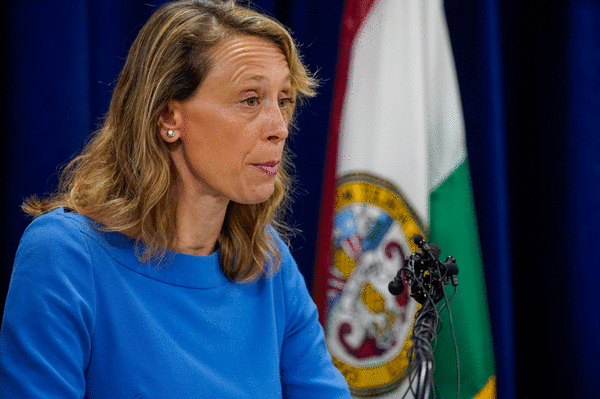
SAN DIEGO — A San Diego County supervisor is proposing seismic changes to how county government works, who controls it and how many terms they can serve.
Supervisor Terra Lawson-Remer wants to ask voters to overhaul the county’s charter — effectively its constitution — in a way that could hand additional power to supervisors and strip it from county staff and bureaucrats who have long played a key role in running its operations day to day.
A three-page working summary of the proposal calls for creating a county ethics commission, establishing new budget and auditing offices responsive to supervisors and giving supervisors the direct power to confirm and remove top bureaucrats.
But the summary also proposes an overhaul to who is elected in San Diego County and how long they can serve.
Listed as “under discussion” are proposals to convert the appointed job of the top county executive to an elected one, relax existing term limits for supervisors and enact new ones for all other county elected officials, who aren’t currently subject to any.
In an interview, Lawson-Remer said labor unions and constituents have pushed her to support certain elements of the package, particularly confirmation hearings for top county hires and greater transparency around the budget. Of all the components of her proposal, she said she was hearing the least support for the elected county executive.
“Everything else — including, by the way, the term limits — has been a no-brainer,” she said.
County records show Lawson-Remer’s office began exploring the effort as early as last fall.
In November, her office commissioned a $40,000 taxpayer-funded poll of about 700 residents to gauge support for draft language of the ballot measure, as well as each element of her proposal.
Now, even though many of the package’s details are not yet finalized, Lawson-Remer is still aiming to fast-track it.
In the coming weeks, she plans to finalize language for a proposed ballot measure that, if passed, would authorize changes to the county charter. As soon as April, she wants the Board of Supervisors to decide whether to put the package to voters on the November ballot.
Any proposed ballot measure would need to be approved by a majority of supervisors by Aug. 7, said Antonia Hutzell, a spokesperson for the county Registrar of Voters.
Draft ballot language posed to poll respondents refers to the ballot item as “San Diego County government reform, public disclosures, ethics and accountability measure.”
On the proposed extension of current term limits, it only asks if voters want to “limit the County Executive and Board of Supervisors members to three, four-year terms.” It does not say what supervisors’ term limits are currently — two — and it does not mention term limits for current countywide elected officials.
If enacted, any changes to term limits would be a sea change for county government, less than 20 years after an overwhelming 68% of county voters voted to enact the current two-term limits for supervisors.
But how any proposed new term limits might apply to elected officials, including those serving partial terms, hasn’t yet been determined by Lawson-Remer’s office.
Two supervisors — Paloma Aguirre and Monica Montgomery Steppe — are currently serving partial terms due to special elections. Treasurer-Tax Collector Larry Cohen is also serving a partial term after being appointed by supervisors last year.
Lawson-Remer also still has yet to figure out how term limits might apply to Sheriff Kelly Martinez and District Attorney Summer Stephan. Both are currently serving six-year terms set to expire in 2028 in order to comply with a state law that requires elections for public safety officials to be on the same cycle as presidential contests.
Another significant part of the draft package would be the move to an elected county executive. That position would replace the county’s current top executive position of chief administrative officer, which the supervisors appoint.
Elected county executive positions are common in other parts of the United States, but not in California. No California county has one, with the exception of the mayor in San Francisco’s joint city-county government.
And Los Angeles County will vote in 2028 for its first elected CEO, under a broad charter rewrite voters there passed in 2024. That rewrite — passed by a narrow majority of voters — also expands the L.A. County Board of Supervisors from five to nine and created an ethics commission.
But Lawson-Remer’s draft ballot language lacks key details about the powers of a proposed new ethics commission and the elected county executive, noted Sean McMorris, the transparency, ethics and accountability manager for California Common Cause. He said a similar shortcoming was confronted in L.A. County, where he serves on a task force making recommendations about the new charter.
Without enumerating specifics in the ballot measure, county supervisors, not voters, could end up having the final say on what a new charter means in practice, he said.
“Frankly, the devil’s in the details, and there aren’t any details,” McMorris said of Lawson-Remer’s draft ballot measure. “Based on the limited details we have of the San Diego County reforms, on their face I think most of them look great. But again, that lack of detail is deceptive.”
San Diego County’s top bureaucrat, Chief Administrative Officer Ebony Shelton, declined to comment on Lawson-Remer’s proposals.
“My focus as chief administrative officer is leading the day-to-day operations of the county to implement the Board of Supervisors’ policies and ensure employees have the support they need to serve our diverse communities,” Shelton said in a statement.
Few of the countywide elected officials who would be affected by the imposition of term limits — the sheriff, district attorney, assessor-recorder-clerk and treasurer-tax collector — wanted to discuss the idea.
Cohen, who was appointed by supervisors last year after longtime elected treasurer Dan McAllister retired mid-term, said he was confident voters would back the proposed changes.
“Having served at multiple levels of government, I know how important clear rules, independent oversight and public accountability are to effective governance,” he said in a statement.
Martinez and Stephan both declined requests for comment.
Assessor Jordan Marks did not return a request for comment.
‘Too opportunistic’?
Should voters ultimately approve the term-limits changes she’s proposing, Lawson-Remer and her Republican colleague Joel Anderson are the two supervisors who could benefit the soonest — both were first elected in 2020 and will be termed out in 2028 barring any extension.
Lawson-Remer vocally defended most of the charter changes she has proposed. But when asked to explain her push to extend term limits, she declined to weigh in, saying she’s in “listening mode, basically.”
Voters first decided to limit supervisors to two terms in 2010 under a citizens’ initiative known as Measure B that was put on the ballot by labor unions. At the time, the same five Republican supervisors had controlled the county for more than a decade.
Incumbents were still allowed run for office under the new term limits, letting many longtime Republican supervisors remain in office until 2018 or 2020. But gradually, as they termed out, new Democratic supervisors were elected.
Now, current term limits mean that sitting supervisors are more often also running for other elected offices.
Republican Supervisor Jim Desmond, who is termed out this year, is running for Congress in the coastal North County district now represented by Democratic Rep. Mike Levin.
Anderson, who like Lawson-Remer will be termed out in 2028, is running for county treasurer. If elected to that office in November, he would be allowed to run for another two terms and serve until 2038 under the proposed term limits.
In a statement, Desmond came out against extending term limits, saying the jobs of supervisors were “never meant to be lifelong careers.”
“Government works best when leadership turns over, ideas stay fresh and power doesn’t concentrate,” the supervisor said. “Extending term limits does the opposite.”
In a statement, Anderson said he’s never supported term limits for elected officials. He doesn’t support making the CAO an elected position, either.
Neither of the board’s two other Democratic supervisors, Paloma Aguirre and Monica Montgomery Steppe, responded to requests for comment.
Carl Luna, a political science professor at Mesa College, called the proposed changes to term limits “a little self-serving.”
It would be preferable for sitting supervisors to exempt themselves from the new rules, he said.
“Democrats pushed the term limits in San Diego because the Republicans had a lock on the board — but as soon as Democrats have a lock on the board, they want to change it,” he added. “It looks too opportunistic.”
‘Years of work’
Some early backers of Lawson-Remer’s charter proposals support extending term limits.
Kyra Greene, executive director of the Center on Policy Initiatives, a San Diego-based left-leaning think tank, said a new limit of three terms would give supervisors and other elected officials enough time to learn how to work the levers of county government and fulfill campaign promises.
“(Supervisors) can make really big promises, but many times, they take multiple years of work to make sure that they’re properly implemented,” Greene said.
Another supporter of most of the package is Jack McGrory, who served as San Diego’s appointed city manager from 1991 to 1997, before the city moved to its current strong-mayor system.
But McGrory remains skeptical about having an elected county executive, citing similarities it might bear to a strong-mayor system at the city he called “nothing short of a disaster.”
“Now you have a situation where the council and mayor just blame each other for stuff,” he added.
To bolster her case for charter reform, Lawson-Remer is pointing to the early polling her office conducted in the fall. Presented with the proposed ballot language, nearly half of respondents said they’d definitely support it while another quarter said they probably would.
Specific provisions — including more transformative ones, such as three-term limits for supervisors — also drew broad support.
Survey respondents were not informed that supervisors are currently limited to two terms.
©2026 The San Diego Union-Tribune. Visit sandiegouniontribune.com. Distributed by Tribune Content Agency, LLC.






Comments