Could Virginia be next to legalize internet gambling? House, Senate both pass bills
Published in News & Features
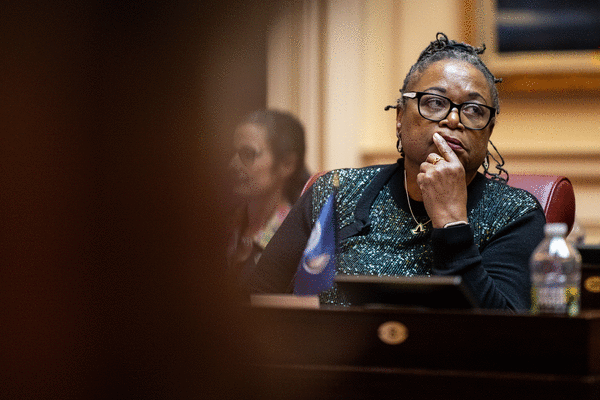
RICHMOND, Va. — Virginia could be poised to become the next state to legalize online gambling after a last-minute scramble ahead of crossover in the General Assembly kept two iGaming bills afloat.
One bill that would legalize internet gaming narrowly failed the Virginia Senate on Monday. Then, Sen. Schuyler VanValkenburg, D-Henrico, moved to reconsider the bill. Hours later, it passed on a 19-17 vote. The next day, the same situation played out in the House of Delegates: the House version of the iGaming bill initially failed, was temporarily passed by and subsequently brought back. After Democrats met while the House was in recess, it ultimately passed 67 to 30.
iGaming includes online slot and table games like Blackjack. It’s currently legal in just eight states, according to the American Gaming Association. But millions of Americans play annually. And some estimates report that Virginians are spending between $12 billion and $16 billion on unregulated internet casino games annually.
Proponents of legalization say creating a legal framework for internet gaming will make it safer for people who already partake in it by creating age verification requirements and consumer protections.
“It’s unfortunate that (illegal iGaming) is increasingly even more visible, because these are companies that are operating either in an unregulated manner, calling themselves sweepstakes casinos, or they’re just outright illegal operations domiciled in other countries that are serving mostly online ads to all types of U.S.-based customers,” said Joe Maloney, president of the Sports Betting Alliance, the trade advocacy organization representing sports betting and iGaming operators like FanDuel and BetMGM.
And some people might not know iGaming is illegal in the first place, advocates say. Celebrities have endorsed online casino companies, and the winning car of the Daytona 500 prominently featured an unregulated sweepstakes casino operator.
Sen. Mamie Locke, D-Hampton, carried the legislation in the Senate.
“Senate Bill 118 will legalize iGaming in the commonwealth of Virginia and dramatically curtail Virginia’s thriving illegal iGaming market and generate upwards of $14 billion in new taxable revenue over the first five years and tens of tens of billions of dollars every subsequent five years in perpetuity,” she said on the Senate floor Monday.
A new report from the Joint Legislative Audit and Review Commission found that Virginia would see a net revenue increase of $240 million in fiscal 2028 from taxes generated through iGaming. That number could grow to $845 million by fiscal 2032, the report found. Those numbers take into account that the state would likely lose out on some revenue from people buying lottery tickets online, as iGaming would directly compete with that industry. Both the lottery and iGaming would generate funding for education.
That revenue would be collected through a 20% tax on an iGaming operator’s adjusted gross revenue. The state would also collect a 6% economic development fee on iGaming operators’ net gaming revenue that would go toward a casino gaming hold harmless fund — the goal there would be to offset potential lost income from existing brick-and-mortar-casinos.
Experts caution against the potentially detrimental effects of iGaming on youth. Republicans are generally more opposed to the legalization. Sen. Bill Stanley, R-Franklin County, spoke in opposition of the legislation.
“We are being asked to take the single most addictive device in human history, the smartphone … a device that has already rewired the brains of our children, that has already driven anxiety, depression and suicide rates in young people to historic levels, and now we’re being asked to put a slot machine on it,” he said.
Some advocates are concerned about transparency in Virginia lawmakers’ votes on iGaming.
“When legislation expanding 24/7 online casino gambling initially fails and then passes within hours after reconsideration, Virginians deserve transparency about what occurred,” said Oliver Barrie, a spokesperson with the National Association Against iGaming in a statement. “We will continue to advocate for a full and transparent discussion of the serious social and economic consequences of iGaming before it is advanced any further.”
Gov. Abigail Spanberger appears supportive of the creation of a gaming commission to regulate Virginia’s gambling industry but skeptical of expanding gaming without the authority up and running. The House version of the legislation would have an iGaming industry up and running beginning in January 2028 but would require the legislature to pass the bill for a second time in 2027. The Senate version has a start date of January 2027.
The House passed legislation creating a gaming commission earlier this week. The legislature is also considering legalizing skill games, consoles often found in convenience stores that resemble slot machines that require more than luck to be successful. That bill passed the Senate last week.
----------
©2026 The Virginian-Pilot. Visit at pilotonline.com. Distributed by Tribune Content Agency, LLC.





Comments