How Isle, population 800, became Minnesota's only city to sign an agreement with ICE
Published in News & Features
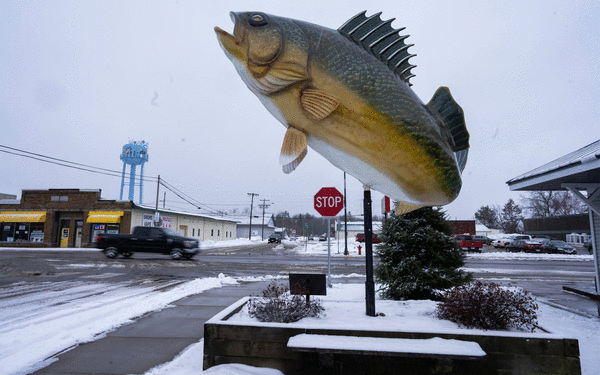
ISLE, Minn. – Tucked away on the southeastern shores of Mille Lacs Lake is the city of Isle, a small community that swells in the summer as tourists visit to fish, camp and snap a picture under a giant walleye statue.
It’s hardly a hotspot for immigrants.
Yet, amid controversy over Minnesota governments’ reluctance to help federal immigration enforcement efforts, it’s the first and only city in the state to sign an agreement with U.S. Immigration and Customs Enforcement (ICE). The agreement allows city police officers to perform some functions of federal immigration officers such as checking citizenship status during day-to-day work and executing search warrants for immigration violations.
“We are grateful to be included in the mission of ICE,” Isle Mayor Ernie Frie said, “and will do everything we can to assist them or any other law enforcement agency.”
With its overwhelmingly white population and just three full-time police officers, Isle seems like an unlikely candidate for such an agreement: Less than 1% of Isle’s 800-some residents were born in another country.
“It sounds great, but there’s really no point,” said Ryan Schik, an Isle resident who works at Boone’s Fine Guns, referring to the city’s demographics.
But Isle stands to gain something from the deal: The Department of Homeland Security will pay for officers’ online training. And once certified, the city could get $100,000 for a new police car and $7,500 for equipment for each trained officer, which is not insignificant for a city with an annual public safety budget of $830,000.
While many residents said they hadn’t heard that the city signed the agreement, several said they expected widespread support for it.
“This is a conservative town. We believe in law,” said Todd Bjerk, a veteran who recently purchased Beckham’s Bar & Bistro in Isle. “But we try to keep politics out of the bar. If we have people yakking, we tell them to take it outside.”
Bjerk and a few patrons sitting around the U-shaped bar this week said they think its a good idea for local officers to receive additional training and be able to help ICE agents with immigration enforcement if asked.
City officials say the ICE agreement happened sort of by happenstance.
Jamie Minenko, city clerk and treasurer, said that a few weeks ago a federal agent was working with the Mille Lacs County Sheriff’s Office to serve a warrant in the county and they stopped at the Isle Police Department to meet with Police Chief Mark Reichel.
The agent asked if Reichel would be interested in entering an agreement with the federal government and, after speaking with Isle City Council members, Reichel signed.
“We do not feel there is major significance in the fact that we are the first [Minnesota] city to participate in the agreement,” Minenko said in an email. “Our sheriff’s department signed the agreement first, and being a department under the sheriff’s jurisdiction, we followed suit.”
There are seven Minnesota counties — Cass, Crow Wing, Freeborn, Itasca, Kandiyohi, Mille Lacs and Sherburne — with similar agreements to aid ICE with immigration enforcement. Jackson County had signed an agreement last year but is no longer listed in the Homeland Security database.
Mille Lacs County Sheriff Kyle Burton, who signed an agreement with ICE in June, said last fall that he hopes the partnership will be a “deterrent for anyone who is in the United States illegally and intent upon coming into Mille Lacs County to engage in violent or criminal behavior.”
The local partnerships came about after President Donald Trump issued an executive order in January 2025 requiring ICE to authorize state and local law enforcement officials to carry out some immigration functions. Congress then approved $170 billion for immigration enforcement, with $14 billion set aside to reimburse local governments.
As of Feb. 13, more than 1,400 law enforcement agencies in 40 states have signed agreements; only about 430 of those are city police departments. The agreements differ from the longstanding deals Freeborn, Kandiyohi and Sherburne counties have with ICE to house federal prisoners in their jails.
Isle’s agreement states that after being trained and approved, officers can “perform certain functions of an immigration officer” within the police officer’s jurisdiction.
That includes the “authority to interrogate any [undocumented resident] or any person believed to be [undocumented] as to his right to be or remain in the United States,” as well as the power to prepare charging documents for immigration violations and transport people to ICE detention facilities. Minenko said no officers have started training yet.
Reichel declined to comment other than through Minenko’s statements, which say he and the City Council believe the relationship with ICE “empowers the department with arresting power to aid both our community and our country as a whole.”
Frie, the mayor, said he thinks the majority of the city’s residents are “in favor of a safer community” and that “every city should be part of the solution and not the problem.”
Jeff Potts, retired chief of the Bloomington Police Department and director of the Minnesota Chiefs of Police Association, said signing such agreements is up to each city.
Potts said he thinks a “significant number of police leaders” have met with ICE regarding the agreements but that many leaders “haven’t fully decided yet” about whether to sign on.
“In most cases, we direct them to making sure that they have their city attorney or the county attorney … review those agreements, but we haven’t taken a position to say that agencies should or shouldn’t,” Potts said.
With the well-documented shortage of officers across the state, some cities might shy away from the ICE agreement because it would add duties to already stretched departments.
Leaders from a number of cities — including Duluth, St. Cloud, Rochester and Willmar — said they haven’t been approached by ICE about entering an agreement. A representative from the Department of Homeland Security did not respond to a request for comment.
----------
—Chris Magan, Jana Hollingsworth, Jp Lawrence and Trey Mewes of the Minnesota Star Tribune contributed to this story.
©2026 The Minnesota Star Tribune. Visit at startribune.com. Distributed by Tribune Content Agency, LLC.






Comments