Mark Zuckerberg testifies in LA trial over claims social media makes kids addicted
Published in News & Features
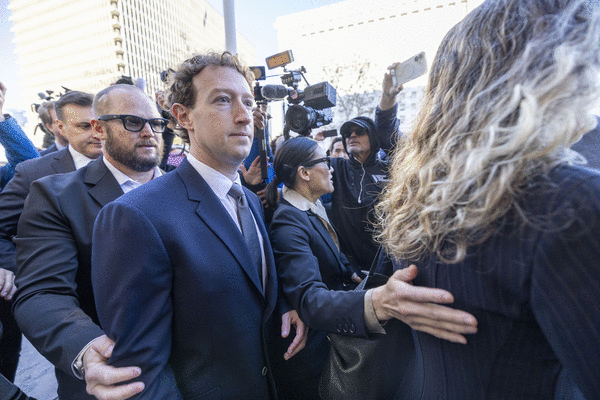
Meta Chief Executive Mark Zuckerberg made an extended, pugnacious appearance in Los Angeles Superior Court on Wednesday, defending his company from the witness stand against a lawsuit that alleges social media harms children.
The Meta boss appeared in a dark suit and gray tie, his signature chestnut curls slightly mussed, darting occasional nervous looks at the jury and the 20-year-old plaintiff, who sat in the courtroom gallery.
"I'm not —I think I'm actually sort of well known to be very bad at this," Zuckerberg told the young woman's attorney, Mark Lanier, when pressed about the professional polish of his testimony.
In a dramatic moment late in the morning, Judge Carolyn B. Kuhl sharply warned anyone in the courtroom against wearing Meta's AI glasses.
"If your glasses are recording, you must take them off," the judge said. "It is the order of this court that there must be no facial recognition of the jury. If you have done that, you must delete it. This is very serious."
The admonition was met with silence in the courtroom.
Simply getting Zuckerberg on the stand Wednesday was a coup for the plaintiffs and a liability for his company's platforms, which must now contend with profound public distaste for the Meta figurehead.
According to a study last year by the nonpartisan Pew Research Center, the overwhelming majority of American adults have an unfavorable view of Zuckerberg.
The percent of adults who view him very favorably is on par with the share who believe the Earth is flat or that aliens live among us.
"It's a very big deal," said Jenny Kim, an attorney in a related lawsuit. "The whole world is coming to watch him."
Crowds filled the plaza outside the Spring Street courthouse downtown Wednesday, with lines stretched out the door to enter the building, where many had waited for hours just for a glimpse of the CEO.
The plaintiff, a Chico, Calif., woman referred to as Kaley G.M., appeared in the courtroom for the first time since she was briefly introduced during opening statements on Feb. 9.
Her lawsuit is a test case chosen from among hundreds charging that Instagram and YouTube were designed to snare young users and keep them hooked on their services. Two other defendants, TikTok and Snap, have settled out of court.
Zuckerberg testified that children under 13 have never been allowed on the platform. Kaley said in her claim that she started using Instagram at age 9.
"I generally think that there are a set of people, potentially a meaningful number of people who lie about their age in order to use our services," he said. "There's a separate and very important question about enforcement, and it's very difficult."
Lanier showed an internal document from 2018 suggesting that Instagram believed about 4 million users were under 13 — roughly 30% of all 10 to 12-year-olds in the U.S. at the time.
"There's a distinction about whether someone is allowed to do something and whether we've caught them for breaking the rule," Zuckerberg said in response to repeated questioning. "I don't see why this is so complicated. It's been our clear policy that people under the age of 13 are not allowed."
Meta's lawyers have so far sought to discredit the idea of social media addiction, while simultaneously casting doubt on whether Kaley actually has it.
Zuckerberg's personal likability is irrelevant to the case, the company said.
"The question for the jury in Los Angeles is whether Instagram was a substantial factor in the plaintiff's mental health struggles," said Meta spokeswoman Stephanie Otway. "The evidence will show she faced many significant, difficult challenges well before she ever used social media."
Regardless of the outcome of the trial, Zuckerberg's testimony has the potential to complicate Meta's image and political ambitions, experts said.
"Just his appearance on the stand illustrates how public opinion has shifted," said David McCuan, a political science professor at Sonoma State University, who studies tech in politics. "That has important impacts on Meta's influence and big tech's influence in California politics."
Indeed, the CEO takes the stand as Meta doubles down its efforts to influence Golden State affairs.
The company has long been a key player in state and local races, pouring millions into ballot measures, the state legislature and candidates for California governor. It regularly lavishes cash on both sides of an issue, and opponents in the same race.
Last year, the corporation sunk $20 million into a new state super PAC — Mobilizing Economic Transformation Across (Meta) California — with an eye to key 2026 races.
It has also pledged $50 million to a joint project with Sacramento State University to redevelop the Capital Mall.
"They've become much more offensive with their money," McCuan said. "They're not just blocking legislation, they've been more actively trying to change their image.
That has the potential to backfire, he and others said.
"Voters are pretty upset heading into the midterms," the expert said. "It comes at a moment when consumers, users, voters, are ready to throw the book at someone or something. Now you have a guy who could capture that anger."
"When you think about how Meta is using Meta's money, it's Mark Zuckerberg's slush fund to play in California or national politics," said Sacha Haworth, executive director of The Tech Oversight Project, a watchdog group.
At the same time Meta expanded its political spending, Zuckerberg and his wife Priscilla Chan aggressively redirected their charitable giving to AI and scientific research.
"I have pledged to give almost all of my money to charity, and I focus on giving billions of dollars to science research, so the better that Meta does, the more we're able to do that kind of research," he told Lanier when pushed on his personal stake in the company.
The judge in parallel federal litigation has already ruled Zuckerberg can't face personal liability, putting his estimated $220 billion fortune out of reach for the thousands of plaintiffs.
"Most of (my) stock in Meta is owned by the CZI organization," the CEO told the jury. "We invest in science research and other charitable causes."
_____
©2026 Los Angeles Times. Visit latimes.com. Distributed by Tribune Content Agency, LLC.






Comments