US, Iran hail progress in nuclear talks after Trump threats
Published in News & Features
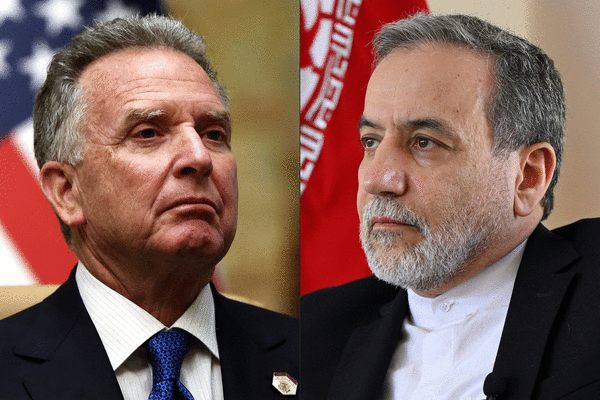
The U.S. and Iran made progress in nuclear talks in Geneva on Tuesday, with Tehran’s negotiators scheduled to return with a new proposal in two weeks, a U.S. official said on Tuesday, a cautiously upbeat assessment that suggests the chances of an imminent military clash are low.
The official, who asked not to be named, said Iran would return with detailed proposals to address the remaining gaps between the two sides, but cautioned that there were still a lot of details to discuss.
“In some ways, it went well,” Vice President JD Vance said in a Fox News interview later Tuesday. “But in other ways, it was very clear that the president has set some red lines that the Iranians are not yet willing to actually acknowledge and work through. So we’re going to keep on working it.”
In an earlier statement, Iran said it had reached a “general agreement” with the U.S. on the terms of a potential nuclear deal that would lift sanctions on Tehran and ease the risk of a broader war in the Middle East. But from the outset, there was also confusion between the U.S. and Iranian sides on the scope of the negotiations, with President Donald Trump bringing Tehran to the talks under the threat of U.S. airstrikes.
“We were able to reach a general agreement on a set of guiding principles, based on which we will proceed from now on, and move toward drafting a potential agreement,” Iranian Foreign Minister Abbas Araghchi told state TV after talks with U.S. Special Envoy Steve Witkoff in Geneva.
The two sides will each draft and exchange texts for a deal before setting a date for a third round of talks, he said, cautioning that the next stage would be “more difficult and detailed.”
Oil fell on Araghchi’s comments, with West Texas Intermediate erasing earlier gains to drop to below $63 a barrel.
The apparent diplomatic progress came despite growing military deployments in the Persian Gulf. Iran said on Tuesday that it would close part of the Strait of Hormuz – a key choke point for energy exports from the world’s top oil-producing region – for several hours due to military drills. The U.S. has also sent a second aircraft carrier to the region.
Success in the talks could pave the way for a landmark agreement between Tehran and Washington that would lift a slew of tough sanctions on Iran’s oil industry and wider economy in exchange for major restrictions on its nuclear program.
The Iranian delegation is “ready to stay longer to finalize any agreement, several days or even weeks,” Iran’s Foreign Ministry Spokesman Esmail Baghaei said earlier on Tuesday, according to the semi-official Iranian Students’ News Agency.
Iran has threatened to fully close the Strait of Hormuz in the past but has never done so. Brent is up almost 13% this year, largely because of the U.S.-Iran tensions and the prospect of a war in the oil-rich region.
“My concern is that the rhetoric from both sides is still escalating,” said Giovanni Staunovo, a commodity analyst at UBS Group AG. “But as long as oil exports are not disrupted, market participants will price in only a limited risk premium,” he added.
Several tanker industry veterans said Iran’s military drills hadn’t prompted any fresh guidance to shipping in the past few days that they’re aware of. They said they didn’t anticipate a disruption to oil shipments.
Military drills
The drills started on Monday and are focused on delivering a “decisive” response to security threats. The IRGC is monitoring the strait continuously and plans to unveil additional equipment soon to boost its military capacities there, Navy commander Alireza Tangsiri is quoted as saying, according to the semi-official Iranian Labour News Agency.
“Diplomacy and the battlefield stand side by side,” Iranian analyst Akbar Masoumi wrote in an analysis for Iran’s semi-official Tasnim news agency. “These two complement each other and together have created a positive process for the country.”
Earlier on Tuesday, Iran’s Supreme Leader Ayatollah Ali Khamenei stepped up his warnings that the U.S. will suffer if it strikes the Middle Eastern country, as Trump has repeatedly threatened if the sides can’t reach a deal.
“They keep saying: ‘We sent a warship towards Iran,’” Khamenei said. “Well, a warship is certainly a dangerous weapon, but more dangerous than a warship is the weapon that can sink this warship to the bottom of the sea.”
The talks in Geneva, mediated by Oman, started at around 10:00 a.m. local time and lasted around 3.5 hours.
The negotiations have gained urgency since Trump deployed an additional aircraft carrier to the region amid warnings of a possible strike on Iran if talks — which could drag on for weeks — fail to produce a compromise.
The U.S. team is led by Witkoff and Trump’s son-in-law Jared Kushner. Trump said on Monday that Iran wants to make a deal and that he’ll be indirectly involved in the discussions.
Israel is pushing for the negotiations to include limits on the range of Tehran’s ballistic missiles, but Iran has so far dismissed that as a red line.
During a visit to Tel Aviv on Monday, U.S. Republican Senator Lindsey Graham said Washington was “weeks, not months” away from a decision between diplomacy and military action against Iran.
-------
—With assistance from Eltaf Najafizada, Alex Longley, Dan Williams, Carla Canivete and Paul Richardson.
©2026 Bloomberg L.P. Visit bloomberg.com. Distributed by Tribune Content Agency, LLC.






Comments