1 acquitted, 2 guilty in scheme that kept 7 Michigan candidates off 2022 ballot
Published in News & Features
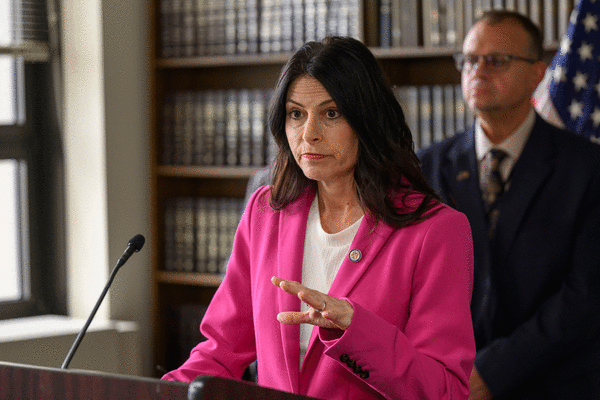
MOUNT CLEMENS, Mich. — Two men accused of being the ringleaders of a signature fraud scheme that kept the names of seven judicial and gubernatorial candidates off the August 2022 primary ballot have been found guilty of forging citizen signatures, and one has been acquitted on all counts.
Shawn Wilmoth and Willie Reed were found guilty Monday by a Macomb County jury of forging or allowing the forgery of signatures on nominating petitions and defrauding the Republican gubernatorial campaigns of Perry Johnson, James Craig, Donna Brandenburg, Michael Brown and Michael Markey, as well as judicial candidates Tricia Dare, John Cahalan and John Michael Malone. Reed was also convicted of stealing from Ryan Kelley's gubernatorial campaign, but Wilmoth was acquitted.
Wilmoth's wife, Jamie Wilmoth, was accused of the same acts, but the jury found her not guilty on all charges.
Monday's verdict followed a multiple-day trial in Macomb County Circuit Court.
Assistant Attorney General Chris Kessel said at the start of the trial Feb. 28 that the Wilmoths and Reed own businesses that hire people to collect signatures that allow candidates for public office to get their names put on the ballot. He alleges they allowed for the falsification of signatures on these nominating petitions, as 68% of the citizen signatures submitted to the state Board of Electors were found to be false.
Shawn Wilmoth was convicted of one count each of conducting a criminal enterprise, seven counts of election law forgery, two counts of false pretense of $100,000 or more, two counts of false pretenses over $50,000, three counts of false pretenses over $20,000 and seven counts of using a computer to commit fraud.
Wilmoth was found not guilty of one count of false pretense of $100,000 or more, one count of election law forgery, two counts of using a computer to commit fraud and one count of larceny.
Conducting a criminal enterprise and false pretenses over $1,000 — the most serious of the charges — carries a maximum sentence of 20 years in prison.
Reed, meanwhile, was convicted of one count of conducting a criminal enterprise, three counts of election law forgery, two counts of false pretense of $100,000 or more, two counts of false pretenses over $50,000, one counts of false pretenses over $20,000, four counts of using a computer to commit fraud and one count of larceny between $1,000 and $20,000.
Reed was found not guilty of five counts of election fraud, one count of false pretense of $100,000 or more, two counts of false pretenses over $20,000, five counts of using a computer to commit fraud.
“I am proud of the diligent work my office and the Department of State has done to secure this conviction," Attorney General Dana Nessel said in a statement. "We will continue to investigate and prosecute instances of election fraud to protect our democratic process.”
"The right to vote is one of the most important rights we have," Kessel said. "And what this case is about is what happens when a small number of individuals take action that disenfranchises tens of thousands of fellow voters, fellow Michiganders, from getting the right to vote, specifically from getting the right to vote for the candidate of their choice, and that's because of the actions of these defendants."
Susan Dunn, Jamie Wilmoth's attorney, said during opening statements that Jamie Wilmoth was not even one of the owners of the businesses.
"She is not on any of the business papers. She doesn’t own one share or one dime of any of these companies," Dunn said.
To get on the Michigan primary ballot, candidates need a certain number of citizen signatures on nominating petitions. The number required varies depending on the office candidates are seeking. Candidates often hire signature-collecting companies — firms run by people such as the Wilmoths and Reed — which, in turn, hire validators who verify signatures on the petitions to ensure names and addresses match voter records.
Nearly 70,000 fraudulent signatures made it to the Secretary of State's Office on nominating petitions in 2022, an unprecedented number, Bureau of Elections Regulatory Manager Adam Fracassi testified in January 2024 at a preliminary examination.
The Wilmoths and Reed promised a signature validity rate of 70 or 75%, Kessel said, meaning that 70 or 75% of the signatures they obtained would be accepted by the Secretary of State.
About 68,000 signatures were submitted to the Board of Elections, Kessel said.
"Almost every single signature that came from the defendant's companies was determined to be fraudulent," Kessel said. "(This was a) colossal and obvious and massive fraud. ... They knew they were giving them false signatures, but they didn’t care."
The attorneys for the Wilmoths and Reed say the state went after the wrong people. Noel Erinjeri, Shawn Wilmoth's attorney, said during opening statements that the AG's office did not speak to any of the 37 people who were paid to collect signatures on the sheets where all the invalid signatures were found.
Attorney General Dana Nessel said at a news conference in 2023 that there were 36 signature collectors involved in the fraud ring, but that Shawn Wilmoth, Jamie Wilmoth and Reed were "the worst actors."
Shawn Wilmoth and Reed will be sentenced March 18.
Shawn Wilmoth is also charged with three counts of failing to file taxes, which will be tried at a separate time.
_____
©2026 The Detroit News. Visit detroitnews.com. Distributed by Tribune Content Agency, LLC.





Comments