Minnesota school leaders fear declining attendance during ICE surge will also lower state funding
Published in News & Features
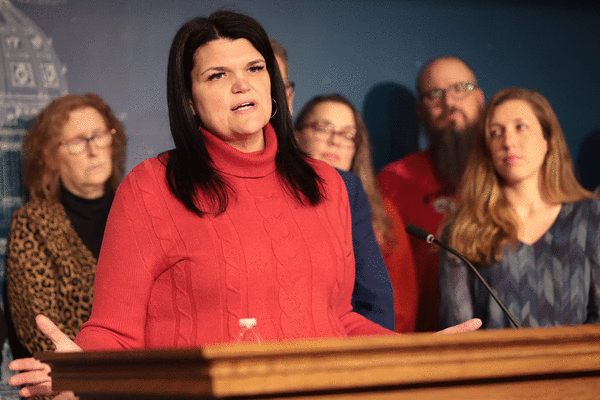
MINNEAPOLIS — The recent surge of federal agents in Minnesota has not only forced businesses that rely on immigrant and refugee workers to curtail their hours and some to close their doors.
It’s hurting schools as well. Especially their finances.
Fears that their children will be approached and detained by U.S. Immigration and Customs Enforcement and Customs and Border Protection agents have prompted many families to keep their kids at home, causing attendance to drop sharply at many of Minnesota’s K-12 schools as Operation Metro Surge enters its third month.
Because the money to pay teachers, counselors, bus drivers and principals is tied to attendance, officials fear prolonged absences by students in hiding will lead to declining state funding for schools.
“For Fridley Public Schools, even a small number of students (missing) makes a real difference,” Fridley Superintendent Brenda Lewis said in an email to the Minnesota Star Tribune. “If 25 students were dropped ... with roughly half the school year remaining, the revenue impact would be well over $100,000.”
Since schools can’t cut staff midyear, she said there’s no way to substantially lower costs during the year for Fridley Schools, which sued ICE and CPB this month to keep federal agents away from schools.
“So, this becomes a direct financial hit on top of existing obligations,” Lewis said.
With thousands of families across the state keeping their kids at home, the financial impact of ICE’s surge on schools and school finances could be substantial, said Education Minnesota President Monica Byron, who leads the statewide teachers union, which also joined the lawsuit with Fridley.
“No system of public education in America was designed to withstand this sort of intentional intimidation and harassment of students and the people who educate them,” Byron said in a statement. “Cruel decisions by the DHS, ICE and other agencies have affected every part of public education.”
In a statement, the Minnesota Department of Education said enrollment records “serve as the foundation of calculating Average Daily Membership, which is then used to calculate funding.”
While there are ways to educate students who aren’t in the classroom — state law allows remote learning — the district still must show that students are receiving instruction, services or supervision. If not, their funding could be cut.
“What is happening across our state in schools and communities is harming children,” the department said. “It’s interrupting the full academic experiences we work so hard to create in every classroom. The Minnesota Department of Education remains committed to ensuring every child — of every background and ability, and regardless of immigration status — has access to a world-class education."
State education officials on Friday couldn’t confirm if the agency will be adjusting funding for school districts as a result of the disruption.
Along those lines, school districts across Minnesota have renewed and expanded the online learning options that were created and expanded during the COVID-19 pandemic. Both St. Paul and Minneapolis have created temporary virtual schools and recently announced they were extending them — until April 6 in Minneapolis and indefinitely in St. Paul.
Many schools are delivering meals to kids as well.
St. Paul is partnering with Second Harvest Heartland to offer weekly food boxes to a limited number of temporary virtual learning families.
And for those families who still want to send their kids to school but are too afraid to have them walk, be driven or stand at bus stops, Lewis said Fridley offers door-to-door transportation.
While the impact on school finances is expected to be serious, Lewis said, the ICE surge has hurt schools and kids in other ways — and maybe for years to come.
“Extended absence and disrupted instruction — whether through missed in-person days or emergency shifts to virtual — translate into learning loss that can take years to recover,“ she said. ”Especially for students who were already behind or need additional support."
_____
©2026 The Minnesota Star Tribune. Visit startribune.com. Distributed by Tribune Content Agency, LLC





Comments