Ex-premier and 2 others guilty in Turks and Caicos landmark corruption trial
Published in News & Features
A decadelong trial into large-scale corruption in the Turks and Caicos Islands concluded Wednesday, when a judge found the one-time premier of the British territory, his brother and a former minister of land and natural resources guilty of a series of offenses involving bribery and the fraudulent sale of government-owned land.
The judge found that Michael Misick, the British overseas territory’s former premier; Thomas Chalmers “Chal” Misick, his brother and an attorney; and McAllister “Piper” Hanchell, the former minister of lands and natural resources, accepted tens of millions of dollars in illicit benefits — including multimillion-dollar loans, luxury property and elite credit cards — in exchange for granting developers discounted land and government concessions during a period of rapid and controversial development.
Their convictions come more than two years after another judge issued a mixed verdict involving other members of Misick’s Progressive National Party government who were accused of similar charges in the archipelago, located about 600 miles south of Florida.
A member of a political family — his brother Charles Washington Misick is currently premier of the country and head of the PNP — Misick is credited with transforming the Turks and Caicos from a little known island-chain into a favored destination of the rich and famous. As he jetted off to conferences around the globe, he was featured in U.S. magazines because of his sales pitch and his highly publicized marriage to American actress LisaRaye McKoy during his tenure in office, 2003-09, and later their contentious divorce.
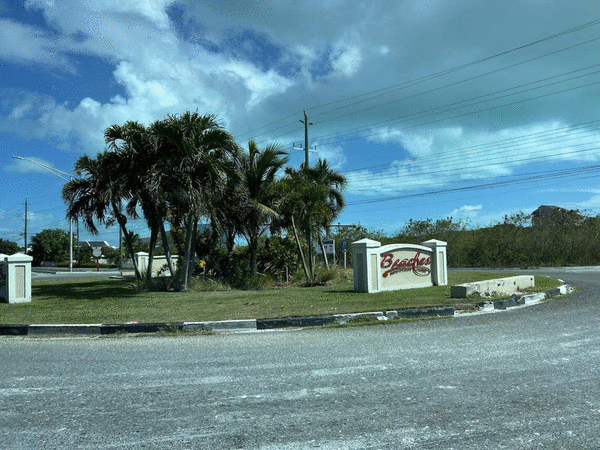
The three men were convicted on charges of bribery, conspiracy to defraud the Crown and the government of the Turks and Caicos Islands, and violations of the Proceeds of Crime Ordinance. Misick was found guilty of three counts of bribery in relation to developments linked to Beaches Resort in Providenciales, Salt Cay and West Caicos. Hanchell was convicted of two counts of bribery related to Salt Cay and West Caicos. Chal Misick was convicted on four counts of money laundering.
The verdicts were reached by Justice Rajendra Narine, who delivered the findings during a four-hour hearing in a packed Supreme Court session in Providenciales that was broadcast live over Zoom. The case had gone to trial after a team of British detectives descended on the island to investigate claims that Misick and his ministers were furnishing their lavish lifestyles through corrupt deals — allegations the former premier and his co-defendants denied.
Following the investigation, which also involved assistance from U.S. authorities, a commission of inquiry was launched by the British government. After it found systemic corruption, Britain suspended self-governance and imposed direct rule between 2009-12. In 2011, charges were filed against the three and other former government ministers and lawyers. The prosecution requested a trial without jury be held, arguing that it was impossible to find an impartial jury.
The proceedings began in 2015 but were repeatedly delayed after the death of the original judge six years into the proceedings.
Neither Misick nor Hanchell responded to requests for comment from the Miami Herald. But the two have previously declared their innocence, with Misick describing the case as a “political witch-hunt” after he was forced to resign in 2009.
May 4 sentencing
In his ruling, Narine found that Misick “knowingly and intentionally received payments as an inducement” to act corruptly, granting favorable concessions and Crown land to developers at a steep discount. Those benefits include a $6 million loan, a $3 million villa in the Dominican Republic and an American Express Centurion card that racked more than $4 million in expenditures over three years.
“The Crown alleges payments were intended to induce Mr. Misick to act corruptly, citing evidence of fund transfers, lack of legitimate purpose, and rapid disbursement aligned with his decisions,” the judge said. “Having considered the evidence carefully, the court draws the reasonable and compelling inference that Mr. Misick received the payments knowingly and intentionally, using inducements for him to act corruptly.”
Narine reached a similar conclusion in the case against Hanchell, whose defense lawyers unsuccessfully argued was “independently wealthy and did not need to solicit” payments.
“The fact that Mr. Hanchell was independently wealthy does not negate the possibility that Mr. Hanchell was offered and accepted bribes from an investor with whom the (Turks and Caicos Islands Government) was engaged in active negotiations,” Narine said.
All three men are scheduled to be sentenced on May 4. They are barred from leaving the country and must surrender their passports.
Narine allowed the men to remain free on bail pending sentencing. But he increased the amounts. Misick’s bail was raised from $10 million to $15 million, Hanchell’s from $3 million to $4 million and Chal Misick’s bail was set to $6 million.
Prosecutor Andrew Mitchell said the Crown will be seeking to confiscate $20 million from Misick, $5 million from Hanchell and $13 million from Chal Misick.
Misick became chief minister of the Turks and Caicos, in 2003, and its first premier in 2006 following the adoption of a new constitution.
Defense: political judgment
Neither Misick nor Hanchell testified during the trial. Through their lawyers, they argued that the decisions under scrutiny reflected political judgment rather than corruption. Misick was attempting to balance development needs — particularly efforts to develop Salt Cay — against the risk of losing foreign investment, his lawyer argued.
But the questions for the island chain’s 40,000 residents, given the controversial and rapid development, have always been at what cost. The case prompted outrage in the sun-swept country due to its delays and cost to local taxpayers.
A central figure in the case was Mario Hoffman, a Slovak national who sought to develop a resort on Salt Cay, the smallest inhabited island in the chain. Hoffman was initially granted 11.5 acres of Crown land, and later received hundreds more acres of additional government land, including a 99-year lease on 238 acres for a golf course. He was also sold land at a 50% discount reserved for natives of the country known as “belongers,” a status he did not hold.
In exchange, prosecutors said, Misick accepted $15,281,241 in corrupt payments and benefits between January 2005 and April 2009 “directly or indirectly from Mr. Hoffman and or related entities.” Among these benefits was the granting of an American Express Centurion cards to him and his wife.
Narine noted there was no evidence Misick attempted to repay the money.
The judge reached a similar conclusion with Hanchell despite defense claims he was a successful businessman who earned $6.5 million during his tenure in office from his businesses. As minister of natural resources, Narine said, Hanchell was well positioned to facilitate Crown land grants and concessions, and the payments he received were intended “to influence him or reward him” for favorable treatment of Hoffman’s projects. The judge also linked Chal Misick to money used to pay for expenditures and debts on behalf of Hanchell.
_____
©2026 Miami Herald. Visit miamiherald.com. Distributed by Tribune Content Agency, LLC.






Comments