Kremlin says Trump asked Putin to halt strikes on Kyiv to Feb. 1
Published in News & Features
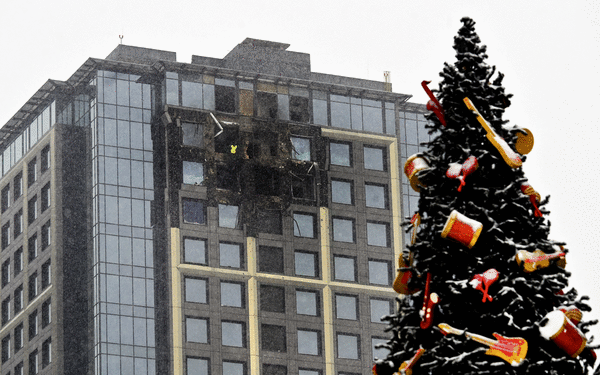
The Kremlin confirmed that Donald Trump asked Vladimir Putin to halt Russian strikes on Ukraine’s capital, Kyiv, though it said the agreement is set to expire on Sunday.
“Indeed, President Trump made a personal request to President Putin to refrain from striking Kyiv for a week, until Feb. 1, in order to create favorable conditions for negotiations,” Kremlin spokesman Dmitry Peskov told reporters Friday. Putin “of course” agreed, Peskov said, declining to say what was covered by the moratorium and whether it extended to other areas of Ukraine.
He didn’t indicate when the request had been made. The U.S. president told a White House cabinet meeting Thursday that he’d asked Putin “not to fire into Kyiv and the various towns for a week, and he agreed to do that.”
Ukraine and Russia are due to continue peace talks on Sunday brokered by the U.S. in the United Arab Emirates after meeting in Abu Dhabi for two days last week. Negotiations are taking place against the backdrop of an extreme cold snap in Ukraine, with temperatures forecast to drop below minus 20C (minus 4F) at night.
That’s adding to wartime hardships for the weary population with many buildings in Kyiv and other cities across Ukraine plunged into cold and darkness during protracted blackouts.
Trump’s announcement prompted Ukrainian President Volodymyr Zelenskyy to tell reporters late Thursday that he’s ready to halt attacks on Russian energy infrastructure if Putin agreed to abide by Trump’s proposal. “If Russia does not strike our energy infrastructure — generation facilities or any other energy assets — we will not strike theirs,” he said.
Zelenskyy appeared unaware that the Kremlin considered the deal already to be in force, calling it “an opportunity rather than an agreement.” He added: “Whether it will work or not, and what exactly will work, I cannot say at this point.”
The Ukrainian leader said on Friday that while there were no attacks on energy facilities overnight, infrastructure in several regions was hit on Thursday and the Russian army was shifting “toward strikes on logistics.”
The last major Russian strikes on Ukrainian energy facilities were reported on Jan. 27 when Naftogaz infrastructure in western Ukraine was hit and a DTEK power plant in Odesa was attacked. Even as Russian forces appear to pause massive attacks on Ukraine’s energy, they shifted focus to other vital areas of infrastructure including rail and road transport.
Three Shahed drones attacked a passenger train in Ukraine’s Kharkiv region on Tuesday, causing a fire and killing six people, according to local authorities. Ukrainian Railways said Friday it had to limit the movement of trains between the cities of Dnipro and Zaporizhzhia due to Russian drones.
Russia continued attacks on Ukraine overnight, launching one ballistic missile and 111 combat drones, Ukraine’s Air Force said on Telegram. Still, the scale was smaller than in some of Russia’s most intense recent assaults.
With the frontline in eastern and southern Ukraine shifting only gradually as the war nears its fourth full year, Russia has sought to break morale among Ukrainians by stepping up attacks on civilian infrastructure. Ukraine has responded by waging a campaign to strike Russia’s oil refineries and other infrastructure, aiming to undermine its ability to fund the war with income from energy sales.
Amid rising tensions between the U.S. and Iran, Zelenskyy told reporters it was unclear if Sunday’s meeting in Abu Dhabi would go ahead.
The key sticking point of Russia’s territorial demands from Ukraine remains unresolved, he said. Russia is demanding a Ukrainian withdrawal from areas of the eastern Donetsk region that Putin’s forces have failed to occupy in fighting dating back to 2014.
The U.S. has proposed establishing a so-called “free economic zone” in Donetsk region, which would imply a Ukrainian troop withdrawal. Kyiv has rejected that idea and proposed instead that Russia and Ukraine halt the fighting along the existing frontlines.
“In my view, the least problematic possible solution is ‘we stay where we are.’ That is our position,” Zelenskyy said. “The issue of control over any territory — including a free economic zone — must also be fair. Specifically, it must involve Ukraine maintaining control over the territories that we currently control.”
Zelenskyy reiterated that he’s ready to meet with Putin and Trump for peace talks in any country except for Russia and its ally Belarus. He dismissed an offer this week from Kremlin foreign policy aide Yuri Ushakov to come to Moscow for talks with Putin.
“I can just as well invite him to Kyiv, let him come,” Zelenskyy said. “I am publicly inviting him, if he dares, of course.”
©2026 Bloomberg L.P. Visit bloomberg.com. Distributed by Tribune Content Agency, LLC.





Comments