Washington state eyes arbitration for lawsuits against government as costs soar
Published in News & Features
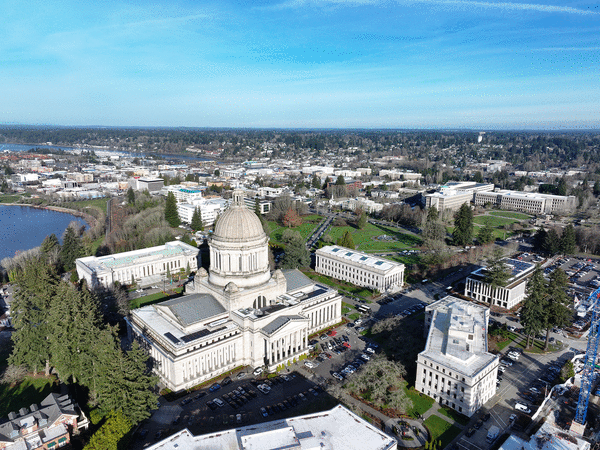
SEATTLE — Washington's escalating legal costs — with billions of dollars in lawsuit payouts slamming state and local governments — have led state lawmakers to consider legislation forcing anyone suing public agencies to go through arbitration before taking cases to a jury.
The proposal, Senate Bill 6239, is the first serious effort by majority Democrats to rein in the ballooning tort liability costs that have put the state's self-insurance fund $1 billion in the red.
The state's total legal payouts reached a record $500 million in the past fiscal year, more than triple what they were five years ago, according to its risk management office. The bulk of those claims have stemmed from cases of child abuse and neglect in the foster care system.
In addition, the state is paying tens of millions in legal costs every year, including increasingly large contracts to private law firms hired by the Attorney General's Office.
State Sen. Manka Dhingra, D-Redmond, the bill's prime sponsor, said the situation has become untenable.
We are simply at the point in time that we cannot continue to do fiscal management and responsibility without addressing tort liability," Dhingra said at a public hearing on the bill Tuesday before the Senate Law and Justice Committee, which she chairs.
Civil arbitration, which Dhingra's bill would require, is a way to resolve disputes in which a neutral third-party arbitrator, instead of a judge or jury, examines evidence and arguments presented by both sides and issues a decision. It's already required for small-dollar civil lawsuits, but Dhingra's proposal would extend that to all lawsuits against the state and local governments.
Supporters of the idea hope it would spur earlier settlements of cases, saving millions in legal fees for taxpayers. The bill would still allow plaintiffs to go ahead to a jury trial if they disagree with an arbitrator's decision.
The severity of Washington's liability problem is underscored by the fact that legislative Democrats are even considering the bill despite vocal opposition from trial lawyers, major political benefactors of the party.
Dhingra's bill was roundly slammed at the hearing by plaintiff attorneys who represent abuse survivors. And some survivors testified that efforts to put up new barriers to jury trials could retraumatize victims and shield public agencies from accountability.
Kris Norwood struggled with tears Tuesday as he recounted being abused at Secret Harbors, a boarding school in Skagit County, where he'd been sent by the state. It was only through the court system, he said, that "I was able to stand up to the system that hurt me."
Marta O'Brien, an attorney who has represented survivors of childhood sexual abuse, said she's seen case after case in which school districts were notified of problematic staffers but failed to act.
"Open court proceedings deter misconduct, expose those systemic failures and drive reforms to protect our students. Arbitration does the opposite," she said. "It is a barrier to students who are subjected to sexual abuse … It is a closed process often lacking in transparency and decided by a single arbitrator rather than a jury of our peers."
Sumeer Singla, another attorney representing abuse survivors, said the proposal amounts to "a tax on a victim of sexual abuse" that would require them to pay for private arbitration before a trial.
Singla said the state should instead focus on preventing abuse by adequately funding and monitoring social workers and others responsible for protecting kids.
But supporters of the bill, including cities, counties and school districts, pleaded with the state for relief, noting their budgets are also being severely strained by a wave of lawsuits similar to the one hitting the state.
Pierce County Executive Ryan Mello said the county is facing an influx of sex-abuse claims as a result of the Legislature's elimination of the statute of limitations on filing such cases.
The county in recent years has received 140 claims seeking over $320 million total, mostly for alleged abuse from more than two decades ago at a juvenile detention center, Mello told lawmakers Tuesday. The county has paid out more than $9 million so far.
"I want to be stone-cold serious with you. The totality of the claims that are in front of us would likely cut core constitutional services," Mello said, saying the expenses will drain money for public safety and running elections if something isn't done.
Derek Young, executive director of the Washington State Association of Counties, said counties are seeing "exponential growth" in the cost of lawsuits as well as liability insurance premiums.
Tyna Ek, the general counsel for the risk management pool for school districts, said schools have been targeted by plaintiff lawyers as the "deep pockets" in lawsuits even when they are not fully responsible for misconduct.
Ek called the proposal a "small, incremental step" that would not address bigger problems such as attorney's fees or the state's broad liability laws. She asked legislators to pass the bill without watering it down.
"In the past, with all due respect, every action by the Legislature has just increased the exposure, liability and expense on schools," she said. "This is the first one trying to do something about it."
A potential committee vote on the bill has been scheduled for Thursday. Its prospects for passing in the 60-day session remain unclear, and it is likely to be amended to address at least some concerns by critics.
"We're going to try to move it forward and see what happens, Dhingra said.
Gov. Bob Ferguson has not taken a position on the proposal, according to a spokesperson.
©2026 The Seattle Times. Visit seattletimes.com. Distributed by Tribune Content Agency, LLC.





Comments