Central Florida volunteers search for homeless as part of federal count
Published in News & Features
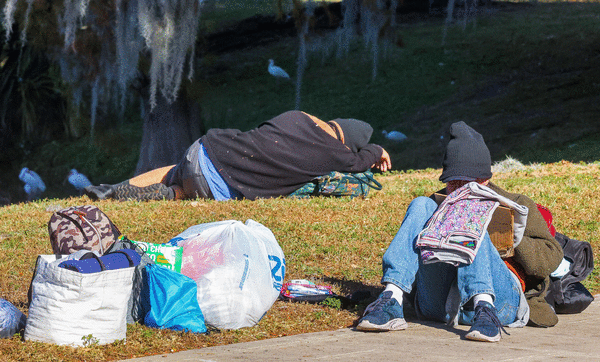
ORLANDO, Fla. — The two volunteers spotted blue tarps hanging from trees in a wooded area off Orange Blossom Trail and pulled their car over hoping to count the people in the makeshift encampment near Apopka.
But as they approached on foot Monday, a pack of dogs bared their teeth and growled, so they quickly retreated from the area littered with broken shopping carts and an old refrigerator.
One man who’d just exited the camp spoke with the volunteers, telling them there were more people under the tarps. But because of the dogs, whoever was hidden remained so.
Each year, hundreds of volunteers fan out across Central Florida to survey homeless people for a federally mandated point-in-time count. The results of the count — a three-day event finishing Wednesday and similar to ones that are done across the country — are used to measure the effectiveness of an area’s homeless policies and help lawmakers determine funding for programs to combat the problem.
But as the encounter with the aggressive dogs showed, counting people who live on the margins can be tricky. Homeless advocates say Florida’s ban on camping in public places, which kicked in last year, has made finding those without permanent homes even more difficult, as more have moved deeper into wooded areas to evade police detection.
The two count volunteers found Zachariah Maxwell, 44, eating a can of ravioli over a trash bin outside a Dollar Tree in Apopka, soon after they’d left the encampment with the dogs.
Maxwell said he has been homeless for 6 years and is now often confronted by police.
“They’ll roll up on you, say, ‘You can’t sleep here. You got to keep moving, keep walking.’ There’s no place to rest,” Maxwell said. “You got to kind of hide next to a tree, that way they can’t see you.”
Maxwell sleeps in the woods where he said he is swarmed by mosquitoes because he doesn’t have a tent. He said his legs continually ache from walking all day.
The volunteers counting in Apopka in a light rain were organized by Pathlight HOME, an Orlando nonprofit that helps house homeless people.
“It’s really important. It helps with getting more resources,” said Danny Arroyo, the nonprofit’s chief operating officer.
Six Pathlight volunteers went out in two separate groups on Monday morning, the first day of the Central Florida count. They headed toward homeless “hotspots,” including woods along OBT and a vacant area behind a shopping center on the same road.
The Central Florida count is coordinated by the Homeless Services Network of Central Florida, which sends teams run by organizations like Pathlight to count homeless people in Orange, Osceola and Seminole counties. The organizations recruit volunteers to help find and survey those without homes.
“It’s heartbreaking to see that so many people are suffering just because maybe they lost their jobs or because relatives are not able to take care of them,” said Julian Chambers-White, a nurse who volunteered to help with the count for the first time this year.
She joined Pathlight’s other group and spent the morning driving around west Orlando.
Like other volunteers, Chambers-White used her cellphone to access a survey provided by the U.S. Department of Housing and Urban Development. The survey asks for names and birthdates and also where they slept last night and how long they’ve been homeless.
During her three-hour shift on Monday morning, Chambers-White surveyed five people.
“I saw a person, he was 26 years old and he said he’s been homeless since he was 18. It’s really sad,” she said.
The results from the survey are usually released later in the year. Homelessness in the tri-county area has spiked by more than 150% since 2022. But from 2024 to 2025, the number of homeless in the area remained steady, likely because the anti-camping law made it harder to find people, officials said when the 2025 count was released.
That count found that 2,781 people were homeless in Central Florida, with 1,090 living unsheltered.
Although a similar undercount will likely happen this year, Arroyo said the annual effort is still helpful.
Last year, it showed an increase in the number of elderly people who were homeless. So Pathlight created a new program aimed at bringing older residents off the streets, which so far has housed 11 people, he said.
Arroyo and another volunteer found five people on Monday morning during their search around Apopka, including Dale Smith, 60, who has been homeless for a decade.
About three months ago, Smith was struck by a car while crossing OBT. His leg, he said, was injured so badly he had to get a knee replacement and now relies on a walker.
There are no shelters with vacancies near Apopka, he said, so he sleeps on the side of the road. He said the trick to avoiding police is to keep your spot clean.
“Most people don’t like homeless people because they’re slobs, man. They leave garbage everywhere. I don’t do that,” Smith said.
Arroyo said the weather can impact the count, with Monday’s rain making it harder to find people.
But the cold weather that arrived Tuesday, while a hardship to those living outside, can make the count easier as some head to emergency warming centers set up by county governments. There they can be counted and asked to take part in the surveys.
Before finishing his morning count, Arroyo spotted one last man on OBT. Dennis Clark, 67, said he’s been homeless for much of the last eight years. He is diabetic, he said, and also lost vision in one eye because of an injury sustained in a bar fight nearly two decades ago.
Clark camps in the woods with 10 other people. His birth certificate, ID and other important documents were destroyed when the camp was flooded during a bad storm last year, which makes him determined to avoid the police, fearful he’ll face more problems without identification.
He said he can live off about $20 to $30 a day and tries to find odd jobs to earn that money. But, mostly, he relies on the kindness of strangers.
“I don’t like panhandling. But when it comes down to my diabetes or just being hungry, I got to make some money somehow,” he said. “It’s very hard out here on the streets.”
------------
©2026 Orlando Sentinel. Visit at orlandosentinel.com. Distributed by Tribune Content Agency, LLC.





Comments