Public defiance, private deals: Delcy Rodríguez tests fragile US–Venezuela truce
Published in News & Features
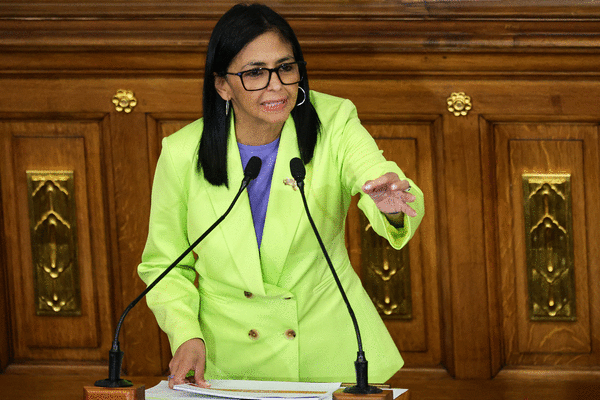
Venezuela’s new socialist leader, Delcy Rodríguez, has launched a public campaign aimed at reassuring the regime’s radical base that she has not become a puppet of Washington — even as President Donald Trump publicly praises her leadership for fostering what he calls a “wonderful” relationship between the two countries.
In recent days, Rodríguez has pushed back against international media reports suggesting she privately assured U.S. officials she would cooperate fully in a transitional government before Trump ordered a swift military operation in Venezuela on Jan. 3. That operation led to the capture of President Nicolás Maduro and his wife, Cilia Flores, who were transferred to New York to face federal drug-trafficking charges.
Since the operation, the socialist government under Rodríguez has taken steps — though often slowly — to align with a U.S.-backed stabilization plan aimed at reviving Venezuela’s economy and political system. Those measures include the release of hundreds of political prisoners and preparations to allow U.S. companies to reenter Venezuela’s oil sector with fewer restrictions.
But the sudden thaw in relations with Washington has fueled suspicion among hard-line chavistas that Rodríguez is abandoning the movement’s deeply anti-American ideology. Social media platforms have been flooded with accusations that she played a role in an internal conspiracy that betrayed Maduro.
On Monday, Rodríguez sought to draw a clear line between her interim government and Washington, saying Venezuela would not submit to pressure from the White House.
“Enough of Washington’s orders about politicians in Venezuela,” Rodríguez said during a televised event with oil workers in the eastern city of Puerto La Cruz, broadcast on the state channel Venezolana de Televisión. “Let Venezuelan politics resolve our differences and internal conflicts. This republic has paid a very high price for confronting the consequences of fascism and extremism.”
She added that Venezuela “has a government, and this government answers to the people,” responding to remarks by U.S. Treasury Secretary Scott Bessent that she described as “inappropriate” and “offensive,” without specifying the comments. Rodríguez also said she was not intimidated by what she called “personal threats” against her.
“I was aware of those threats when I was sworn in as interim president,” she said. “We are not afraid. We are not afraid of having relations with the United States, but those relations must be based on respect — respect for international law and basic human dignity.”
Rodríguez made the remarks during a meeting with representatives of the oil sector that included executives from companies with a long-standing presence in Venezuela, such as Spain’s Repsol, U.S.-based Chevron and Britain’s Shell. Those firms are expected to play a central role in the Trump administration’s plans to revive Venezuela’s oil industry.
During the meeting, U.S. and foreign oil companies discussed proposed changes to Venezuela’s Hydrocarbons Law, which the government says would create conditions for large-scale foreign investment in an industry crippled by years of mismanagement and sanctions.
Rodríguez’s nationalist rhetoric contrasts sharply with her evolving relationship with Washington since taking office. One day after the U.S. military operation, Trump said the United States would effectively oversee Venezuela until a “safe” transition could be secured. In an interview with The Atlantic magazine, he warned Rodríguez that if she “did not do the right thing,” she could “pay a price” even “higher than Maduro’s.”
Yet just 10 days later, after a phone call between the two leaders, Trump softened his tone, calling Rodríguez “fantastic” and saying he had “worked very well” with her.
On Monday, Trump again struck a conciliatory note, praising Rodríguez’s government for accelerating prisoner releases.
“I am pleased to report that Venezuela is releasing its political prisoners at an accelerated pace, and this pace is expected to increase in the coming weeks,” Trump wrote on his Truth Social platform. He thanked Venezuelan leaders for agreeing to what he called an “important humanitarian gesture.”
His message followed statements by Interior and Justice Minister Diosdado Cabello — widely viewed by analysts as the leading figure among hard-line chavistas and a potential obstacle to closer cooperation with Washington — who said 808 people have been released since “before December.” U.S. officials say the releases have accelerated since Maduro’s removal and are part of a U.S.-managed “stabilization” phase now led by Rodríguez’s interim government.
Human-rights organizations, however, dispute the official figures, estimating that between 250 and 270 detainees have been released and noting that Venezuelan authorities continue to deny the existence of political prisoners. Before the release campaign began, Venezuelan nongovernmental groups estimated that more than 1,000 people were jailed for political reasons.
Trump has repeatedly praised Rodríguez’s administration while also warning that the United States could carry out another military operation if Venezuela’s new leaders fail to meet Washington’s expectations.
Last week, the Venezuelan government rejected as “fake” a report by the British newspaper The Guardian that said Rodríguez had privately pledged cooperation with the Trump administration ahead of the U.S. military operation that captured Maduro.
On the official X account of Miraflores, the presidential palace, authorities posted an image of The Guardian’s headline stamped with a red label reading “fake,” without offering further details or addressing the substance of the report.
The Guardian article cited four sources involved at high levels in the discussions who said Rodríguez and her brother, National Assembly President Jorge Rodríguez, had secretly assured U.S. and Qatari officials through intermediaries that they would cooperate with Washington once Maduro was removed from power.
According to the newspaper, the siblings did not actively assist the U.S. military operation carried out on Jan. 3, but signaled in advance that they would “welcome Maduro’s departure” and help manage the political aftermath.
The sources emphasized that the assurances stopped short of direct participation in the U.S. raid, drawing a distinction between post-operation cooperation and active involvement in Maduro’s capture.
The Guardian reported that communications between Rodríguez and U.S. officials began in the fall and continued after a phone call in late November between Trump and Maduro, during which Trump demanded that Maduro leave power voluntarily. Maduro rejected the demand, according to the report.
By December, one American involved in the talks told the newspaper that Rodríguez had sent a clear message to Washington. “Delcy was communicating, ‘Maduro needs to go,’” the source said. Another person familiar with the messages quoted Rodríguez as saying, “I’ll work with whatever is the aftermath.”
The newspaper said Qatari officials played an intermediary role in the discussions, citing Rodríguez’s close personal ties with Qatar’s ruling family. Qatar, a key U.S. ally, used its access in Washington to facilitate discreet negotiations, according to two of the sources cited.
The Guardian also reported that Secretary of State and National Security Adviser Marco Rubio, initially skeptical of engaging with figures from Maduro’s inner circle, came to see Rodríguez’s assurances as a potential way to prevent instability following Maduro’s removal.
©2026 Miami Herald. Visit at miamiherald.com. Distributed by Tribune Content Agency, LLC.



Comments